
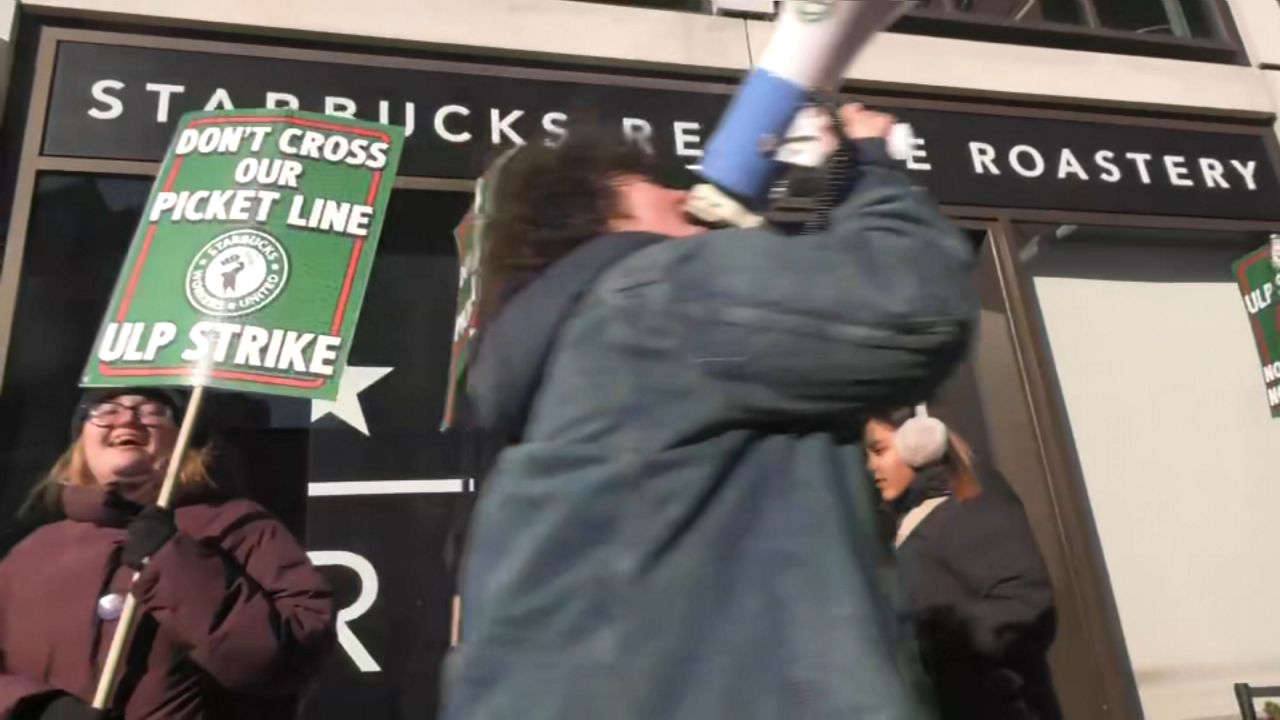
Chanting “No contract, no coffee!” and holding signs reading “What’s disgusting? Union busting. What’s outrageous? Union wages,” Starbucks workers picketed outside the company’s Reserve Roastery in Chelsea, calling for a fair labor contract.
The demonstration was part of the “Red Cup Rebellion,” a nationwide labor action that kicked off Nov. 13.
What You Need To Know
Starbucks workers picketed outside the company’s Reserve Roastery in Chelsea as part of the nationwide “Red Cup Rebellion”
Union members say they are demanding livable wages, fair working conditions and proper staffing levels
Starbucks says the union walked away from negotiations and notes it has reached more than 30 tentative agreements nationwide
The company says less than 4% of its U.S. retail workforce is represented by Workers United
“We are looking for livable wages, fair working conditions, and no more understaffing, like actual proper staffing,” said Morgan Pagan, a shift supervisor at a Starbucks in the Financial District. “We ideally just want a contract. We want Starbucks to come to the table. We want them to settle down and negotiate for a livable wage and all the things we’re asking for. We’re not asking for anything unrealistic.”
Pagan has worked for Starbucks for seven years. While the company’s starting wage is above the minimum wage, she said it is still not enough to live on.
“We really want people to have the option that they can work one job, get paid, do what they have to do, and afford the bills that they have to afford and not have to work 50, 60 hours a week or worry that their hours are gonna get cut so that they can’t make benefits,” Pagan said.
Starbucks said the union walked away from the bargaining table and added that its commitment to negotiating has not changed.
Picketers, including Pagan, said they are ready to return to negotiations when Starbucks meets their demands.
“We negotiated fair livable wages for our partners, and they agreed on a 17-cent increase to their wages. Seventeen cents is not livable wages,” Pagan said.
In a statement to NY1, Starbucks said, “With more than 30 tentative agreements already in place, we’re confident we can move to a reasonable contract—one that reflects that Starbucks offers the best job in retail, with pay and benefits averaging over $30 an hour for hourly partners.”
Not every Starbucks location is unionized.
According to the company, Workers United represents less than 4% of Starbucks’ 210,000 retail partners in the U.S., and many employees who temporarily went on strike returned to work ahead of the union’s unconditional return-to-work notice.
Kai Fritc, a barista at a Starbucks in South Brooklyn, said she enjoys her job and making coffee for customers but believes workers deserve more.
“I appreciate the opportunities this job has given me, but I also know that workers there deserve so much more, especially at a multi-billion-dollar company,” Fritc said.
Fritc is on strike, advocating for a contract she said would improve working conditions.
“And so I’m saying, because I love my union and I love my job, I want it to be one that people can work without having to hold three other jobs to make it happen,” she said.
Despite the picket line outside the Starbucks Reserve in Chelsea, customers continued to enter the store to buy coffee.