
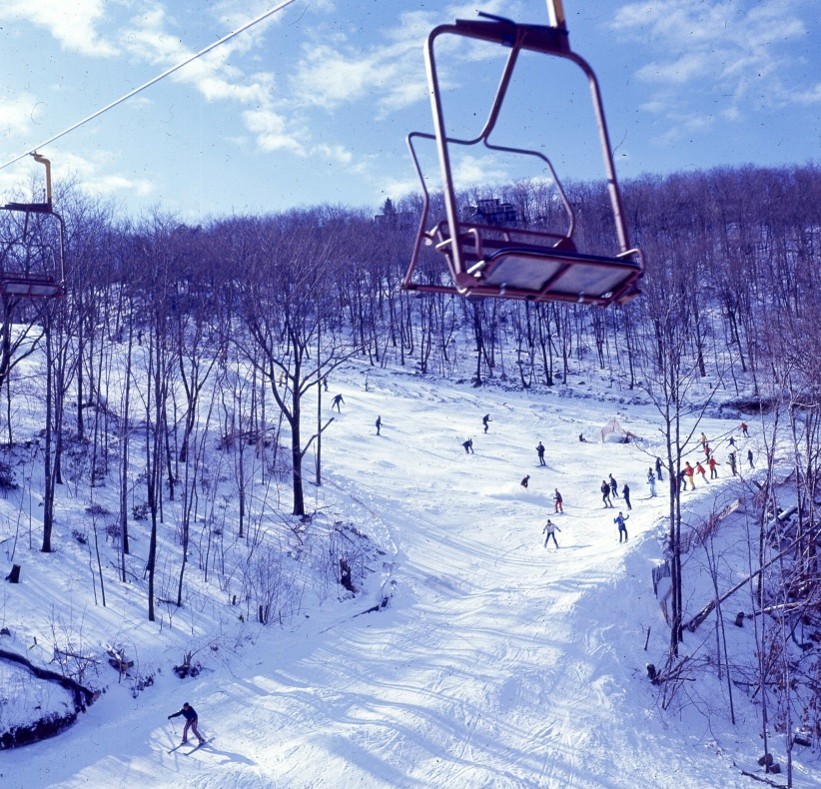
When it comes to downhill skiing, the Hudson Valley was never Sun Valley. But for a time, in the 1950s through the 1980s, the lower Valley boasted several mom-and-pop ski centers that offered many people their first taste of the sport. Most are gone, but their memory remains — perhaps most indelibly in the sharp mind of 99-year-old Don Edwards, who co-owned three centers in the area.
Edwards, who will turn 100 in March, lives in Florida now. “I don’t miss the cold,” he said recently, but he does miss the fun he and his business partners, brothers Bill and Sandy Gilbert, had while running the Fahnestock, Silvermine and Sterling Forest ski centers. “It was my life.”
It became Edwards’ life in 1953, after he and Bill Gilbert failed to find a good ski run on the drive home to Westchester from a day at Whiteface Mountain. They passed Fahnestock State Park, which had an abandoned ski run built by the Works Progress Administration in the 1930s.
Article continues below this ad
“Bill and I said, Why don’t we put a ski area in there?” Edwards said.
Edwards worked in textiles, while Bill Gilbert and his brother, Sandy, whom they recruited to the cause, worked in the liquor business. But that didn’t deter them. They knew a resort in Wisconsin called Wilmot Mountain that made artificial snow, a new technology at the time. They flew out to the Midwest to learn how it was done.
On their return, they wrote a letter to New York Gov. Averill Harriman, himself a skier who had led the creation of Sun Valley, in Idaho, as the nation’s first ski resort. They requested to lease the property in the park and establish a manmade snow center there. They had a meeting with the general manager of the Taconic State Park Commission and signed a five-year lease, under which they paid approximately 5% of their revenues as rent.
Article continues below this ad
They also got a question.
“The guy said, Are you kids crazy?” Edwards laughed. “We said, yeah.”
Left: Don Edwards on the slopes in Syracuse in 1947. Top right: Edwards mans the artificial snowmaker — then a novel technology — at Fahnestock Ski Area in 1955. Bottom right: Edwards, at age 95, at Silvermine.
Courtesy of Rich Edwards
Top: Don Edwards on the slopes in Syracuse in 1947. Middle: Edwards mans the artificial snowmaker — then a novel technology — at Fahnestock Ski Area in 1955. Bottom: Edwards, at age 95, at Silvermine.
Courtesy of Rich Edwards
‘Plenty’ of Hudson Valley ski areas
Skiing took hold in America after World War II, as veterans who had learned the sport in Europe returned home. (Edwards learned at Syracuse University after the war, using Army surplus equipment and a parka he bought for $12.) In the 1950s and ’60s, small ski centers popped up all over the Northeast, including the lower Hudson Valley.
Article continues below this ad
“The number of ski areas in the immediate Hudson Valley wasn’t quite as high as other nearby areas like the Catskills, Connecticut or the Berkshires, mainly due to smaller hills, but there were plenty of them,” said Jeremy Davis, who runs the New England Lost Ski Areas Project, a website devoted to his niche interest. “Parker’s Outdoor World, Katonah, Lewisboro Kiwanis and more were generally small operations, but plenty of skiers learned there.”
Some schools and colleges opened their own areas, like Millbrook School. A few others, like Victor Constant at West Point and Thunder Ridge, are still open.
In southern Dutchess County, Mount Storm “endured a tragic history throughout its 30-year lifespan,” Davis writes on his website. The mountain opened in the 1950s, closed in the mid-1970s and then reopened under new ownership. It had three main slopes, a 600-foot vertical drop, one chairlift, one T-bar and two rope tows. But in 1987, the lodge burned down due to arson — a member of the owner’s family died in the fire — and the center closed.
The Dutchess Ski Area on Mount Beacon is seen in an undated photo. In 1967, the newly formed Dutchess Ski Area Corporation bought the parcel and hired Walter Foeger to turn Mount Beacon into a center that could compete with bigger-market ski areas and start an instructional school.
Courtesy of Beacon Historical Society
Another former slope was on Mount Beacon. According to the Beacon Historical Society, local skiing enthusiasts rough-cut trails on the mountain from the summit to the base station of the Mount Beacon Incline Railway. The so-called “Mount Beacon Ski Trail” was first used in 1946, but really got going in the winter of 1947-48, when more than 4 feet of snow fell. The railway ran trolley cars on weekends that winter, bringing skiers to the summit for $1 — 50 cents for subsequent lifts.
Article continues below this ad
“Though short-lived, the makeshift ski area experiment proved popular that year, with 2,200 fares recorded as sold to skiers,” according to the Beacon Historical Society.
In 1967, the newly formed Dutchess Ski Area Corporation bought the parcel and hired Austria-born Walter Foeger, a well-known ski designer and instructor, to turn Mount Beacon into a center that could compete with bigger-market ski areas in the Northeast and to start an instructional school to draw novice skiers from downstate. Under his leadership, new trails were cut on the mountain, including a 3,100-foot double chairlift that carried skiers to the summit. At the base, a 350,000-gallon holding pond was created to ensure sufficient water for snowmaking.
“His Commuter Ski School attracted enrollments of 500 or more each year in a 10-week course of day or night skiing instruction with the guarantee you will be skiing in seven days or your money back,” according to the Beacon Historical Society. On a good day, 3,000 skiers would buy a lift ticket.
Meanwhile, Edwards and the Gilberts added to their portfolio and would soon run three centers, mostly during their off-hours.
Article continues below this ad
Left: A 1967 prospectus for the Dutchess Ski Corporation. Top right: The Commuter Ski School run by Walter Foeger on Mount Beacon. Bottom right: The Dutchess Ski Area on Mount Beacon, undated photo.
Courtesy of Jeremy Davis/Courtesy of Beacon Historical Society
Top: A 1967 prospectus for the Dutchess Ski Corporation. Middle: The Commuter Ski School run by Walter Foeger on Mount Beacon. Bottom: The Dutchess Ski Area on Mount Beacon, undated photo.
Courtesy of Jeremy Davis/Courtesy of Beacon Historical Society
A family affair
By the early 1960s, their snowy empire required the owners to divide and conquer. Sandy Gilbert managed Fahnestock, Bill ran Sterling Forest and Edwards patrolled Silvermine.
“We were three kids,” Edwards said. “We didn’t know what the hell we were doing.”
Article continues below this ad
His son, Rich Edwards, has said his earliest childhood memories were of his father coming home from work in Manhattan, having dinner and then going to make snow for six hours. Then he’d return home, sleep for three hours, swap his snow suit for a business suit and catch the train back into the city.
Rich Edwards was on skis at Silvermine by age 2 and stamping lift tickets by age 6. Adults paid $3, kids $1.50. Edwards remembers “counting quarters and putting them into those paper rolls,” he said. His older brothers, Jeff and Cliff, and younger sister, Nancy, also helped in the family business.
It was a primitive business back then. Only Sterling Forest had chairlifts. Don Edwards bought an automobile with a rope tow attached to it from Mount Snow and used it to haul kids up the bunny slope at Silvermine. The “facilities,” at first, were outhouses.
“My wife went to the gas station to pee. She wouldn’t sit in there,” Edwards said.
Article continues below this ad
The Silvermine Ski Area in its heyday is seen in an undated photo.
Courtesy of Harriman State Park
Still, the slopes made money. But when the partners were offered a chance to buy Catamount in 1974, they left their smaller operations to their employees and used what they had learned to resurrect the bankrupt Berkshires resort. When they retired, their sons, Rich Edwards and Tom Gilbert, took over, running Catamount until it sold again in 2018. Rich Edwards still serves as base facilities operations manager.
Growing the sport
They were smart to move on. The number of small ski areas “certainly has decreased in the last 50 to 60 years,” Davis said.
Article continues below this ad
He cites a combination of reasons, including warming winters with less snow, higher insurance rates, competition with larger areas farther north, changing consumer habits and a lack of capital improvements. The Dutchess Ski Area, for example, could not pay off its debts and went bankrupt in 1975.
Don Edwards said it was a great run while it lasted, and he’d do it all again — despite the long hours and the many mistakes — if he had the chance.
“I loved skiing. My children loved it. To this day, they are all excellent skiers,” he said.
Article continues below this ad
And, along with the Gilberts, he helped the sport grow nationwide.
“The initial surge of skiing started at Fahnestock and Silvermine, and it spread all over the industry,” Edwards said.