
Photo: New York Magazine.
Photo: New York Magazine.
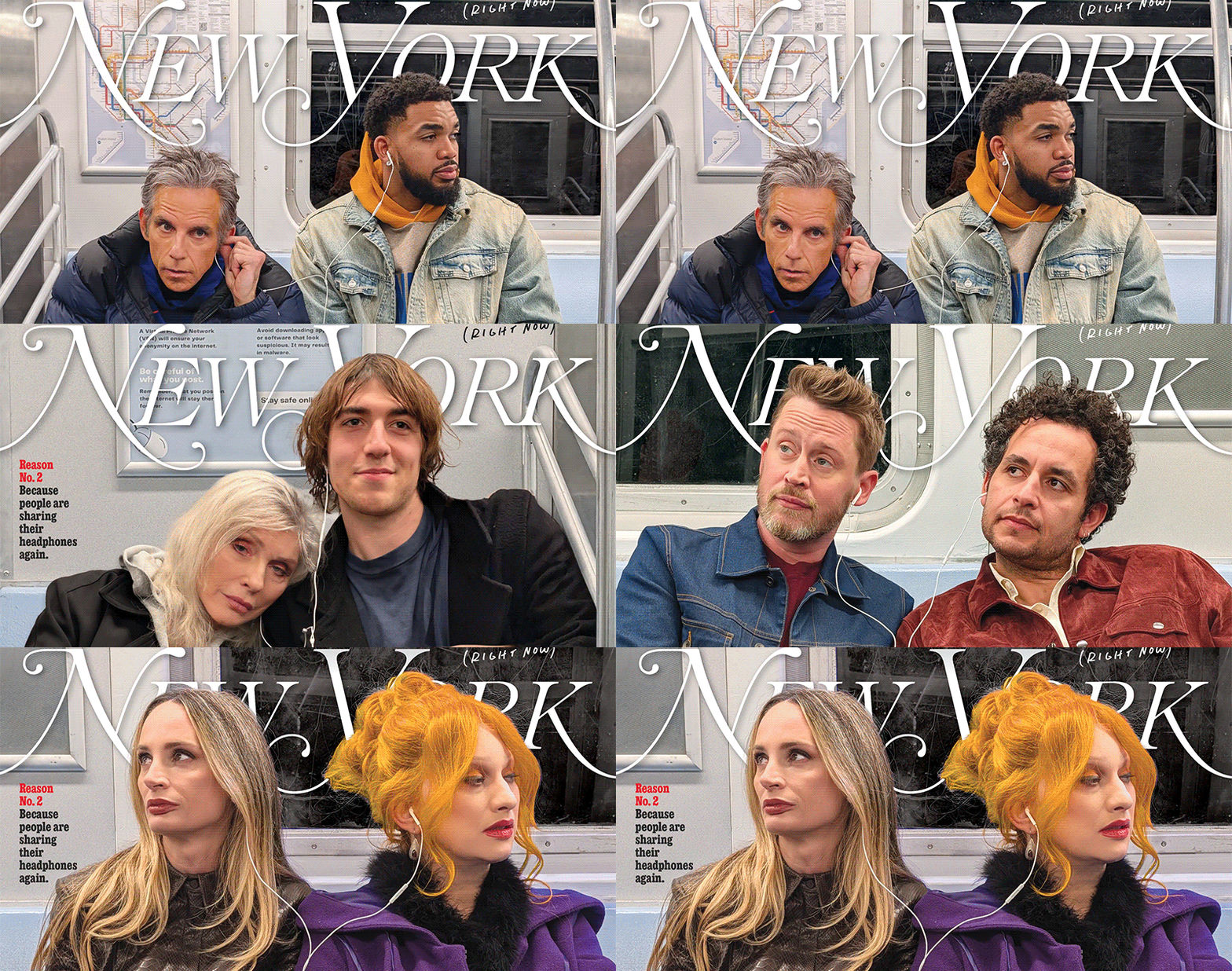
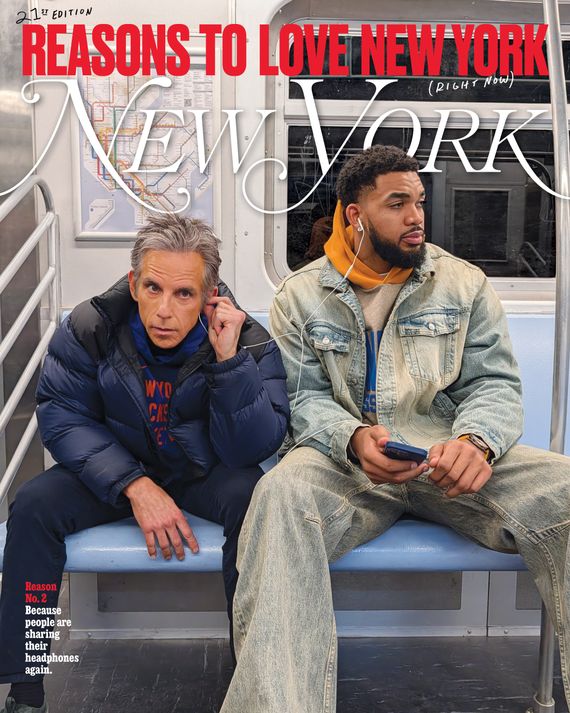
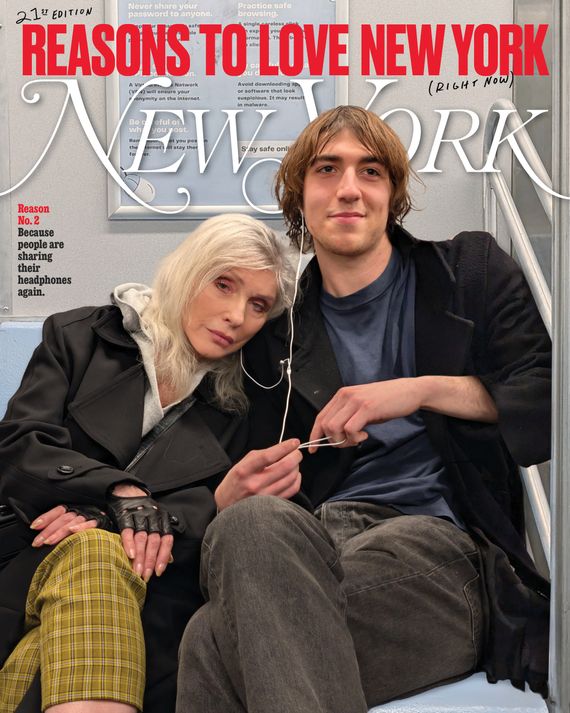
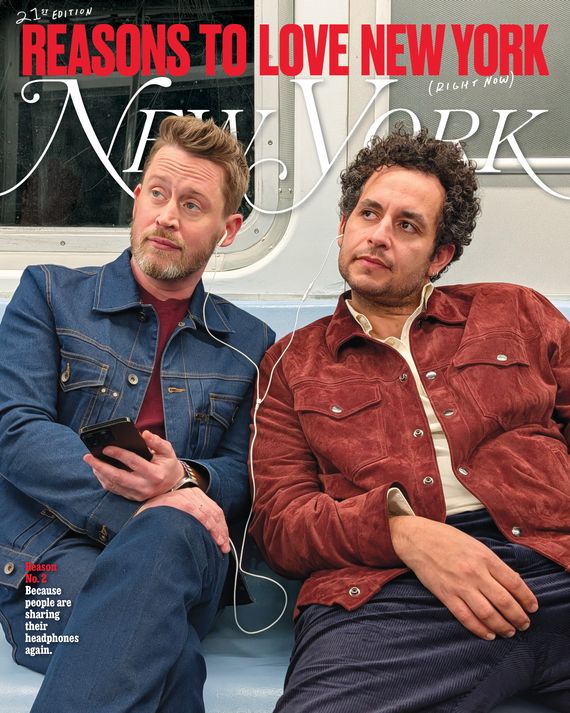
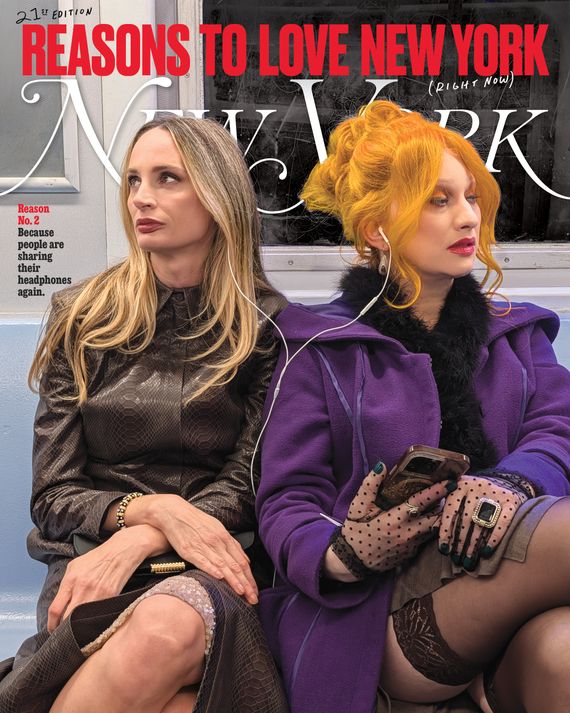
New York’s annual “Reasons to Love New York” issue catalogued 39 things to cherish about the city right now. On Instagram, Daisy_ste_and_me lamented, “I left nyc for a long weekend and regret it.” For the four covers, we photographed pairs of celebrity New Yorkers sharing wired headphones on the subway. Saying there was “something very sweet” about this choice, editor-at-large Erik Maza explained on The Brian Lehrer Show, “Obviously, it was a challenging year for everyone, and we wanted to capture a sense of community, a sense of New Yorkers embracing each other.” Stating a common complaint, however, Cags wrote, “just egregious manspreading on Ben Stiller’s part in that photo; he clearly never got told about himself on the train at rush hour.” Drawing the most commentary was an item about teens adapting to the ban on cell phones in city schools by playing poker and conversing face-to-face. Journalist Robinson Meyer tweeted, “People say … you’re looking at the wrong problem, that it’s pointless to resist. And then you enforce a phone ban and miracles happen.” Also on X, L.A. based writer Jamie Lynn Harris said, “This is the most nature is healing article I’ve ever read. Sorry, but you’ll never convince me the problem with a lot of things today isn’t the phones. All these kids actually developed hobbies and interests in a matter of months.”
Elsewhere in the issue, Charlotte Klein traced Bari Weiss’s journey to the top of CBS News. The ACLU’s Gillian Branstetter said Weiss’s “main role in public life is telling rich people they were right all along.” YouTuber Michael Burns agreed: “Weiss has become a media mogul not because her work has ever been popular, but because a small group of rich and well connected guys liked her work as it made them feel good about not using pronouns and stuff.” Eric Alterman, author of We Are Not One: A History of America’s Fight Over Israel, tweeted, “It’s so weird that someone who tells the super wealthy that they are wonderful and racists that it’s ok to be racists would be successfully funded by the super wealthy and beloved by racists.” Music writer Maura Johnston called the article a guide to “how to become a big pseudointellectual fish in a rancid pond full of credulous dopes who love being sucked up to.” Journalist Taylor Lorenz noted the consequences: “Challenge their worldview and opportunities will be cut off and you will not make money. This is especially true in the MSM.” Calling out Weiss’s “strategic patronage,” T.I.gilpatrick called her content “a collection of warmed-over critiques of ‘wokeism’ and a siege mentality concerning Israel, all presented with an irritating tone of persecuted righteousness. The actual brilliance lies not in the ideas, but in her slight skill at branding and positioning,” adding that her boosters “needed someone who could navigate the cultural swamp and deliver their anti-progressive grievances without sounding like a Fox News host. Weiss, with her New York Times lineage and queer identity, was the perfect choice to validate their private anxieties. This is why her rise is not a story of entrepreneurial success but of structural enablement.” Some readers were struck by former Activision CEO Bobby Kotick’s role in elevating Weiss. Joshua Rivera said Kotik had gone from “ruining video games to ruining journalism,” while esports writer Jackie Peanuts noted, “if you’ve ever played World of Warcraft this is actually all your fault.”
Lane Brown laid out the theory that Stanley Kubrick’s final film was actually about Jeffrey Epstein. Brimorche wrote, “I’ve never heard a thing about this conspiracy theory but … it immediately clicked in my head that Sydney Pollack could be an Epstein-esque stand in.” Other readers threw cold water on it. Redditor jackieirish asked, “Is there any filmmaker more subject to conspiracies from his fans than Kubrick? You can point to almost any detail … and there will be someone out there confidently claiming that, not only was it proof of Kubrick’s utter God-like intentional genius, but also how it ties into some broader concept he was apparently trying to communicate in secret.” Wred42 reiterated the point that “the movie is a straight adaptation of a book written 70 years earlier in a different country. It’s an incredibly faithful adaptation, not some secret message that could only be revealed this way.” And Missmagda concluded, “My perhaps too-optimistic view is that the conspiracy freaks are responding on a subconscious level to a film that feels like a dream. But because they don’t know how to process art, they start trying to make it literal.”
Send correspondence to comments@nymag.com. Or go to nymag.com to respond to individual stories.
Thank you for subscribing and supporting our journalism.
If you prefer to read in print, you can also find this article in the December 29, 2025, issue of
New York Magazine.
Want more stories like this one? Subscribe now
to support our journalism and get unlimited access to our coverage.
If you prefer to read in print, you can also find this article in the December 29, 2025, issue of
New York Magazine.