
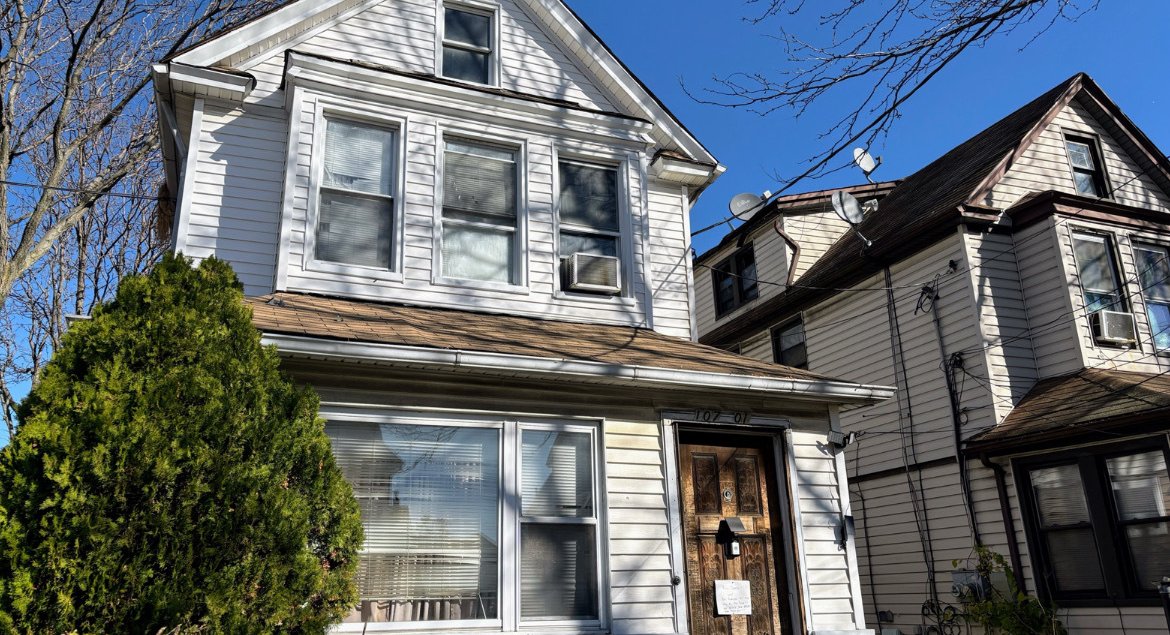
Homes worth millions of dollars are bought and sold each week at foreclosure auctions across the five boroughs — typically for a fraction of their true values.
But while New York City is home to more than 8 million people across hundreds of neighborhoods, a Gothamist review of auction sale data reveals a familiar geographic pattern. One- and two-family homes sold at foreclosure auctions so far this year are overwhelmingly concentrated in neighborhoods of Southeast Queens, like Jamaica and Springfield Gardens, and sections of Central and South Brooklyn, like Canarsie and East Flatbush.
The data mirrors the results of a report released last month by the Center for NYC Neighborhoods, which found New York City foreclosure filings nearly doubled during the first half of the year compared to the last six months of 2024, with most of the affected homeowners living in the same parts of Brooklyn and Queens.
Black New Yorkers have traditionally made up the majority of homeowners in those neighborhoods, and Latino and South Asian residents also comprise a growing subset of the population. The same neighborhoods were hit especially hard by the 2008 mortgage crisis, with residents made vulnerable to foreclosure through predatory lending, extremely high-interest loans and rising unemployment.
Public policy experts and advocates for low- and middle-income homeowners say the data is a reminder of the lingering impact of that crisis and the financial threats many New Yorkers still face.
“These homes are overwhelmingly located in communities of color and working-class neighborhoods, and when they are lost to foreclosure, it is accelerating displacement and economic inequities,” said Center for NYC Neighborhoods Executive Director Christie Peale, whose organization studies ownership trends and coordinates with attorneys and advocacy groups across the city.
Gothamist used court records and data from the real estate site PropertyShark to identify 335 one- and two-family homes that were sold at a mortgage foreclosure auctions in the first 11 months of 2025.
In each instance, a court-appointed referee had filed a report of sale into the court record. There are likely more sales not yet reflected in court records, and others that faced obstacles after auctions. Owners can delay losing their homes by filing for bankruptcy during foreclosure processs, sometimes on the days of the scheduled auctions, and winning bidders can, at times, back out of deals, prompting new auctions at later dates.
The analysis shows one ZIP code concentrated in Springfield Gardens, a section of Queens surrounding JFK Airport, accounted for 23 foreclosure auction sales — the highest number in the city so far this year. Three ZIP codes covering East Flatbush and Canarsie in Brooklyn and Jamaica in Queens each accounted for 17 auction sales this year.
Problems with the foreclosure process go beyond the loss of homes. A recent investigation by Gothamist and the news outlet New York Focus found former homeowners may also be deprived of tens of thousands of dollars after their homes are taken and sold at a foreclosure auction because of how lenders and attorneys calculate their debts. Attorneys used the same disputed calculation method in several cases included in the review of 2025 auction sales.
The investigation led state Sen. Zellnor Myrie and Assemblymember Khaleel Anderson to introduce legislation standardizing debt calculations and requiring lenders to use a method that favors those losing their homes.
Myrie said the latest data shows how “homeowners in Black and brown communities are under threat.”
Peale, from the Center for NYC Neighborhoods, said the map of sales and the recent increase in the number of foreclosure filings show “the quiet erosion of one of New York City’s most important sources of affordable housing: one- and two-family homes owned by low- and moderate-income New Yorkers.”