
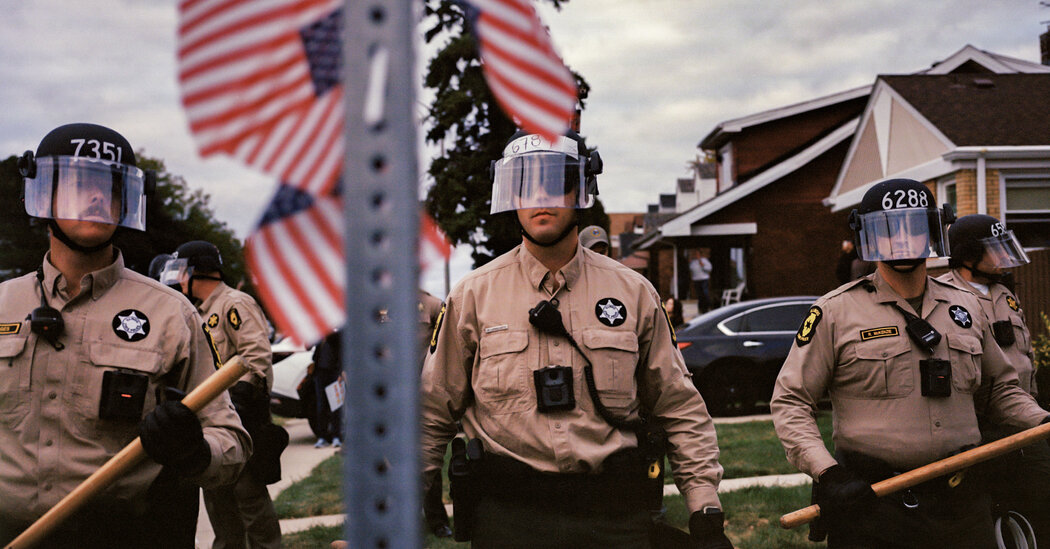
Year 1 of President Trump’s quest to conduct the largest deportation campaign in U.S. history turned towns and cities into battlegrounds.
The crackdown and detentions swept from one coast to the other: day laborers in Los Angeles, a flower seller in Chicago, immigrants in New York courtrooms.
From Texas and New Mexico to Illinois and New York, a New York Times reporter and photographer spent the year documenting Mr. Trump’s immigration crackdown.
In just 11 months, about 500,000 people would be deported in an unrelenting campaign celebrated by those who saw it as long overdue and lamented by those who saw it as inhumane.
Over the year, the deportations forced Americans, even those who welcomed the stepped-up enforcement, to reckon with the human consequences of rounding up and expelling people from their streets.
Homes were emptied. Families were splintered. Neighborhoods were subdued.
The immigration crackdown came to a Brooklyn street when a Guatemalan man was picked up by ICE agents looking for someone else.
In the kitchen of a buzzy Manhattan pub and bistro, where a Guatemalan line cook stopped showing up, a chef was left scrambling for answers.
Electric bicycles littered sidewalks in Chicago and Washington after the riders were detained while making deliveries.
In the New York suburbs, Maria Priego huddled for dinner with her four children, leaving empty the chair where her husband, Alejandro Juarez, had sat every night before he was deported to Mexico after 20 years in the United States.
Mr. Trump, catapulted back to the White House by voters whose views had shifted sharply against illegal immigration, was making good on his campaign promise to enforce immigration laws to their fullest extent.
Americans were confronted with a swelling deportation force that, under pressure to meet arrest quotas, traded targeted raids for sweeps that critics saw as indiscriminate and supporters as vital.
Protesters clashed with armed agents as the dragnet widened, sweeping up recent and longtime immigrants, those with criminal records and many without.
The all-of-government effort was stunning, an abrupt pendulum swing for a country that had just absorbed a record influx of migrants during the Biden era, overwhelming cities, souring voters and fueling Mr. Trump’s hard-line agenda.
For decades, a fragile, tacit understanding had allowed millions of undocumented immigrants to build lives here, largely without fear of deportation, so long as they worked hard and stayed out of trouble.
In less than a year, that status quo was upended.
Shutting Down the Border
The 2,000-mile swath of desert, mountains and steel walls that separates Mexico from the United States is unrecognizable from just a few years ago, when illegal crossings by hundreds of thousands of people generated disorder.
Now, few dare cross.
The silence is pierced by the thudding of military helicopters conducting surveillance with infrared cameras. Soldiers deployed by Mr. Trump are perched on eight-wheeled armored vehicles that had typically been used for combat in Iraq and Afghanistan.
They are the visible deterrent along the 30-foot-high bollard walls.
Under President Joseph R. Biden Jr., the Border Patrol apprehended an average of 5,000 people a day crossing the border illegally, millions of whom were released into the country while awaiting asylum hearings.
Mr. Trump vowed to end the Biden-era practice he called “catch and release,” declaring a national emergency at the southern border on the day he was inaugurated and vowing to “repel the disastrous invasion of our country.”
He immediately halted asylum for people seeking refuge through the border, using a contested legal justification that relied on his declaration of a state of “invasion.” Now, nearly all migrants are quickly turned back at the border.
In El Paso, migrants once filled a shelter. Keepsakes are left behind at another shelter in Ciudad Juarez, Mexico.
And under Mr. Trump’s “zero tolerance” policy, they are being charged with illegal entry, a federal misdemeanor that can carry up to six months in prison or up to two years for repeat offenders.
The deterrent policies have proved consequential: The Border Patrol apprehended an average of 258 people a day in October, the lowest levels at the southern border since 1970.
“It’s a breath of fresh air,” a Border Patrol officer told The New York Times on a recent October morning, the border wall disappearing into the New Mexico desert behind him, and the belongings of those who had been detained left lying in the dust. “Total 180. Now, we have the time to do our jobs properly.”
The decrease in crossings has eased the strain on cities on both sides of the border, leading to the closure of shelters that once provided temporary housing to thousands of migrants.
In El Paso, dozens of bunk beds sit empty in Annunciation House, the network of shelters where Ruben Garcia has welcomed refugees for nearly 50 years.
For Mr. Garcia, 77, the empty beds at his diminished shelter system are a reminder of the way that the United States had turned its back on vulnerable migrants fleeing violence, poverty and repression.
“The strength of the United States has been the country’s willingness to identify with other human beings,” said Mr. Garcia, the director of the shelter network.
“That is our strength, that we see something of ourselves in other people,” he said. “This year has been about losing our souls, losing our souls and pretending that we’re not seeing what is happening.”
Deportations Begin
On a cold night in March, plainclothes agents entered the lobby of an apartment building in Upper Manhattan and arrested a recent Columbia University graduate and pro-Palestinian activist as he was returning home with his wife.
Mahmoud Khalil, the man they arrested, was a permanent legal resident. Overnight, the push to deport Mr. Khalil transformed him into a central figure in a debate over free speech as more international students who had spoken out in favor of Palestinian rights were detained.
When Mahmoud Khalil was detained, his wife, Dr. Noor Abdalla, used his prayer rug.
An Ivy League campus, it turned out, became the unlikely location of the first salvo in New York.
The raids that New York leaders had envisioned at the city’s migrant shelters — which began closing and emptying as border crossings dropped — did not materialize.
Instead, federal agents arrived at the city’s immigration courthouses, the staid government buildings in Lower Manhattan where migrants intent on following the rules show up for routine court hearings and check-ins.
On a parallel track, Mr. Trump moved through executive decree to transform an already-broken immigration system into an America First apparatus. He sought to restrict birthright citizenship, instituted travel bans and revoked humanitarian programs that had shielded migrants from deportation to unstable countries.
Scaring undocumented immigrants into abandoning the United States voluntarily — or “self-deporting” — became part of the mission.
ICE launched a multimillion-dollar advertising campaign warning them to leave or be “hunted down.” Restrictions were loosened to allow agents to make arrests in places that were previously off-limits, including schools, churches and hospitals — though arrests there were rare.
And the agency began deporting some immigrants to countries they were not from and to which they had no ties.
Merwil Gutiérrez was deported to a notorious prison in El Salvador.
More than 100 people from Asia and the Middle East, including Iranian Christians fleeing persecution, were sent to Panama in February. The following month, more than 200 Venezuelan men were flown to a notorious Salvadoran prison, where many later said they were tortured.
The swift actions were heralded by a cohort of Americans who hailed the deportations as essential to deterring illegal immigration and ensuring fairness for immigrants who had entered the country through legal pathways.
But from Seattle to Miami, fear and anxiety spread across immigrant enclaves during those early months. Schools, restaurants and barbershops emptied as many limited their time outside, waiting for large sweeps to hit.
Raids in Democratic Cities
It began in Los Angeles.
Agents barged into Home Depot parking lots to detain day laborers. They searched for vendors in the alleyways of the city’s fashion district. And they fanned out, armed and on horseback, across a mostly empty park, a display of force in a Mexican neighborhood.
Upset with the pace of deportations, Trump officials began focusing on Democratic cities with so-called sanctuary policies that Republicans argued protected immigrants at the expense of public safety.
Protests against the raids flared in Los Angeles, home to the country’s largest undocumented population, prompting the president to send National Guard troops and Marines in June, the first deployment of forces to a major city in 2025. But not the last.
Scenes of officers firing flash-bang grenades and tear gas at demonstrators they described as agitators became a harbinger of the turmoil that would soon spread.
A telegenic Border Patrol commander, Gregory Bovino, emerged as the face of the operations, deploying confrontational tactics and turning the raids into a made-for-TV roadshow as he advanced on other Democratic cities.
After gaining Mr. Trump’s admiration, Mr. Bovino, trailed by cameras filming Hollywood-style promotional videos of officers arresting immigrants, was sent to another Democratic city about 2,000 miles away: Chicago.
Unmarked vehicles and military-style convoys soon roamed downtown Chicago and heavily Latino blocks. Agents scooped up Hispanic men from gas stations and bus stops, relying heavily, critics said, on racial profiling.
One of the first to be detained was Leodegario Martínez Barradas, a vendor from Mexico who sold flowers at an intersection in the Archer Heights neighborhood on weekends to provide for his six children.
In Chicago, withering flowers testified to their sellers’ absence.
On Sept. 7, agents handcuffed him and whisked him away, leaving behind his backpack and scattered flowers. He was deported to Mexico a few days later.
“It’s sad because they’re not only taking people with problems with the law, but also people who are just working,” he said in a video posted on social media from Mexico.
Mr. Bovino defended his tactics, saying that the deportations aligned with the will of the people: “We’re in lock step with Ma and Pa America, with the taxpayer.”
Residents, recording with their phones, honked their horns and crowded around agents. An ICE facility in the suburbs drew protesters as agents threw smoke bombs and slammed demonstrators to the ground.
“This is not making anybody safer,” Gov. J.B. Pritzker of Illinois said at the time. “It’s a show of intimidation.”
All told, federal officials said that they detained more than 10,000 immigrants in Los Angeles and more than 3,000 in Illinois and Indiana, leaving Mr. Trump’s supporters encouraged.
“There are legal ways to get here, and they should be used,” said Aaron Dahl, 49, a Tennessee resident who voted for Mr. Trump. “If you’re here illegally and get benefits for it, that’s taking away from the taxpayers and everything else that’s just a drain on our own people.”
Chicago’s Archer Heights was a locus of immigration officials’ activity.
But the arrests, and the debates over whom ICE was targeting, also deepened partisan divides.
ICE followed a similar playbook as it moved from city to city: The agency singled out the arrests of immigrants with criminal records, releasing mug shots and rap sheets, which included convictions related to murder, assault and sexual assault.
Supporters, cheering on a president they saw as prioritizing citizens, backed the hard-line tactics, with some adopting the administration’s preferred argot for its targets: monsters, criminal illegal aliens, the worst of the worst.
The agency’s own data revealed a more nuanced picture.
Critics, angered by detentions they denounced as cruel, described the arrests as kidnappings, with some insulting ICE officers as “pigs” and “Nazis” during protests.
Polls began showing signs that Americans were upset by the aggressive tactics.
While a majority approved of Mr. Trump’s approach to immigration, 53 percent said he was doing “too much” when it came to deporting immigrants in the country illegally, up from 44 percent in March, according to a Pew Research Center survey from October.
Matt Newton, 49, a Republican from Cookeville, Tenn., who voted for Mr. Trump, said he supported the crackdown but was grappling with the deportation of law-abiding immigrants who he said were working jobs that American wouldn’t do.
“I feel like they should maybe take a little time to look at it and be like, ‘OK they’ve been here, doing the right thing, haven’t caused any problems,’” Mr. Newton, who works in sales and identifies as a libertarian, said. “The question is, why have they not tried to get a visa or not become American citizens already?”
New York Braces for More Raids
New York City, despite having the largest immigrant population in the country, has mostly avoided the large-scale raids that engulfed Los Angeles and Chicago.
For now.
Whistles in New York sounded an alert about federal agents.
City and state leaders are preparing for a potential surge in ICE activity in 2026 following the inauguration as mayor of Zohran Mamdani, a Democrat who has spoken out against ICE.
New Yorkers have had glimpses of what may be to come.
In September, a raid at a nutrition-bar plant in Central New York scooped up 57 immigrant workers, the largest raid in the state this year.
Immigration agents showed up at a nutrition-bar factory in Cato, N.Y., and arrested workers like Maribel Lopez, whose bed remains empty after being deported.
In late October, more than 50 federal agents spread out near Canal Street in Lower Manhattan, arresting nine African men, some with criminal records, on sidewalks long crowded with vendors who hawk counterfeit luxury goods.
The raid sparked spontaneous pushback from New Yorkers and protesters who chased the agents as they retreated to ICE offices a few blocks away.
A few weeks later, protesters foiled another raid near Canal Street, boxing in agents gearing up for an operation inside a parking garage.
And the final weeks of 2025 have delivered near-daily reports of smaller-scale arrests of Hispanic men in the city’s immigrant-rich neighborhoods, from Jackson Heights in Queens to Sunset Park in Brooklyn.
Neighbors in those communities trade tips about ICE sightings in group chats and distribute whistles meant to alert residents about raids in the vicinity.
Every week, relatives of detained migrants make a pilgrimage across the Hudson River, to an industrial corner of Newark.
On a cold evening in October, Leticia Cortez, 30, arrived with her son to see her husband, Santiago Rendón, 27, for a last time.
The family, Ms. Cortez said, migrated from Colombia in 2022 after they were allowed to legally enter the United States to claim asylum. She found a job as an administrator at a Brooklyn migrant shelter; he as a tattoo artist.
In early September, Mr. Rendón was detained by ICE in New Jersey while he was handing out fliers to promote his tattoo studio, Ms. Cortez said. The agency said Mr. Rendón was detained because he had previously been charged with assault; Ms. Cortez said she believed he did not have a criminal record.
Mr. Rendón ultimately chose to be deported to Colombia to avoid languishing in detention.
A volunteer distracted Elián David Rendon as he waited to visit his father at a detention center in Newark.
“Everything crumbled from one day to another,” Ms. Cortez said.
On her last visit to Delaney Hall, their 7-year-old boy, Elián David Rendón, collapsed on the floor and began crying when he saw his father in shackles. Minutes later, a security guard announced that the visit was over.
Two days later, her husband was deported.