
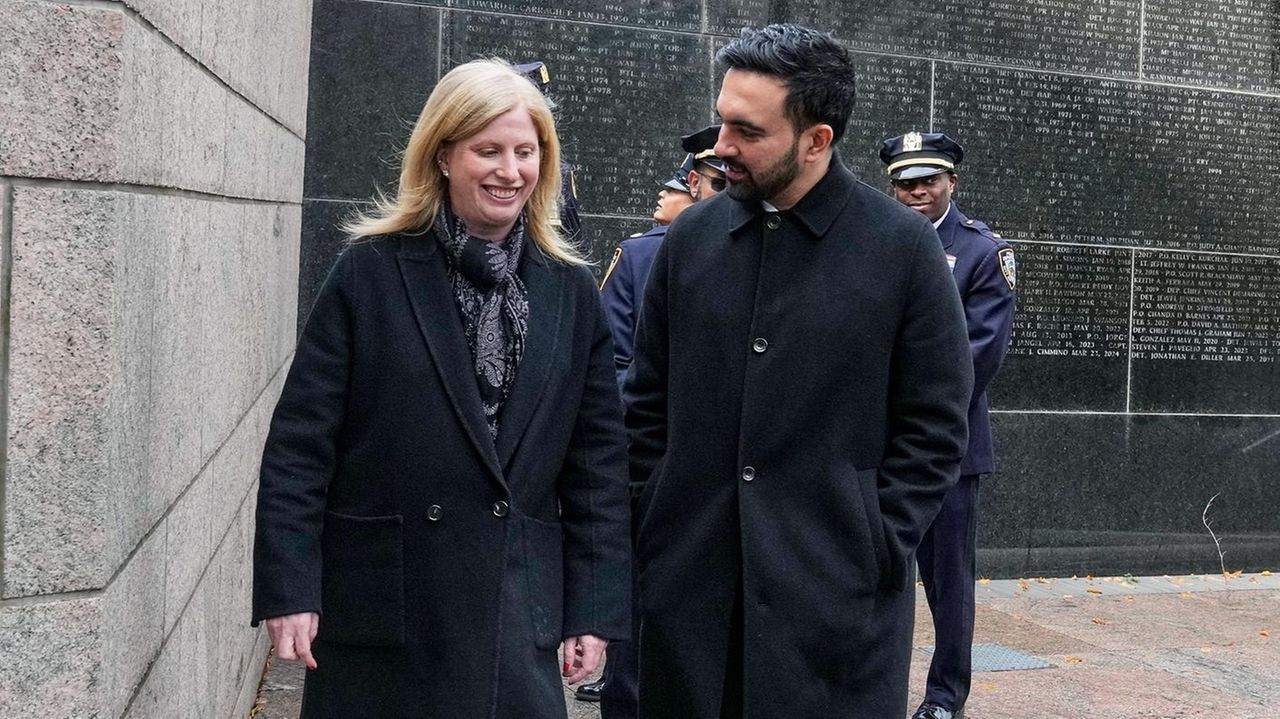
As 2025 winds down and New York City is projected to see its lowest number of homicides and serious crimes overall since Mayor Eric Adams took office, law enforcement experts are waiting to see if Mayor-elect Zohran Mamdani — without the policing experience of his predecessor — can keep the city safe at a time when the NYPD is under tremendous recruitment pressure.
While the NYPD added thousands of officers in 2025, the hemorrhaging of police through retirements and resignations continues to sap its strength: experienced people, particularly detectives. The new year will also bring police contract negotiations that are likely to prove challenging at a time when New York City could face a potential budget shortfall of $8 billion.
The mayor-elect assuaged some fears among NYPD officials when he decided to retain Jessica Tisch as police commissioner. But some wonder how long Tisch and Mamdani, a staunch progressive who has expressed views about policing that conflict with those of Tisch, can work together effectively.
Fewer homicides
The latest NYPD data shows that rapes spiked by 15.7% and felony assaults by 0.3% in 2025, but barring a last-minute crime explosion, New York City is on track to record just over 300 homicides, a level not seen since 2018 and the third smallest number in modern history. The city is also projected to record just over 121,300 major felonies, also the lowest number since Adams took office, and a drop of 2% from 2024.
WHAT NEWSDAY FOUNDLaw enforcement experts are waiting to see if Mayor- elect Zohran Mamdani — without the policing experience of outgoing Mayor Eric Adams — can keep the city safe at a time when the NYPD is under tremendous recruitment pressure.New York City is projected to see its lowest number of homicides and serious crimes overall in 2025 since Mayor Eric Adams took office, but crime-fighting questions remain because of the ongoing exit of police officers and detectives with decades of experience.The relationship between Mamdani and NYPD Commissioner Jessica Tisch will be worth watching, experts say, because of well-known philosophical differences on policing.
In the 13 months since Tisch took over in November 2024, she has made a central part of her strategy the deployment of 1,800 uniformed officers to special anti-crime areas and the subways to muscle down crime numbers that had remained stubbornly high since the end of the COVID-19 pandemic.
Tisch, a data-driven manager, has constantly cited the large drop in shootings and homicides this year as an indicator of success. According to the latest NYPD data, there have been 683 shootings this year, compared with 897 during the same period in 2024. Homicides totaled 302 compared to 380 in 2024. Officer also seized more than 25,000 illegal guns in 2025, the NYPD said.
“I think the numbers on crime are very encouraging, clearly, the department has done a very strong job in reducing violent crime,” said Richard Aborn, head of the nonprofit Citizens Crime Commission of New York City.
However, Aborn said, more rapes and felony assaults have driven the overall crime numbers higher. In 2020, the NYPD recorded a 20-year low of 95,500 serious felonies, including homicides, rapes, burglaries and felonious assaults. But since then, there has been a spike in those crimes of nearly 33% in Adams’ tenure.
The reason for the crime increases is still being debated among law enforcement experts and politicians. A change in the laws defining rape had the effect of increasing the number of reports for the traditionally underreported crime, officials have noted. But former NYPD Chief of Department John Chell, like many in law enforcement, including Tisch, believes 2019 bail reform sparked big jumps in recidivism and prevented the Adams administration from showing declines in certain serious felonies.
“I am a firm believer that bail reform caused a market adjustment in crime,” Chell told Newsday in an interview.
‘Cops on the dots’
To deal with the crime trends, Tisch has put what she called “cops on the dots”— places in the city where statistics show violent crime at high levels. The result, Tisch has repeatedly touted, is that homicides and shootings have dropped to levels for most of the past year not seen since modern police record keeping began in 1994.
The hope among some law enforcement experts and police officials is for Mamdani to avoid meddling with NYPD tactics and instead, let Tisch continue with programs that have led to the drop in shootings and homicides since Adams named her commissioner.
But experts note, the NYPD is undergoing a continuous personnel drain as officers decide to retire and quit in large numbers. Tisch noted a week ago that some 4,100 new officers were hired in 2025, the most in modern history, to offset the losses.
“From the day I took this job, I made it clear that our goal was to rebuild our headcount to ensure our department has the people, presence, and professionalism to meet its obligations — and we are delivering on that promise,” Tisch said in a statement last week.
Police union and department data show that more than 3,000 officers have left this year, indicating the NYPD is essentially treading water in the long term on the number of police. The exodus is fueled by major work and quality of life issues, said Police Benevolent Association president Patrick Hendry.
Of particular concern, said Detective Endowment Association president Scott Munro, has been the loss of 735 detectives in 2025, a drain of experienced investigators that will take years to replace.
With Mamdani holding fast to his position that he will keep the authorized strength of officers at 35,000 — a number not reached since 2021 — it remains unclear if, even with new hires, the NYPD will see any sudden influx of officers to help implement Tisch’s programs and stop the loss of experience. The current number of NYPD officers, including the latest class of 1,100 sworn in a week ago, is about 34,700, although those new hires won’t hit the streets until June 2026.
With attrition running at about 280 officers a month, the head count could drop by June to around 33,300 before a new class of officers joins the police academy. The NYPD hit a historic high of just over 40.000 officers in 2000.
Focus on mental health
One of Mamdani’s campaign pledges was to develop a new Department of Community Safety to lessen the need for police to respond to 911 calls of people in emotional distress. The aim would be to shift officers away from responding to such calls and instead use a cadre of mental health professionals.
“Police have a critical role to play,” Mamdani said during the campaign. “But right now we are relying on them to deal with our frayed social safety net which prevents them from doing their actual jobs.:”
However, the proposed department, which would also be known as DCS, could cost $1 billion and likely take years to fully implement. NYPD officials were reluctant to comment on plans for a DCS because it has not been formulated or legislatively authorized. Hendry said that while mental health calls are the most challenging for officers, a DCS wouldn’t make a big difference in officer workload. NYPD records show that reports of people in crisis amounted to about 2% of police response to 911 calls through September.
Aborn suggested that since mental health calls have the potential to take a turn for the worse and suddenly require police intervention, the better approach might be to have officers initially respond along with DCS mental health workers and then leave if the situation is judged stable by a supervising officer.
On the labor front, the PBA negotiations will start again in the spring with the city facing a projected budget shortfall of $8 billon to $10 billion through fiscal 2027.
Current starting salary for NYPD officers is $52,942 a year with a rise after 5 1/2 years to the top pay scale of $109,300. To increase retention of police, Hendry told Newsday he is proposing that officers hit the top pay scale after only three years.
Losing decades of knowledge
“There was a time when recruits entered the Academy planning to wear our uniform for their entire career,” Hendry said in a statement. “Today too many of our finest recruits are viewing the NYPD as a stepping-stone to a better law enforcement job, one with a more manageable workload, less demonization and better pay.”
In 2025, 33 NYPD officers left and joined the Suffolk Police Department, according to the SCPD. A spokesperson for the Nassau County Police Department said a majority of its 31 new hires in 2025 came from the NYPD, although precise numbers weren’t available.
A loss of detective strength brings its own long-term issues because the experience of seasoned investigators — with decades of knowledge and street smarts — is difficult to replace in the short term, Munro said. Training of a new detective takes years of tutelage from the more experienced detectives..
In particular, Munro added, large numbers of detectives in specialized units such as the bomb squad, arson and explosive squad and joint terrorism task force will be eligible to retire with good pension benefits at their 20-year mark in 2026. Although it isn’t certain that such retirements would actually happen, any loss of such experience would take years to replace and could leave the city with fewer knowledgeable investigators in the event of an emergency, he said.
“Losing our most experienced specialty squad detectives means less safety for every New Yorker no matter where they reside,” Munro told Newsday.
With serious crimes persistently higher over the Adams years, some believe that even with innovations of the kind pushed by Tisch, it may be tough to get further improvements.
“You are only as good as your last day,” Chell said.
Waiting and watching
Law enforcement experts are watching to see how well Mamdani and Tisch — who differ philosophically on issues like police discipline and the importance of criminal group databases — work together in the months ahead.
Mamdani has signaled that he wants to empty the Rikers Island jail complex and move away from quality-of-life policing, which was an important element of Adams’s proactive policing policy and which Tisch embraced.
Aborn believes that quality-of-life enforcement should remain an important part of what the NYPD does. Many 311 calls about quality-of-life issues come from low-income and minority neighborhoods, he noted.
“Everyone in the city is entitled to live in a city with high quality of life,” he said.
Mamdani has said he wants to work with Tisch in a relationship based on “partnership and shared purpose.”
Such a purpose “is ensuring police officers remain focused on serious and violent crime, while strengthening the city’s response to issues like homelessness and mental health,” Mamdani said in a statement when he announced Tisch was staying on as commissioner.
Aborn thinks Tisch wouldn’t have taken the job if she didn’t think there was a chance the relationship could work.
“I think they really need each other,” Aborn said of Mamdani and Tisch. “They need to support each other for the good of the city.”

Anthony M. DeStefano has been a reporter for Newsday since 1986 and covers law enforcement, criminal justice and legal affairs from its New York City offices.