

Trudging along in weather proof boots, layers of thermal protected jackets and gloves, Richard Aracil and Edmundo Martinez spent Sunday with their eyes to the skies and the shoreline, tracking birds in the Bronx.
The two braved freezing temperatures from dawn to late afternoon to contribute vital data to the annual NYC Christmas Bird Count, a community science program which observes and records the numbers of different species of birds across the United States.
Coordinated locally by birding organizations and volunteers, the Christmas Bird Count happens each year between mid-December and early January.
Counters spend a full day identifying and counting every bird they see within designated areas, including well-known urban hotspots like Central Park, Pelham Bay Park, Jamaica Bay, and Prospect Park.
Local birders then send their data to the National Audubon Society, which has organized the count nationwide for more than 100 years.
The count is designed to include birders of all levels of commitment and expertise. Martinez told the Bronx Times that initially he was unsure about identifying by the term “birder.” But these days, he said that the more he observes birds as a hobby, the broader his personal definition of who can be birder becomes.
“Anyone who appreciates wild birds is a birder,” Martinez said.
He said that his journey to becoming a self-identified birder began through simply enjoying nature and looking for moments of peace in the outdoors.
“ It’s super meditative— it’s calming,” Martinez said. “You get out in nature, you’re not thinking about your bills or your personal issues while you’re birding because you’re so focused on listening or paying attention to what it looks like or what it’s doing. The other stuff kind of just falls away and you’re hyper present and just observant of nature.”
Despite several inches of snow and biting cold temperatures, Martinez and Aracil expertly spotted birds in the skies and on the water. Aracil brought a scope that could view as far as 10 football fields away and continuously found birds that would not be visible to the naked eye.
In just over an hour at Clason Point Park, Martínez and Aracil counted over 20 species of birds. When a group of pigeons scattered, they immediately began scanning the skies to find the thing that spooked them.
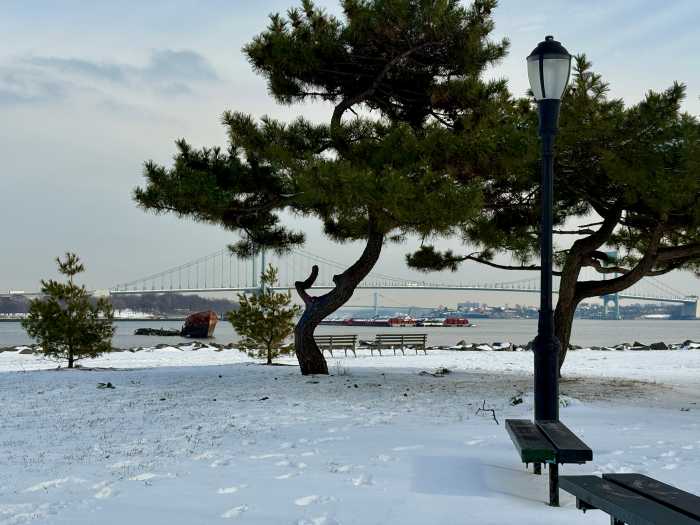 Edmundo Martinez and Richard Aracil spent around two hours at Clason Point Park, counting the different species of birds perched in trees and enjoying the water. Photo by Sadie Brown
Moments later, Aracil honed in on a Cooper’s Hawk through his scope. The stunning predator with brown streaked feathers and yellow eyes, hunts other birds. It landed atop a tree across the bay from the park. It was one of many unique creatures that birders in the Bronx spotted during the Christmas count on Sunday.
The Christmas Bird Count plays a critical role in tracking long-term trends in bird populations. The survey, which has been conducted annually for more than a century, allows scientists to use the data to study how climate change, habitat loss, and urban development are affecting bird species over time, according to the NYC Bird Alliance.
Throughout the day, Martinez and Aracil recorded more than 50 species of birds in the borough, although according to Aracil, the entire count in the borough included significantly more than they observed through only the East Bronx where the two spent the day counting.
One of the most frequent species spotted along the East Bronx shoreline was the Bufflehead, a small duck with a puffy head covered in black and white feathers. The Bufflehead travels in small groups, according to the national Audubon Society. Martinez and Aracil pointed to the duck, noting to each other when one would dive down into Westchester creek or the East River in search of food and then flagging when the tiny duck would pop back up into view.
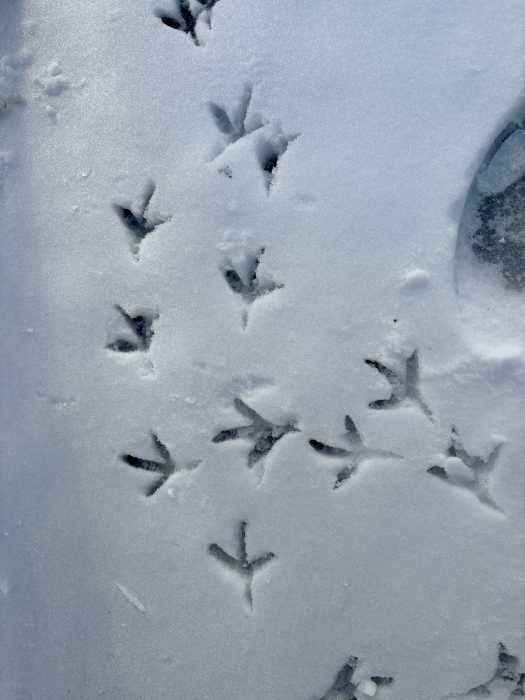 Prints in the snow from birds can be seen from Sunday Dec. 28 during the NYC Christmas Bird Count. Photo by Sadie Brown
The duo said that birding has exploded in popularity since the pandemic. They appreciated how technology had not only lowered the threshold of effort needed to learn about and appreciate local bird populations, but also encouraged Black and Brown people to take up the hobby.
Martinez said that people can take up birding as a hobby with as much or as little commitment as they like.
“ You don’t have to be a full-on nerd to enjoy it,” Martinez said. “You can be super casual and low lift about it.”
He said that he’s even found books that identify birds in both English and Spanish for people who are bilingual or learning a second language. Martinez said that it had helped him share his love of birds with other Latino people who may not speak English.
They highlighted apps like eBird, created by Cornell University to allow individuals with access to wifi and a smartphone the ability to document the birds they see or find more information about specific species. They also talked about Merlin, an app that can help identify birds based on their songs.
The pair then moved on to explore Pugsley Creek Park, which despite being located along a body of water, was filled with significantly more trees than Clason Point Park. From here, trees and foliage limited the visibility compared to viewing points near the water, and Aracil and Martinez shifted their strategy to spot Bronx birds.
Martinez said that he looked out for movement in the trees or foliage to indicate the presence of birds, while Aracil could distinguish different species by listening to their bird calls. He identified two Red Bellied Woodpeckers by listening to their songs.
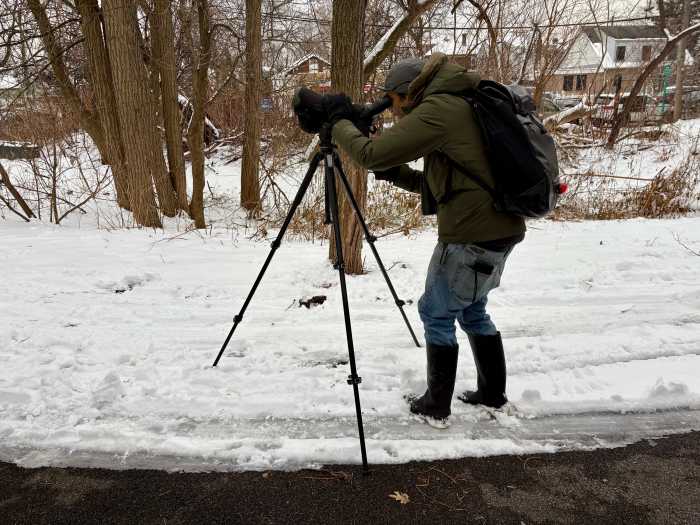 Richard Aracil looked through a scope with a magnification capable of seeing up to 1,000 years, or 10 football fields, away to view birds a Pugsley Creek during the NYC Christmas Bird Count in the Bronx. Photo by Sadie Brown
Aracil, who discovered his love of birds in the borough as a teen and later became a traveling field biologist doing ornithological research across countries and continents, said that he had personally seen around 300 different species in the borough, many more than the 176 documented species by the National Audubon Society.
Aracil said that the Bronx was an especially important sanctuary for birds in the New York City Area.
“ It’s got a lot of intact habitat,” Aracil said. “I think it’s got more park area than any other burrow and it’s got a diversity of habitats and because of that, you got a nice diversity of birds.”
He said that the conservation efforts in the Bronx have been successful in maintaining and creating additional space for habitats that both resident and migratory birds need to thrive. Aracil said the efforts to protect habitats have been especially successful in Pelham Bay Park, which he noted as one of his favorite places to find birds in the borough.
“ They’ve cleared out all the invasive species and they’re going to try to re-wild it with planting trees and bringing back the habitat because before it was just invasive, choked vine lands,” Aracil said. “So, I’m hoping that the habitat will be better and then it’ll be better for birds too.”
Aracil and Martinez said they hoped the increased interest in birding will help advance the ecological restoration of the Bronx, where portions of the borough like Pelham Bay Park are designated as an Important Bird Area by the National Audubon Society, a designation for vital and unique bird habitats that are threatened.
The park has consistently seen some of the highest counts of hawks in the country since the 1980s, according to the National Audubon Society.
By the end of the day, Aracil and Martinez had added dozens of sightings to a citywide effort that extends far beyond the Bronx. For them, the Christmas Bird Count was both a way to contribute to long-term research and a chance to spend hours enjoying Bronx parks, waterways and the wildlife that depends on them.
Reach Sadie Brown at sbrown@schnepsmedia.com or (214) 994-6723. For more coverage, subscribe to our newsletter and follow us on Twitter, Facebook and Instagram!