
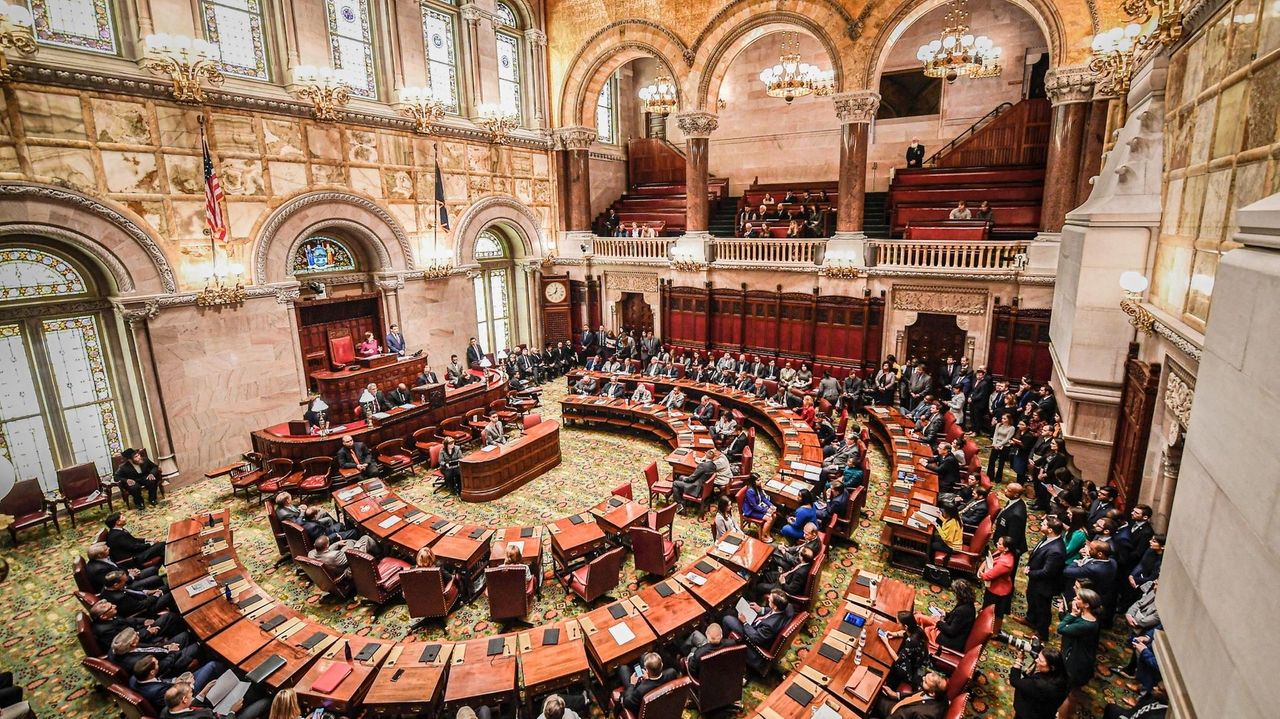
ALBANY — State lawmakers returning to session Wednesday plan to make New York State more affordable by focusing on expanding childcare and tackling rising utility and health care costs, legislative leaders told Newsday.
Democrats, who hold majorities in the state Senate and Assembly, also aim to increase housing, reduce prescription and insurance costs, boost consumer protections regarding artificial intelligence and protect immigrant communities from federal deportation efforts under the Trump Administration.
“The Senate Majority will lead with purpose, tackling the issues that New Yorkers face every day,” Senate Majority Leader Andrea Stewart-Cousins (D-Yonkers) said in an e-mailed statement. “Our focus will be on lowering costs, including unfair utility rates, promoting universal child care and defending the fundamental rights of everyone in our state.”
Assembly Majority Leader Crystal D. Peoples-Stokes (D-Buffalo) also pledged to address affordability, also with childcare at the top of the list. “Clearly the whole affordability issue really resonates well with all Americans quite frankly,” she told Newsday.
WHAT NEWSDAY FOUNDState lawmakers returning to session Wednesday plan to make New York State more affordable by focusing on expanding child care and tackling rising utility and health care costs, legislative leaders told Newsday.Affordability was a rallying cry for Democrats in 2025, but this year they face a $4.2 billion budget gap for fiscal 2027 and added pressure to deliver for their constituents with all 213 legislative seats up for election in November.Lawmakers will begin detailing specific plans when they return, much of which will be shaped in reaction to Gov. Kathy Hochul’s State of the State address on Jan. 13, as well as her budget proposal a week later.
Additional topics on lawmakers’ agenda include requiring companies to reduce their plastic packaging waste, addressing maternal health including high cesarean section rates, and allowing the medical use of psilocybin, a naturally occurring psychedelic compound found in some mushrooms.
Affordability was a rallying cry for Democrats in 2025, but this year they face a $4.2 billion budget gap for fiscal 2027 and added pressure to deliver for their constituents with all 213 legislative seats up for election in November.
“An election year session is much more complex with the balance tilting toward politics,” said Larry Levy, executive dean of the National Center for Suburban Studies at Hofstra University.
Gov. Kathy Hochul, a Democrat, also is facing reelection, putting added pressure on legislative leaders to work with her or risk having a Republican in the seat should she fail.
Affordability isn’t just the watchword for Democrats; it’s also being touted by Republicans.
The big difference between them is whether the government can spend its way to affordability, Assemb. Edward Ra (R-Garden City South) told Newsday. The state continues to grow its budget year after year, he said, adding, “I think that we have to have sustainable and targeted investments.”
Lawmakers will begin detailing their specific plans when they return. Many of those will be shaped in reaction to Hochul’s State of the State address on Jan. 13, in which she will outline her legislative agenda, as well as to her budget proposal a week later, which will detail how to pay for it all.
Here’s what to watch this session:
Taxes, contingencies
Finances will be the main challenge, said Blair Horner, senior policy adviser with the New York Public Interest Research Group. “To me that’s the real challenge: how do you expand funding in significant ways, argue that you’re keeping the state affordable and increase revenue.”
Federal cuts to health care and safety-net programs are expected to increase the state’s costs by more than $3.4 billion in fiscal 2027, according to the state’s mid-year update.
“I don’t think that we’re going to ever make up for the cuts that the feds are going to impose, but … we’re going to have to make priorities and we’re just going to have to do it in a way that keeps as many people from harm as possible,” Assembly Health Committee Chair Amy Paulin (D-Scarsdale) told Newsday.
The potential for an economic downturn and additional federal cuts will add uncertainty to the process, Horner said.
While Democrats will be hesitant to raise taxes in an election year, more left-leaning lawmakers have expressed a desire to raise taxes for millionaires and billionaires, which Hochul has resisted. An alternative would be to raise corporate taxes, state lawmakers and political experts told Newsday.
But there needs to be a more comprehensive approach, Senate Finance Committee Chair Liz Krueger (D-Manhattan) told Newsday. “For me, everything should actually be evaluated on a reasonable and fair scale of who’s winning and who’s losing in each of these stories,” she said. “It’s never one size fits all and it’s never one answer.”
Lawmakers could also add contingency plans to the budget as they did in 2025, allowing for mid-year cuts, Peoples-Stokes said. “We do have to be realistic here.”
Child care, education
“This session is really going to revolve around families, workers and local communities,” Assemb. Michaelle Solages (D-Elmont) told Newsday.
The child care discussion is three conversations: how it’s funded, how to help businesses that provide care and how to boost the workforce, she said, adding that it will be important to increase pre-kindergarten slots statewide.
That all would come at a cost and a child care plan would likely have to have a multiyear rollout, Krueger said. “The question has always been how can we add up enough money to pull it off and get it rolling in very different geographies and municipalities across the state.”
Sen. Patricia Canzoneri-Fitzpatrick (R-Malverne) said she doesn’t agree with using tax dollars to provide free day care. “That’s going to put more burden on the working people,” she said.
Ra said he believes universal pre-kindergarten is an “important part of the overall child care discussion” and more funding should be made available so all districts can participate. He’d also like to see further tweaks to the complex state funding formula, known as Foundation Aid, which was enacted in the 2007-08 school year. “I think we’re going to have continued discussions … as we sort of get to a Foundation Aid that reflects the cost of education in 2026 and beyond,” Ra said.
Political pressures
This session is unique, with more complicated policies and people driving them than Albany has seen in decades, Levy said.
Hochul and the Legislature will have to balance their own agendas with what’s coming out of the Trump administration and Congress, whose me mbers also are up for election, as well as the agenda of newly elected New York City Mayor Zohran Mamdani, who, Horner said, could be a beneficial political tool in boosting election turnout.
Political pressures from Republicans on Hochul to be tough on crime may put her at odds with the Legislature, which has been hesitant to ame nd criminal justice reforms.
The Democrat is being primaried by her estranged Lieutenant Governor Antonio Delgado and challenged by Nassau County Executive Bruce Blakeman, a Republican endorsed by Trump.
Legislative leaders said they hope to limit state and local agencies’ collaboration with federal immigration agents unless there’s a judicial warrant — legislation that would give Blakeman further ammunition.