
Most school districts across the East Valley experienced enrollment declines yet again in 2025, reshaping campuses, budgets, and classrooms.
With the exception of Queen Creek Unified and Tempe Union High School districts, all other districts in the region saw pupil count continue a steady downward decline.
Experts attribute the trend to declining birth rates, housing affordability and availability for young families with school-aged children, and increased competition from charter schools and Empowerment Scholarship Accounts, which have expanded access to private schooling and homeschooling.
Across the East Valley, districts are adjusting to these enrollment shifts in different ways.
While the challenges and opportunities vary, the trend underscores how declining enrollment impacts budgets, classrooms, and long-term planning.
The most dramatic impact has been in Kyrene School District, where the Governing Board last month voted to close four elementary schools and two middle schools over the next two years across Ahwatukee, Chandler and Tempe.
The district has seen enrollment plummet over the last 10 years from 20,000 students to just under 13,000 and is projected to lose another 1,000 students over the next five years.
Because Arizona public schools are funded on a per-pupil basis, even modest shifts in student counts can have outsized effects, influencing staffing levels, program offerings, and long-term planning decisions.
Student counts cited in this story are based on average daily membership (ADM) figures reported in school districts’ 2025-2026 expenditure budgets. ADM is the metric Arizona uses to calculate base-level school funding and reflects an averaged count of students enrolled in a district.
Here’s a look at how enrollment trends are affecting East Valley school districts.
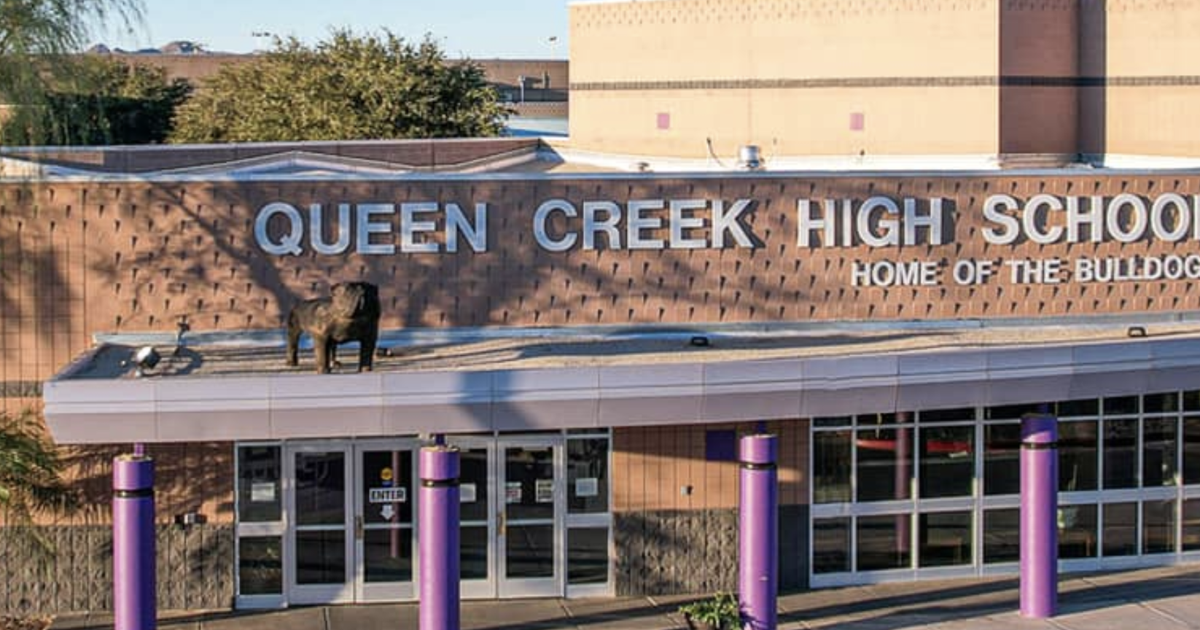
Queen Creek Unified
Queen Creek Unified saw its ADM rise by about 200 students from the 2024-25 school year.
To support the continued growth the district anticipates, it opened a new elementary school this year, Mountain Trail Academy, as well as two expansions at Eastmark and Crismon high schools.
District spokeswoman Irene Mahoney-Paige said enrollment growth has allowed the district to maintain certified teachers in all classrooms and sustain smaller K-8 class sizes following last year’s voter approval of a 15% maintenance and operations override.
The district reported that growth has supported expanded academic and extracurricular offerings, including career and technical education, fine arts, dual enrollment and athletics, as well as the recent addition of a Naval program at Eastmark High.
Higley Unified
Higley Unified saw declining enrollment, falling by about 330 students since last school year, according to district spokeswoman Jessica Bautista. She added that ADM funding decreased by about 2.1% due to the difference.
The district also faced its first round of budget cuts tied to the phasedown of its 15% maintenance and operations override.
Combined with the decline in enrollment and a roughly $5 million reduction in override funding, the district reduced more than 80 positions starting this school year.
Facing another $4.8 million cut in the latter half of this calendar year, the HUSD Governing Board has already begun discussing budget
priorities.
Chandler Unified
Chandler Unified District also had a significant drop in ADM, with district spokesperson Stephanie Ingersoll noting the drop was more than initially anticipated.
From last school year, ADM dropped by about 1,150 students.
CUSD has not closed any schools or trimmed any programming, and maintains a class size ratio of 24 students to one teacher.
Offering some relief, Chandler voters passed the continuation of the district’s 15% maintenance and operations budget override last November.
As state-aid declines along with average daily membership, the override allows Chandler to exceed its state-imposed budget limits to support operational expenses such as salaries, benefits, supplies, and utilities.
Voters also passed a $271.5 million bond measure, providing the district with additional funding for construction, site improvements, transportation vehicles, furniture, technology and equipment.
Mesa Public Schools
Mesa Public Schools saw its ADM fall by just over 1,440 students from last school year.
MPS last February eliminates 147 district-level positions for the 2025-2026 school year, including three administrative roles and a reduction in force of 42.2 certified staff members.
To account for declining enrollment without having to close schools, the district is removing over 150 portable classrooms by the end of 2027.
By the end of last summer, 77 portables – the near equivalent of five elementary schools – had been demolished. The removals continued this school year, with six out of 15 intended demolitions completed as of September.
Gilbert Public Schools
Much like its neighbors, Gilbert Public Schools has experienced a steady decline in enrollment since the 2019-2020 school year – this year was no different. Average daily membership in the district has fallen by around 1,300 students.
The GPS Governing Board will vote this month on a proposal to close Pioneer Elementary School at the end of the current school year and shift some 350 existing students to other nearby campuses.
Scottsdale Unified
Scottsdale Unified saw its enrollment drop by just over 350 students form 2024-25.
Although declining enrollment did not result in any closures or reductions taking effect in 2025, the district’s governing board voted last month to two elementary schools by this summer.
The closures come as the district faces a budget shortfall that could reach $9 million this year and more campuses could be on the chopping block this year, the district administration warned.
Tempe Union
Tempe Union last month reported a small increase in enrollment this school year over the previous one, confounding its demographer’s projections.
Still, the district has joined Kyrene and Chandler Unified in a marketing campaign aimed at attracting more young families.
The city’s economic development department is leading the campaign and picking up most of the cost, though the three districts are each kicking in $10,000.
Additionally, the Tempe Union launched a new District Enrollment Committee earlier this year. The committee, made up of representatives from each district school, discusses site-based enrollment efforts and brainstorms.
Tempe Elementary
Tempe Elementary School District’s average daily membership has declined by nearly 400 students since the end of the 2024–25. Chief Financial Officer Eric Thompson said the district has been experiencing enrollment declines of about 2% each year.
While school closures were not considered in 2025, district leaders have taken steps to rein in spending.
In March, the governing board approved the elimination of five district office positions and placed a hiring freeze on four others.
Staffing levels across the district have dropped by hundreds in recent years as officials continue to adjust to lower enrollment.
In a budget update Dec. 17, Thompson warned that if staffing levels are not further aligned with enrollment trends, the district could face a $7.6 million deficit in the 2026–27 school year.