
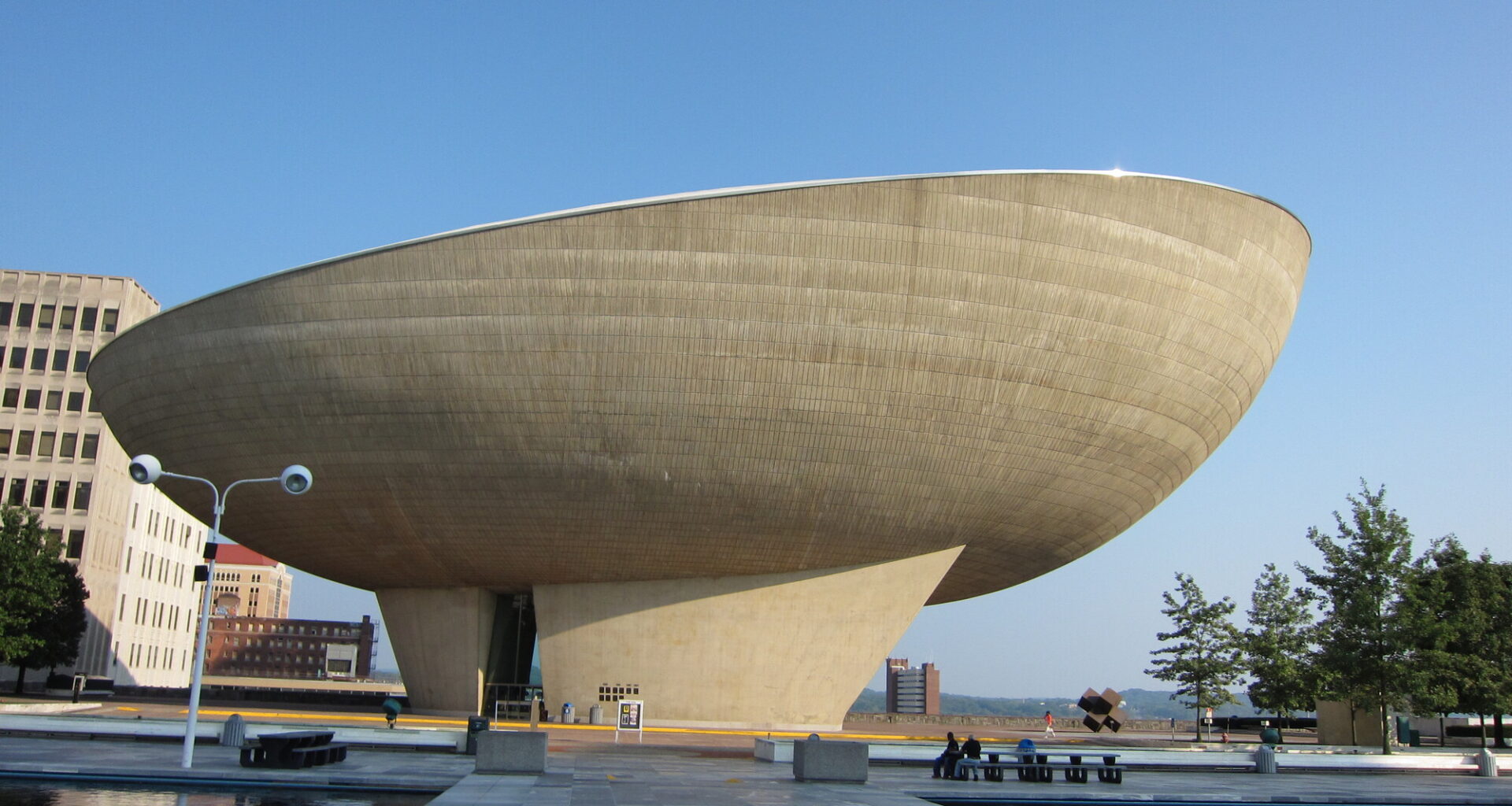
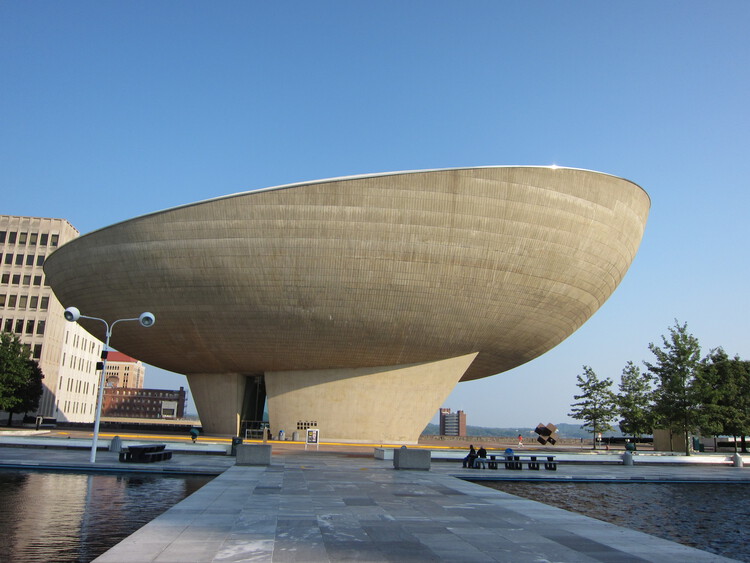
 The Egg, Empire State Plaza, Albany, New York, 1 September 2010. Image © Leonard J. DeFrancisci via Wikimedia Commons, CC BY-SA 3.0
Share
Or
https://www.archdaily.com/1037540/the-egg-performing-arts-center-reopens-following-six-month-restoration-in-albany-new-york
The Egg is a performing arts centre located in Albany, within New York’s Empire State Plaza, designed by the North American firm Harrison & Abramovitz. Construction began in 1966 and was completed twelve years later, in 1978, with the aim of hosting a broad range of cultural events and performances for New York State residents. Drawing inspiration from Brazilian modernism, the domed, egg-like concrete structure stands out as a striking counterpoint within an otherwise rational urban ensemble. Surrounded by state government towers set in an open plaza and clad in stone, the building’s exposed concrete, its seemingly suspended form, and pronounced curved geometry position it as a late example of modernist Brutalism. The venue is currently undergoing restoration and, after six months of renovations, is set to reopen on January 8, 2026, in what has been described as a “refreshed and reimagined” space.

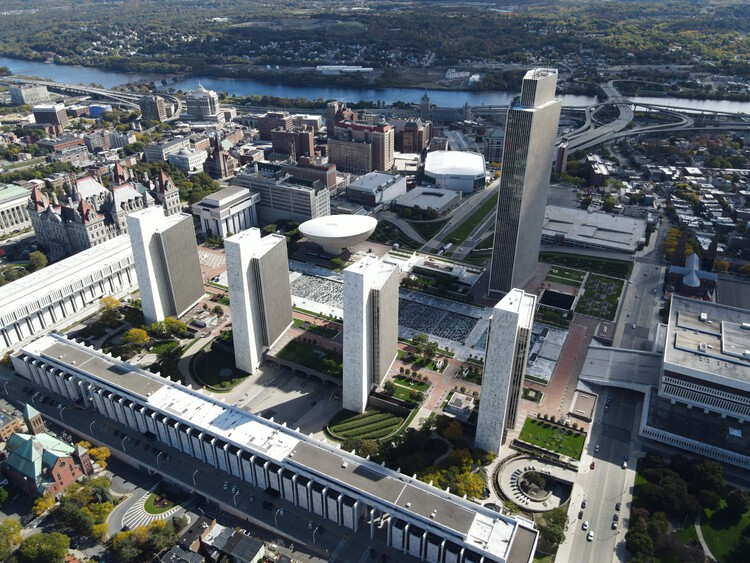 A drone picture looking down on the Empire State Plaza. Taken from southwest of the plaza on October 8th, 2022. Image © Schvaxet via Wikimedia Commons, CC BY-SA 4.0
Structurally, The Egg is supported by a central concrete stem that extends six storeys below ground, anchoring the building deep into the site. A heavily reinforced concrete beam maintains its distinctive shape, poured as part of the shell, which distributes the building’s weight onto the supporting pedestal. This engineering solution allows the structure to appear suspended above the plaza, reinforcing its sculptural presence. The building houses two theatres: the Lewis A. Swyer Theatre and the Kitty Carlisle Hart Theatre. With seating for 450 spectators, the Swyer Theatre is used for chamber music concerts, cabaret, lectures, multimedia presentations, solo performances, and educational programming. The Hart Theatre, with a capacity of 982 seats, accommodates larger-scale productions, including musical theatre, dance, and music concerts.
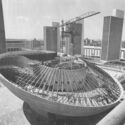
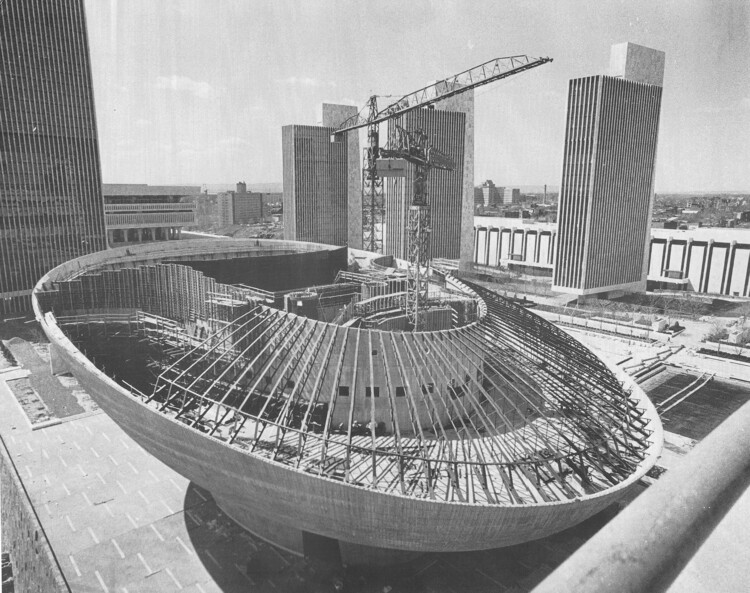 The Egg, a performing arts center that is part of the Empire State Plaza in Albany, New York, United States, under construction. Image via Wikimedia Commons (Public Domain)
Approximately half of the building functions as a lounge area serving the Hart Theatre and is also used for seminars, receptions, post-performance gatherings, and small-scale performances. As suggested by the building’s exterior form, the interior features almost no straight lines or sharp corners. Instead, walls curve upward to meet concave ceilings, while pearwood veneer lining the walls adds warmth and enhances the acoustics throughout the theatres. Originally conceived as a general-purpose auditorium for government meetings, The Egg is owned by the State of New York and managed by the not-for-profit Nelson A. Rockefeller Empire State Plaza Performing Arts Center Corporation.
Related Article Inside the Construction of Niemeyer’s Cristo Rei Cathedral in Belo Horizonte, Seen Through Paul Clemence’s Lens
The renovation project was led by the local firm Fred Basch Architect and included the replacement of seating, carpeting, and lighting in both theatrical and shared spaces. Work began in 2018 and required a temporary closure of the venue for the past six months. The renovation focused primarily on interior upgrades, including the installation of a fully automated LED lighting system designed to support complex productions. Accessibility improvements were also introduced, expanding accessible seating areas and restrooms in both theatres, which are now equipped with induction loop assistive listening systems. Together, these interventions reinforce the building’s original civic mission as part of a public cultural infrastructure aimed at expanding access to the performing arts across the state. The reopening will be marked by a free public ceremony on Thursday, January 8, featuring live music, an aerial performance, and open access to the renovated spaces.
In recent months, several iconic works of modern architecture have required renovation or significant maintenance. Since August 2025, debate has intensified in Dallas over the future of I. M. Pei & Partners’ Dallas City Hall, amid growing concerns about long-deferred maintenance and the need for major investment. Earlier this year, a citizen-led campaign proposed a new use for Kenzo Tange’s Kagawa Gymnasium, which is currently facing demolition. On a more optimistic note, Fountainhead, a house designed by Frank Lloyd Wright, was recently purchased by the Mississippi Museum of Art (MMA) to ensure its preservation and open it to the public through guided tours. Meanwhile, the Canadian Centre for Architecture (CCA) has launched a new research project and institutional collaboration on modern architecture in China, aiming to reframe the histories of modernism during the first three decades of the People’s Republic of China.