
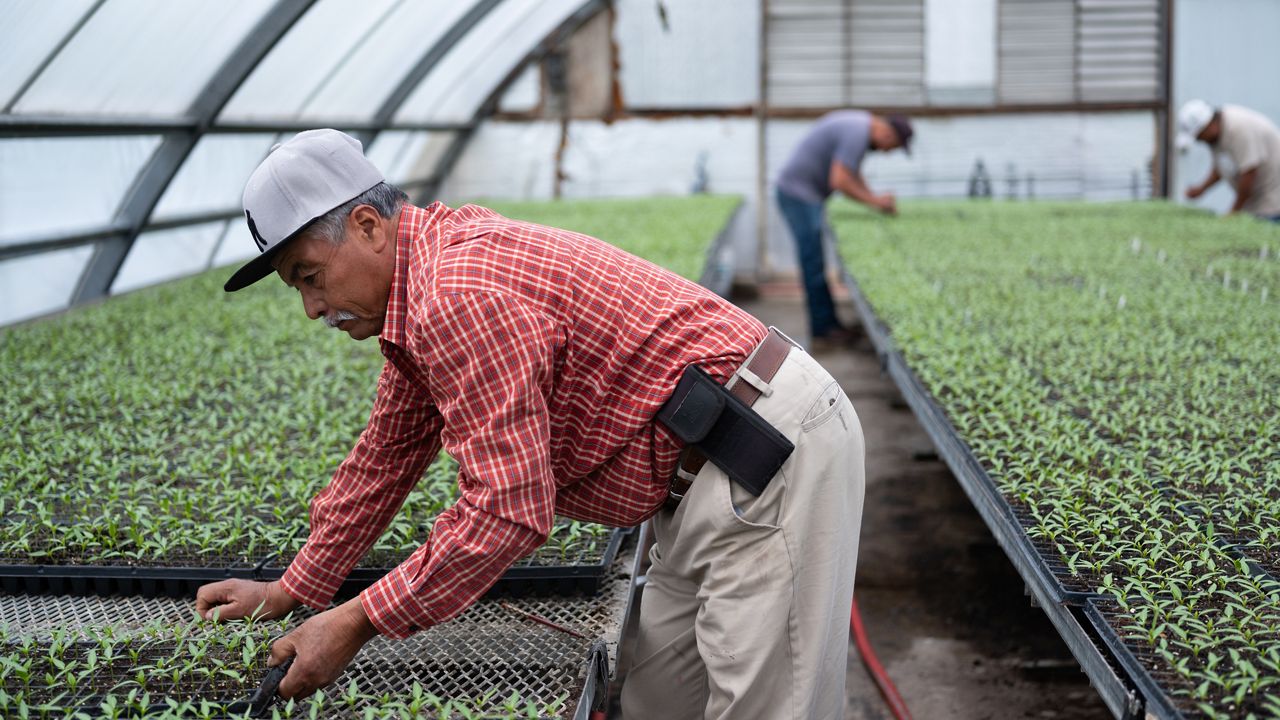
New York farmers are now required to pay overtime to workers after 52 hours, down four hours from 2025, as part of the phase-down threshold for overtime pay for farmworkers.
The change, set in 2022, will decrease the threshold by four hours every other year until it reaches 40 hours in 2032. The lowering of the threshold, however, comes at a time when farmers said they are financially pinched.
“2026 is predicted to be a year of thinner margins than 2025, and with input costs up and the overtime threshold lowering, it makes it more challenging,” said Stuart Ziehm, owner of Tiashoke Farm, a dairy farm in Washington County.
In 2026, all-milk prices are expected to drop by 10%, according to the U.S. Department of Agriculture. For dairy farmers, the price they get paid for their milk is predetermined by the Federal Milk Marketing Orders.
“We are price takers. We don’t have the ability to price our products in order to get it back out of the marketplace,” Ziehm said.
The fourth-generation dairy farm milks about 1,100 cows and grows crops on about 3,000 acres. They employ about 15 people to help with their operation.
“For our team and our family, we try to find a balance of how to keep the work schedules in check so that we can continue to have a healthy wage for all of our team members, but also keep the farm in balance with labor being our number two cost on the dairy farm,” Ziehm said.
He said his farmworkers work about 60 hours per week on average.
Farmers are also eligible for the Overtime Tax Credit, and last year, the legislature and Gov. Kathy Hochul made a correction to a technicality that now ensures all farms are eligible for that credit.
“We appreciate the fact that the governor has fixed the overtime tax credit issue that some of our family [farms] were struggling with, and now the tax credit is available for all of New York agriculture,” Ziehm said.
The tax credit gives farmers partial reimbursement for the overtime hours worked by their employees.
Richard Stup, director of Cornell University’s Agricultural Workforce Development Program, said the tax credit for overtime is crucial for New York farms in this transition.
“It’s helping them to really, frankly, remain competitive. If they didn’t have that overtime tax credit and we still had overtime in place, then it would put New York employers at a competitive disadvantage compared to some of the neighboring states, which don’t have overtime,” Stup said. “Without it, we’d be in a difficult situation.”
Other states that have made changes to their overtime threshold for farmworkers, such as California and Washington, do not offer a tax credit, he said. This has led to those farmworkers getting fewer hours each week. However, despite the credit, Stup said some New York farmers will still have to make adjustments to hours and how they run their business.
“They’ll get somewhat less hours in New York. Farmers are already looking at this and there is some concern about the overtime tax credit and whether it will be there in the long term. So, farmers are already looking at ways, both hiring additional workers or using technologies, in order to increase the efficiency of the labor that they do use in order to reduce the number of hours that farmworkers are working each week,” Stup said.
The outlook depends on which industry farmers work in, he said. With milk prices predicted to be lower in 2026, some dairy farmers may opt to tighten the number of hours their employees are working. In the fruit and vegetable industry, farmers have had to make changes to which crops they grow. Broccoli is one crop that farmers have started to quit growing, Stup said.
“[Farmers] have been starting to cut out certain crops that just took too much labor because they weren’t able to make any money at it because it took so much labor, and in New York, where labor is relatively expensive, they had to move away from certain crops,” Stup said.
Last year, some New York farmers worried about President Donald Trump’s crackdown on immigration, as many rely on immigrants for their labor. However, New York farms haven’t seen a shortage of workers in connection with immigration activity, Stup said.
“Generally, New York farmers are good employers and provide good jobs. We do pay some overtime, and often, housing is a very good quality in New York. So, we’re an attractive place for farm employees to come,” he said. “[Other states] are not seeing as many people available to work, but in New York, we haven’t had as much of a lack of availability yet, it’s not saying we won’t get to that but right now, we’re holding up OK.”