
A New York State Comptroller audit of New York City’s program to provide vouchers to help people in danger of eviction obtain housing found poor conditions, high rents and failure to qualify some seeking help.
The audit by the state comptroller’s office of the program that pays landlords rent subsidies for those at risk of homelessness said “weak oversight and administrative lapses” resulted in “rising costs and placing some vulnerable families in unsafe housing.”
New York City in 2018 created the City Fighting Homelessness and Eviction Prevention Supplement (CityFHEPS) program, overseen by the New York City Department of Social Services.
Designed to help low-income New Yorkers avoid homelessness and find permanent housing, the program cost $834 million in fiscal 2025 and is projected to cost the City $1.2 billion in fiscal 2025, up from $176 million in 2019 as the number it serves increases.
This has become increasingly important with more than 100,000 as of June 2025 sleeping in city shelters, thousands more in public spaces and 200,000 in others’ homes, according to the audit.
“The intent certainly is laudable,” State Comptroller Thomas P. DiNapoli said. “As often happens with laudable programs, the implementation becomes key.”
DSS, in its response to the audit, said New York City, with a 1.4% apartment vacancy rate, relies on this program as one way to battle homelessness.
Run through DSS’s New York City Human Resources Administration and the New York City Department of Homeless Services, the program is currently helping 60,000 households pay for housing, including 14,000 placed in fiscal 2024, the largest number to date.
“The agency would not be able to assist hundreds of thousands of individuals in obtaining permanent housing if it did not establish proper oversight and monitoring controls,” DSS said in its response.
Auditors said they recognize the program’s “role in assisting clients with obtaining permanent housing,” but “improved oversight and monitoring are needed.”
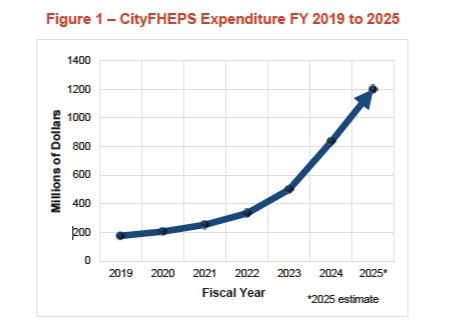 CityFHEPS expenses increased from $176 million to $834 million, as shown in Figure 1. In fiscal year 2025, the program’s projected cost was $1.2 billion.
“The majority of people we looked at moved to an alternative apartment,” said Deputy Comptroller Tina Kim, who conducted the audit. “The City has to approve the apartment and make sure it’s habitable.”
DSS contracts with seven nonprofits to help those at risk of homelessness avoid entering shelters, find apartments and apply for rent subsidies.
Auditors examined 75 out of 8,000 cases involving these nonprofits from January 2022 to May 2024 and $671 million in contracts.
Auditors said they found unsafe apartments with housing-code violations such as mold, infestations (rats, mice and roaches) and defective window guards.
They said renters can and sometimes do seek housing outside New York City, but that those inspections are done virtually, “raising doubts about the integrity of certifications.”
In at least one case, a resident was sent back to an apartment that someone had vacate, due to unsafe conditions that auditors said had not been remediated.
“The audit also found landlords who continued to receive rent payments for uninhabitable apartments, increasing costs and forcing families to relocate,” according to the Comptroller’s office.
The audit found missing documentation and that 30 of 75 cases showed no evidence that income was verified.
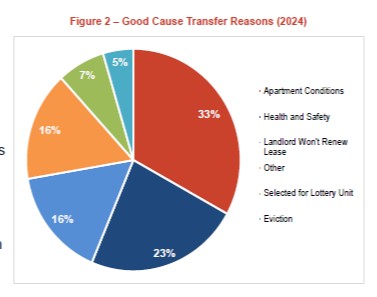 In 2024, of 4,201 approved Good Cause Transfer cases, 1,388 (33%) were due to unsuitable habitability conditions, as shown in Figure 2.
DSS said they are using a software called “CurRent” that helps provide “additional oversight and monitoring controls.” And they set up a Rental Assistance Integrity unit for quality control and to review clearance and eligibility.
Auditors said there is still no “system to disqualify landlords with repeated building code violations or poor performance,” including some on the Public Advocate’s Worst Landlord Watchlist.
“Restricting voucher use to only pristine landlords would shrink an already microscopic pool of available units,” DSS replied, noting the Worst Landlord Watchlist is not a “legal enforcement tool,” and each apartment must qualify.
The audit also found improper payments such as fees to a broker affiliated with the landlord, when brokers must be independent to qualify for fees.
Auditors found a “failure to perform required rent reasonableness tests and approving rents exceeding comparable rates.”
Rents were approved at above market by an average of $525 per month without documentation of required rent-reasonableness assessments, according to the audit.
The auditors recommended strengthening oversight, extensive pre-clearance inspections of all apartments before approving subsidies, creating a list of disqualified landlords and verifying the income of renters to be sure that they qualify.
DSS said they conduct “robust pre-clearances and walkthrough processes” and “despite many challenges, this program remains a vital tool for moving families into permanent housing.”
The agency said all programs require “continuous improvements and course corrections,” and they remain “committed to such improvements.”
“We’re hoping now that we have a new administration in the city, that they will embrace our recommendations,” DiNapoli said.