
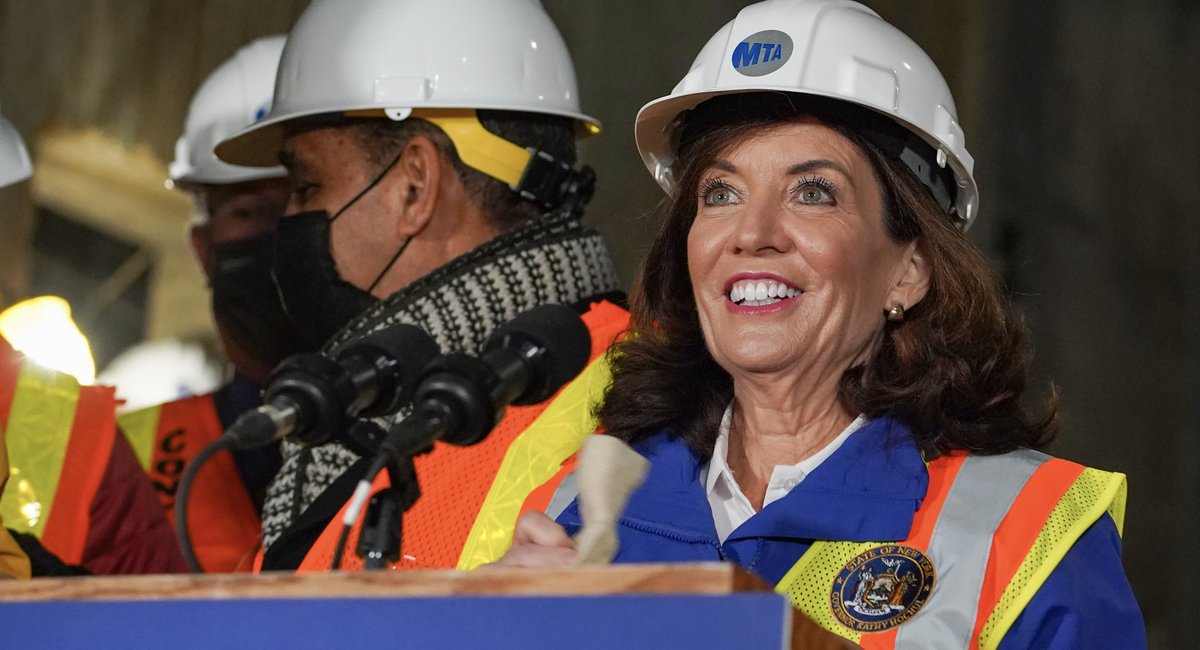
The MTA’s next extension of the Second Avenue subway won’t go down Second Avenue — but will instead travel west along 125th Street, Gov. Kathy Hochul announced Tuesday.
The proposal, slated to be part of Hochul’s annual “State of the State” address, comes as the transit agency works to build three new stops on the line in East Harlem that will bring the northern end of the Q train up from East 96th Street and Second Avenue to East 125th Street and Lexington Avenue.
Hochul said once the $7.7 billion project is finished, the MTA will expand the line west with three new stations on 125th Street, ending at Broadway in Morningside Heights.
The change is a departure from more than a century of planning by New York transportation officials, who have spent generations trying and failing to create a train line that travels down Second Avenue all the way to the Financial District.
In 2024, Hochul requested that the MTA conduct a feasibility study to examine changes to the expansion plans. She directed the MTA to move forward with designing the 125th Street project on Tuesday. Her office said the state would cover the cost of the design work, which would need to be approved by the Legislature as part of the budget.
The governor’s office said that the plan will establish a critical connection in Harlem for residents who currently lack easy or accessible travel options east-west in the neighborhood or access to the Upper East Side.
The westward extension would add Q line stops at Lenox and St. Nicholas Avenues on top of the new Broadway terminal, and provide new transfer points to A, B, C, D, 1, 2 and 3 trains.
“Our efforts to extend the Second Avenue Subway will save hundreds of millions of dollars in future costs and reduce time — big wins for the 240,000 daily riders projected to benefit,” Hochul said in a written statement.
To get the westward expansion done, the MTA first has to complete the second phase of the project, extending the Q line through East Harlem, which is expected to wrap up in 2032.
Last year, officials at the transit agency inked a $2 billion contract to begin digging a tunnel and new train stations from the Upper East Side to East Harlem.
According to the feasibility study funded by Hochul, continuing the tunnel work along 125th Street west of Lexington Avenue would save the MTA “substantial time and money.”
MTA officials have previously said parts of the tunnel boring machine that will dig through East Harlem will stay below East 125th Street in anticipation of the extension west.
Hochul’s spokesperson Sean Butler said the governor will reveal the anticipated cost to design the proposed extension when she releases her executive budget next week.
The MTA published an analysis of the 125th Street extension in 2023 through its 20-year needs assessment, which estimated Hochul’s proposed line would cost $8.1 billion, a figure that includes the cost of new subway cars needed to service the line.
“Despite the high cost, this project is cost-effective with very high ridership and moderate travel time savings,” the report said.
The ongoing work to extend the Q train in East Harlem has already sparked some concerns in the neighborhood, particularly among residents who are being forced to move as a result of the construction.
The new line is slated to transform the area, but some community advocates fear it will lead to gentrification that could price them out.
RanDe Rogers, treasurer of the East 125th St. business improvement district and owner of a Caribbean restaurant in the neighborhood, had mixed thoughts about Hochul’s plan to extend the Q farther west.
“You can guarantee that the mom and pops are going to have less say and less protections against the damages of this construction,” Rogers said. “It’s a fascinating and ambitious initiative, and I can understand why politically it is a salient, rhetorical message, but I think that there’s a lot of questions about how it’s going to be implemented in a way that’s responsible.”
With the shift focused now on the crosstown line, the long-described “Second Avenue” subway might need a new name. If Hochul’s proposal is realized, the Q will only travel along Second Avenue for roughly 2.2 miles.
The line within Manhattan would have a question mark shape that wraps around Central Park but stays mostly away from Second Avenue.