
 New exhibition interrogates the implications of being able to see inside the body with works by Barbara Hammer, Ana Mendieta, and more
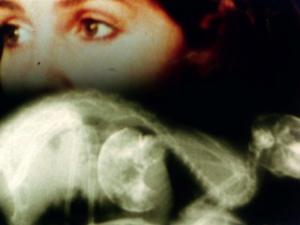
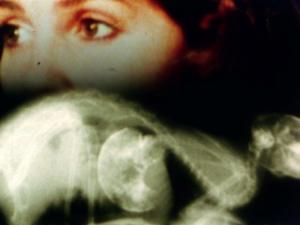
Astoria, New York (January 13, 2026) — Museum of the Moving Image (MoMI) announces Overexposed: Art, Technology, and the Body, a major exhibition organized by Sonia Shechet Epstein, opening to the public on March 14, 2026. Taking its title from a Sylvia Plath poem, Overexposed examines how medical imaging technologies—from X-rays and ultrasounds to MRI, CT scans, and endoscopy—have reshaped how we look at, understand, and control the human body.
Featuring 33 historical artifacts, film, and installation-based works, by pioneering artists including Barbara Hammer, Ana Mendieta, Liz Magic Laser, and Donald Rodney, the exhibition interrogates the supposed objectivity of medical imaging tools and the biases, limitations, and cultural implications embedded in how bodies are imaged.
“Every medical image tells a story—not just about health, but about power, vulnerability, and trust,” said Sonia Shechet Epstein, MoMI’s Curator of Science & Technology and Executive Editor, Sloan Science & Film. “Overexposed invites visitors to look beyond the surface of these technologies and consider how our bodies—and our sense of self—are constantly being redefined by the tools that claim to see us most clearly.”
Exhibition Highlights
X-ray technology and cinema debuted to the public on the same day, on December 28, 1895; two inventions that mapped the living body in new ways. Overexposed: Art, Technology, and the Body traces the evolution of medical imaging from this moment to the present, bringing together research-based, educational, and artist-driven films.
Spanning 1891–2025 and featuring work by 16 artists from 13 countries, the exhibition considers how artists have responded to—and intervened in—the politics and practices of looking inside the body, from overcoming barriers to access to confronting the effects of being imaged.
Overexposed is organized in three distinct yet overlapping sections:
Technology and Power uses historical materials, educational films, and works of early cinema to explore how the quest for objectivity in Western science and medicine has privileged mechanical optical tools;
Limits of the Gaze features works by contemporary artists exploring the human desire to see in ways that reveal and challenge the normative gaze embedded in medical imaging; and
Care and Control highlights artists’ experiences with imaging tools that have transformed the Western practice of medicine.
Beginning in the 1960s and 1970s—amid the women’s health movement, second-wave feminism, and the rise of body art—artists such as Barbara Hammer and Ana Mendieta incorporated medical imaging footage into their works, infusing these renderings with subjectivity and personhood. Overexposed will present Mendieta’s X-ray (c. 1975)—the artist’s only film with sound, which shows her skull being imaged through an X-ray device at the instruction of a male doctor—and Hammer’s Sanctus (1990) which makes explicit the latent harm inflicted by X ray exposure.
Other highlights include works by Leslie Thornton, Agnes Questionmark, Panteha Abareshi, Peggy Ahwesh, and Verena Paravel and Lucien Castaing-Taylor. The show also includes historical objects, such as X-ray records created in the USSR by bootleggers to inscribe forbidden music.
Key themes explored in Overexposed include the power dynamics of the medical gaze, personal encounters with imaging during illness, women’s health, patient-practitioner spaces, disability visibility, and speculative futures.
Related Publication
Accompanying the exhibition is a catalog published by ARTBOOK | D.A.P. and edited by Elisabeth Sherman and Sonia Shechet Epstein, featuring essays by Jeremy A. Greene on imaging in practice, Sonia Shechet Epstein on the medical gaze’s limits, Zoé Samudzi on the violence of the medicalizing gaze, Mary F. E. Ebeling and Jena Osman on the ultrasound and fetal personhood, Hannah Zeavin on pedagogical power, David Serlin on haunted futures, and Kirsten Ostherr on medical deepfakes, plus contributions explaining imaging technologies by radiologists Lily Offit and Geraldine McGinty. The interdisciplinary project builds on the editors’ expertise across photography and the moving image and an earlier collaboration at Tate Modern.
Forthcoming Programming
Overexposed invites visitors to reconsider visibility, normativity, and what it means to be “overexposed” in an era of advanced imaging and AI. Full details on dates, programs, and tickets forthcoming at movingimage.org.
Acknowledgments
Lead support for Overexposed was provided by the Alfred P. Sloan Foundation and the Andy Warhol Foundation for the Visual Arts. Additional exhibition support was provided by The Gladys Krieble Delmas Foundation and May & Samuel Rudin Family Foundation. The publication was generously funded by Romy Cohen, Elaine Goldman, and Doug Pugh.
About Museum of the Moving Image
MoMI celebrates the history, art, technology, and future of the moving image in all of its forms. Located in Astoria, New York, the Museum presents exhibitions; screenings; discussion programs featuring actors, directors, and creative leaders; and education programs. It houses the nation’s most comprehensive collection of moving image artifacts and screens over 500 films annually. Its exhibitions—including the core exhibition Behind the Screen and The Jim Henson Exhibition—are noted for their integration of material objects, interactive experiences, and audiovisual presentations. For more information about MoMI, visit movingimage.org.
###
Press contact: Sutton Communications, momi@suttoncomms.com
Museum contact: Tomoko Kawamoto, tkawamoto@movingimage.org, 718 777 6830
Follow the Museum on Facebook (@MovingImageMuseum), Twitter (@movingimagenyc), and Instagram (@movingimagenyc).
Museum of the Moving Image is housed in a building owned by the City of New York and has received significant support from the following public agencies: New York City Department of Cultural Affairs; New York City Council; New York City Economic Development Corporation; New York State Council on the Arts with the support of the Governor and the New York State Legislature; Institute of Museum and Library Services; National Endowment for the Humanities; National Endowment for the Arts; and Natural Heritage Trust (administered by the New York State Office of Parks, Recreation and Historic Preservation). For more information, please visit movingimage.org.