
Sign up for Chalkbeat New York’s free daily newsletter to get essential news about NYC’s public schools delivered to your inbox.
New York Gov. Kathy Hochul wants to revamp the way the state’s schools teach math.
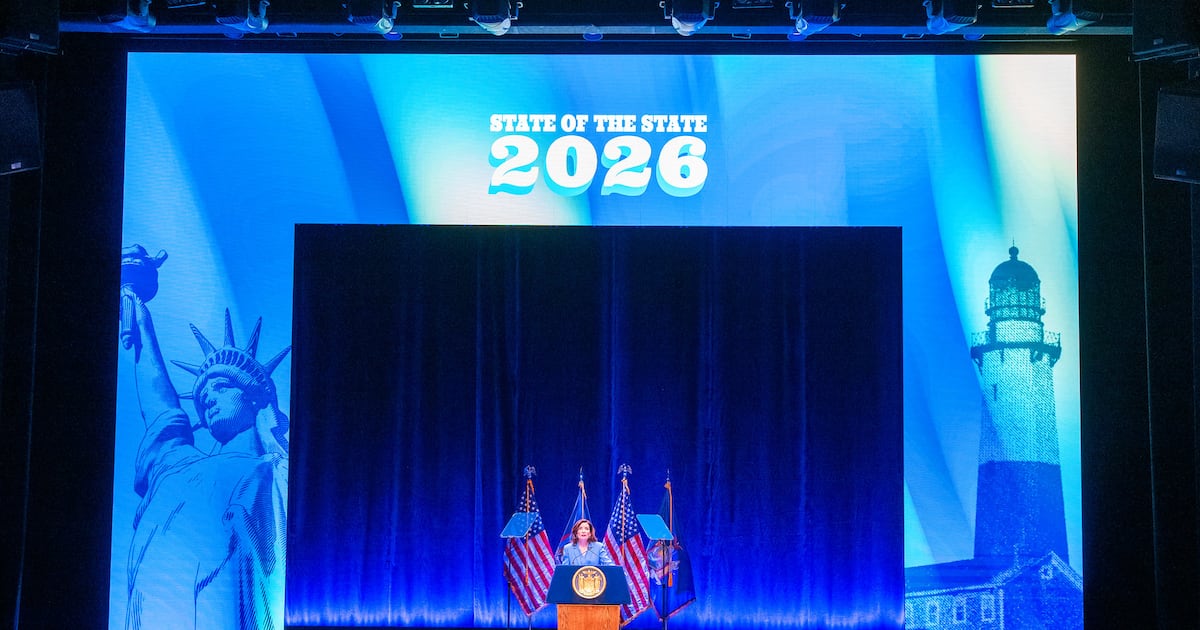
Hochul announced the plan in her annual State of the State address on Tuesday, along with several child care and education initiatives she has previewed over the past week. The governor’s broader agenda includes funding a new, free child care program for 2-year-olds in New York City; expanding pre-K and child care vouchers statewide; growing a mental health training program for high schoolers; bolstering the state’s teacher training pipeline; and building on free community college for adults who want to train for high-demand careers.
The governor’s office released few details about the plan to overhaul math, but in its 2026 State of the State Book outlining Hochul’s priorities for the year, state officials compared it to existing efforts to revamp literacy instruction. The governor has worked with teachers and school districts to adopt evidence-based “science of reading” practices that focus on phonics and explicit reading instruction, state officials wrote.
Similarly, Hochul said in her Tuesday speech that it is time to get “back to basics” in math. “My hope is for New York students to be the most academically prepared in the country,” Hochul said.
To that end, she will introduce legislation to require the State Education Department to provide school districts with best practices for teaching math and guidance on selecting math curriculums that align with state standards.
The state will also require the State University of New York and the City University of New York to offer extra training in evidence-based math instruction to teachers, especially in New York’s districts with the lowest math performance.
Inspiration, advice, and best practices for the classroom — learn from teachers like you.
Across all of our bureaus, Chalkbeat reporters interview educators with interesting, effective approaches to teaching students and leading their schools. Get the best of How I Teach sent to your inbox for free every month.
“With these proposals, New York parents can rest assured that there is no better place for their children to learn and thrive than here in our state,” Hochul said.
New York City is already several years into an experiment in mandating and standardizing school curriculums in the name of evidence-based teaching practices. Well before the state rolled out its curriculum recommendations, former Mayor Eric Adams introduced a teaching overhaul called NYC Reads, which required elementary schools to use one of three city-approved reading programs.
At the same time, under a math reform called NYC Solves, the city required high schools, and later some middle schools, to adopt a standardized curriculum for algebra.
Some educators and experts contended that it didn’t make sense to introduce a math overhaul in high school, when many students were already far behind and lacked the vocabulary or tools to follow what was being taught.
New York City’s new schools chancellor, Kamar Samuels, seems to agree.
Math reform should start with elementary schools, he recently told CBS. “If we don’t do math well,” Samuels added, students won’t “be ready for the jobs that exist, much less the jobs that don’t.”
Samuels also argued for a balancing a “back-to-basics” approach to math that emphasizes memorization and math facts with a focus on creative problem-solving. Conceptual understanding is important, Samuels said, but parents “look back at me and say, ‘My kid is in fourth grade and doesn’t know the times tables.’”
“We think of [times tables] as an old thing, but we absolutely need to incorporate it so that our parents can believe in what we do again,” Samuels said.
The jury remains out on whether New York City’s curriculum mandates have improved performance. The Adams administration pointed to assessments they said were evidence of positive results, but education experts say it’s too soon to draw conclusions.
Abigail Kramer is a reporter in New York City. Contact Abigail at akramer@chalkbeat.org.