
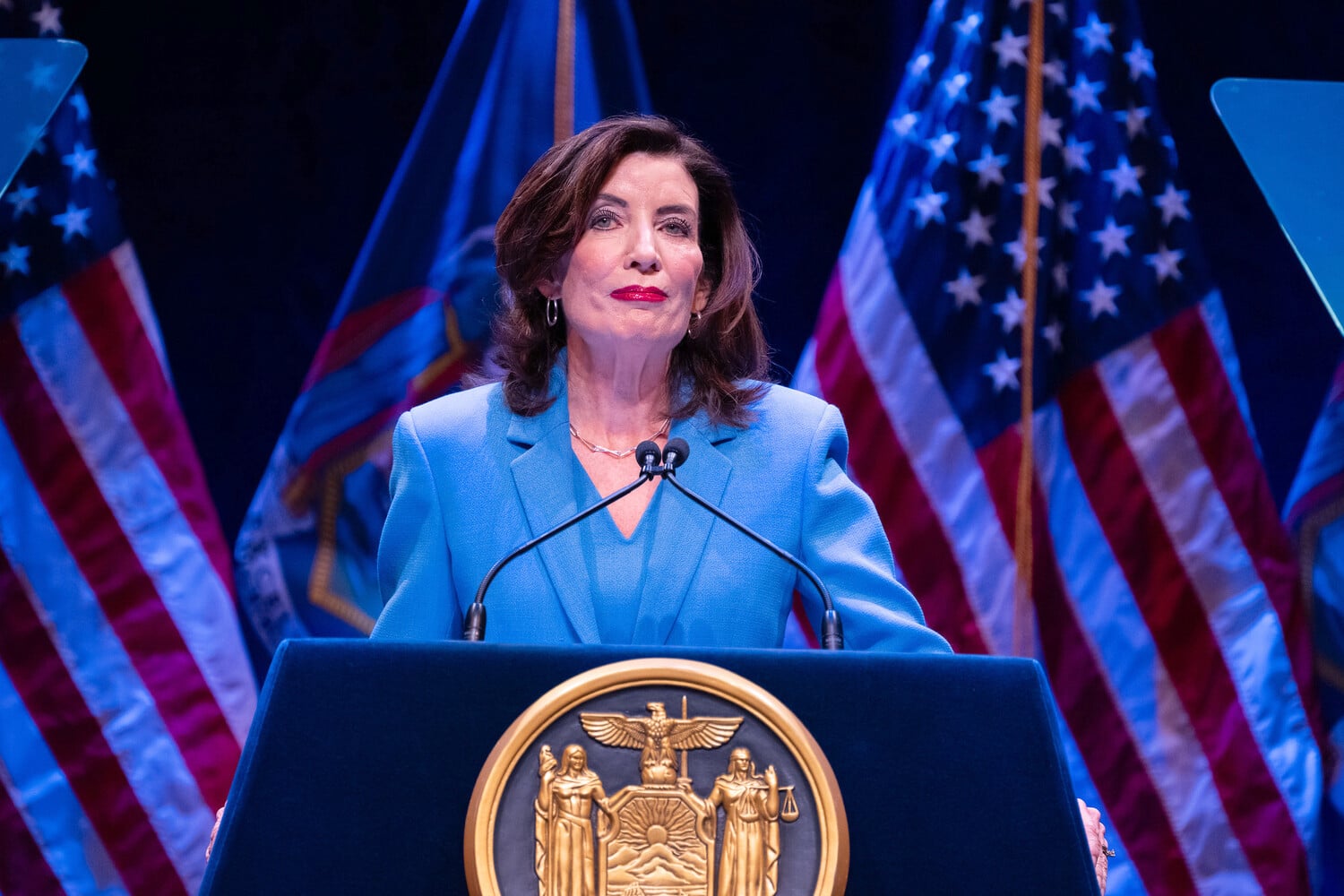
Governor Kathy Hochul laid out her agenda for an election year Tuesday in a State of the State address at the The Egg in Albany that lasted just under an hour. As expected, her focus was on affordability. “Whether we’re talking about child care, groceries, utility bills, one thing is clear,” Hochul said. “Parents, veterans, the disabled, seniors, they all need relief.”
Hochul sounded loose, often making jokes, occasionally needling President Donald Trump, often blaming him for everything from high prices to health care costs to delaying or killing renewable energy projects. “This is a real year of uncertainty, driven by reckless federal policies. Washington’s chaos is hitting our bottom line,” Hochul said. “But here’s the good news. We’ve built the boat to withstand the storm.”
Hochul announced an array of proposals – a path to universal child care; an effort to reduce auto insurance rates; new restrictions on minors’ social media accounts; and $500 million for new job skills training.
Here are some of the issues she touched on that most affect people in the North Country:

Gov. Kathy Hochul outlines her policy priorities in her 2026 State of the State address on Tuesday, January 13, 2026. Photo: Darren McGee/Office of Gov. Kathy Hochul
On childcare
Universal childcare was, predictably, a focus of Governor Hochul’s address. In fact, it was her first topic.
Since 2022, New York has poured $8 billion of additional investments into the state’s child care. Governor Kathy Hochul promised another $1.7 billion this year, and recommitted to her vision of universal childcare for every family in the state.
That won’t be coming in 2026, but expanded care for 2, 3, and 4 years old will in New York City.
In the rest of the state, the Governor is promising a slot for every four-year-old whose family wants it in the state Pre-K program, by 2028. She intends to do that by funding Pre-K slots at a uniform and higher level.
More immediately, she committed to an almost 50% expansion of the state child care subsidy program (CCAP), which will pay for more families childcare, and go a long way to matching funding to demand for CCAP, which has been a growing issue.
North Country communities could also be the site of pilot programs that would provide childcare to all families in certain lower-income areas, without any income limits or means testing.
On nuclear energy
Hochul said she is expanding her goals for nuclear energy development.
Last year, Hochul announced the state’s intent to build a new nuclear power plant in Upstate New York that would generate at least one gigawatt of power.
But in yesterday’s State of the State address, she said it won’t be enough to meet the state’s needs for zero-carbon energy to reverse climate change.
“If there’s one thing I believe, you go big, or you go home. So I’ve decided to raise the bar to 5 gigwatts. That’s more nuclear power that’s been built in the United States in the last 30 years,” Hochul said.
Nuclear power currently produces 3.4 gigawatts of energy in New York, about a fifth of its electricity.
The New York Power Authority recently announced a list of communities that have said they’re willing to host nuclear power plants, including Jefferson and St. Lawrence Counties.
The large amounts of power that nuclear plants generate can attract data centers because of their substantial energy needs. But Hochul said she doesn’t want tech to come at a cost to ratepayers or carbon reduction goals.
“If they want to build in New York, they have to pay their fair share for the power they use,” Hochul said in her speech. “But also, ultimately, I want them, if you’re going to come, they need to generate your own power independently, clean energy, not on the grid. Because we will not allow technology to undermine our infrastructure and raise costs for New Yorkers.”
A data center was proposed last year in Massena, but the project hasn’t gotten very far.
On affordable housing
The governor highlighted housing as another key part of her affordability agenda.
She promised an additional $250 million to help communities build affordable workforce housing, and $100 million to scale up a manufactured starter home project, which the town of Newcomb in Essex County served as a pilot location for.
But her biggest promise in the housing sector wasn’t about funding – it was about red tape. Hochul said she intends to make significant reforms to New York’s State Environmental Quality Review Act (SEQRA), which she said is holding up too many projects.
“When communities say ‘yes’ to housing, infrastructure, clean energy…we’re going to let them build. And when a town or city decides to move forward, they should not be stuck in regulatory hell,” said Hochul in her speech.
A smaller program that could have a large impact on North Country communities is the creation of a loan fund for the state’s 2000 mobile home parks. Those loans would specifically be for capital and infrastructure improvements, which are often financed through raised rents on trailer owners.
The proposed loan fund would provide park owners with affordable capital to finance improvements to septic and water systems, utilities, and roadways.
On K-12 education
Education played a smaller role in the Governor’s address this year.
For example, she made no direct mention of overhauling Foundation Aid, which is the way schools are awarded public funding. That’s something Hochul’s administration DID propose in 2024, to much criticism.
Instead, Hochul celebrated the new statewide cell phone ban in schools, enacted this fall, and the SUNY Reconnect program, which allows adult learners pursuing certain fields to go to community college for free.
Initiatives for the coming year focused on more social media controls for minors, AI regulations, and more mental health supports for students.
The proposal that could have the largest impact in schools statewide would be an updated math curriculum. Hochul wants a revamp of that, echoing changes the state made two years ago to the way early literacy and reading are taught.
On immigration enforcement
Immigration enforcement took center stage in the Governor’s address, as she pushed back against what she called “overreach” by the Trump administration in its immigration crackdown.
Hochul said an “unprecedented escalation” in recent federal actions has unsettled communities across New York, pointing to a series of recent incidents that have drawn public backlash. Among them was a U.S. Immigration and Customs Enforcement (ICE) raid at a dairy farm outside Sackets Harbor in March, where seven people—including three children—were detained.
Hochul also referenced the fatal shooting of a Minneapolis woman by an ICE agent earlier this month, an incident that has fueled national debate over immigration enforcement and the use of force by federal agents.
“Protecting New Yorkers also means this: standing up to ICE agents who abuse their power,” Hochul said in her address.
As part of a slate of new proposals, Hochul said she is backing legislation that would give New Yorkers the right to sue federal agents in New York state civil courts for alleged violations of constitutional rights. She said the bill would ensure immigration officials act within the scope of their authority.
“And when boundaries are crossed, accountability matters,” she said. “No one from the president on down is above the law. Let me repeat: No one.”
Hochul also introduced legislation that would require federal immigration officials to carry a judicial warrant when conducting enforcement actions in so-called sensitive locations—including houses of worship, schools and hospitals.
On outdoor accessibility
The Governor also rolled out a new initiative aimed at making New York’s state lands more accessible to people with disabilities.
The program, called “These Lands are for Everyone,” will invest in outdoor experiences designed to be more inclusive, especially for children and people with mobility or sensory disabilities.
Planned projects include tactile displays in the Adirondacks, sensory trails in the Catskills and a new education center at a nature preserve near Buffalo.
Hochul says the goal is to make sure New Yorkers with and without disabilities can experience the state’s parks and public lands.