
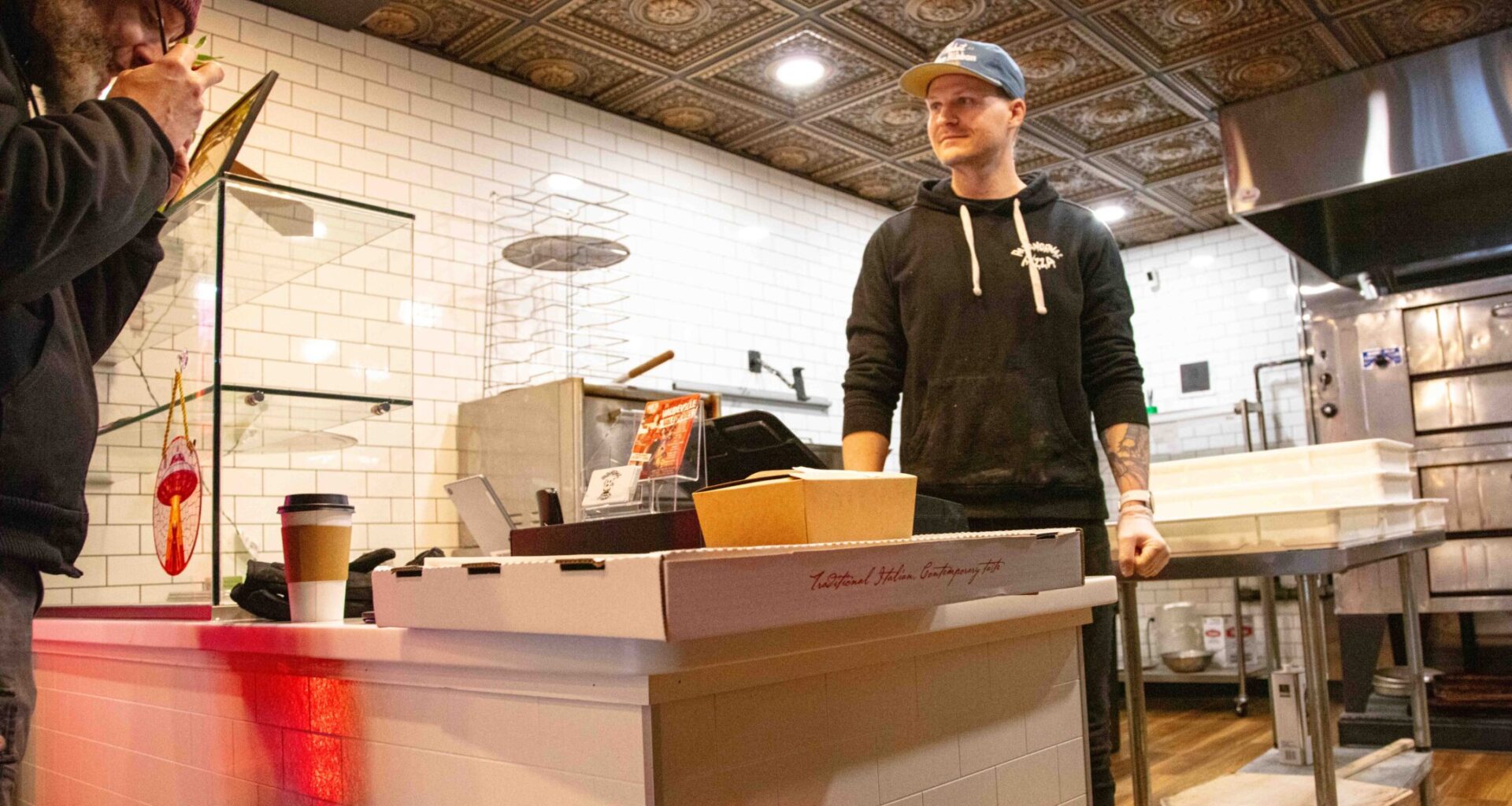
Brothers Marc and Joey Kubushefski, bored like many others during COVID, jumped on the trend of making sourdough bread in their kitchen.
That boredom soon turned into cravings. The brothers both loved pizza but couldn’t find vegan options to order near their home.
Stuck in his kitchen with little else to do, Marc Kubushefski decided to learn how to make vegan cheese.
So he did. Then came the homemade sauce. Soon after, enthusiastic comments began flooding Instagram, where he shared photos of his vegan pizza creation.
While Marc Kubushefski never imagined the pies going beyond his own kitchen, people began asking if they could buy them.
Before he knew it, his small home kitchen turned into a pizza operation. At first, he was delivering frozen pizzas to friends and neighbors. In March 2022, he opened Paranormal Pizza on Bethlehem’s North Side.
When a fire less than a year later derailed the business, the discovery of Rising Tide — a nonprofit loan provider located down the street — helped the brothers save it.
The beginning flame
Before the fire, and before the storefront, the brothers focused on frozen pizzas.
Demand grew so large they added two freezers, a second refrigerator and a large dough mixer, leaving little room to breathe.
That success led them to open hot pizza ordering on Mondays only. Every week, pizzas sold out in less than 15 minutes.
Each pie was named after characters from “The X-Files,” inspiring the paranormal theme behind the restaurant’s name.
The shop built a cult following through Instagram and loyal customers.
Then came the fire.
On Feb. 8, 2023, the business came to a halt and uncertainty set in.
“You’ve got insurance adjusters, landlords, and lawyers and everyone’s telling you what you should do,” Marc Kubushefski said. “Everyone said, ‘You’ll be back in business in six to eight months, just sit tight, and you don’t really have to do anything.’ So then six months went by, and nothing had really been done.”
To keep the brand alive, Mark Kubushefski said they bought a food truck and hosted pop-ups. But money was tight as they searched for a permanent location.
While researching funding options, the brothers discovered Rising Tide Community Loan Fund, a local nonprofit lender that provides capital to small businesses considered too risky for traditional banks. The organization also offers specialized guidance to help navigate financial decisions.
Rising Tide is a subsidiary of Community Action Lehigh Valley, a nonprofit focused on addressing housing, food insecurity and poverty.
Chris Hudock, the associate executive director for business development at Rising Tide, said smaller entrepreneurs in the Lehigh Valley are often rejected by traditional banks due to limited collateral, low credit history or industry risk, with restaurants considered among the riskiest.
Hudock said Rising Tide fills that gap by supporting low-to-moderate-income entrepreneurs bringing goods and services to the region.
“Sixty percent of the number of loans we do in a year, and 60% of the dollar amounts we lend in a year have to go to what is defined as a low-to-moderate income individual, or to businesses in a low-to-moderate income census tract,” Hudock said.
Despite that minimum requirement, Hudock said Rising Tide’s actual percentages exceed the standard.
That focus has earned Rising Tide certification as a Community Development Financial Institution from the U.S. Treasury.
One qualifying low-to-moderate-income census tract is the South Side.
Rising Tide offers four loan programs, including the Bethlehem Small Business Loan Fund.
Hudock said the fund serves as gap financing — meaning other funding sources are meant to be used alongside it — and ranges from $25,000 to $100,000.
Hudock said the fund was originally established by the city of Bethlehem using federal funds to attract small businesses before Rising Tide took over administration about 10 years ago.
Sean Ziller, Bethlehem’s deputy director of economic development and a member of Rising Tide’s board, said the transfer helped deliver capital to business owners more efficiently.
The fund continues to attract applicants due to low interest rates tied to federal funding, which Hudock said are lower than those offered by banks,credit unions and other Rising Tide products..
Paranormal Pizza received $100,000 from the fund while preparing to reopen on the South Side.
“The maximum amount was $100,000 for equipment, which was really helpful, and the interest rate was really good,” Marc Kubushefski said. “Rising Tide really helped us out with that.”
The brothers qualified, in part, because they chose to reopen on the South Side rather than the North Side, which falls outside a low-to-moderate census tract.
After exploring multiple locations, they settled on East Third Street.
Marc Kubushefski said rent matched their previous location, but the building required them to purchase equipment, adding a substantial cost.
Alex Miller, Bethlehem’s economic development coordinator, said the city has shifted tax incentive zones toward the South Side to help offset development and renovation costs.
“In the early 2000s, around the closure of the steel plant, there was a really heavy blanket approach to how the city incentivized development,” Miller said. “Replacing that loss of tax revenue was a large priority for previous administrations, so (Ziller) and I are able to really focus on the downtowns and small business support.”
As South Side incentives grow, Hudock said owners often need help making decisions before and after opening, which is where Rising Tide can lend support.
Beyond funding, the organization offers assistance, including business plans, cash flow projections and expense management.
“No one wants to see a small business fail, so that’s why we provide that technical assistance,” Hudock said.
He said Rising Tide has balanced startups and existing businesses since its founding, assisting 149 startups and 185 existing businesses.
Rising Tide also helps owners navigate zoning and permitting, which Hudock said many new entrepreneurs overlook.
Miller said his department works closely with business owners to help them understand municipal requirements, though many don’t realize support is available.
Marc Kubushefski said they encountered delays during an above-ceiling inspection. After passing two drywall inspections, the brothers failed a third because of a missing patch of drywall in the dish room, an area they believed had already been approved.
The issue delayed reopening by a month until the city approved the use of fire-resistant paint, increasing costs.
Marc Kubushefski said loans from both the Bethlehem Small Business Loan Fund and Rising Tide’s small business loan, helped cover those expenses. He said Rising Tide’s local presence made the process easier than working with national lenders.
Hudock said Rising Tide’s independent loan fund offers up to $150,000 and funded seven loans in 2025, matching last year’s pace.
As the brothers expand business hours after a nearly 15-month recovery, they credit Rising Tide’s support for helping them reopen.
“Rising Tide was a better fit, with better interest rates, and it was local, too, over other banks,” Marc Kubushefski said. “They could meet our needs, and everything was done right here in Bethlehem, so it made the most sense to go with them.”