
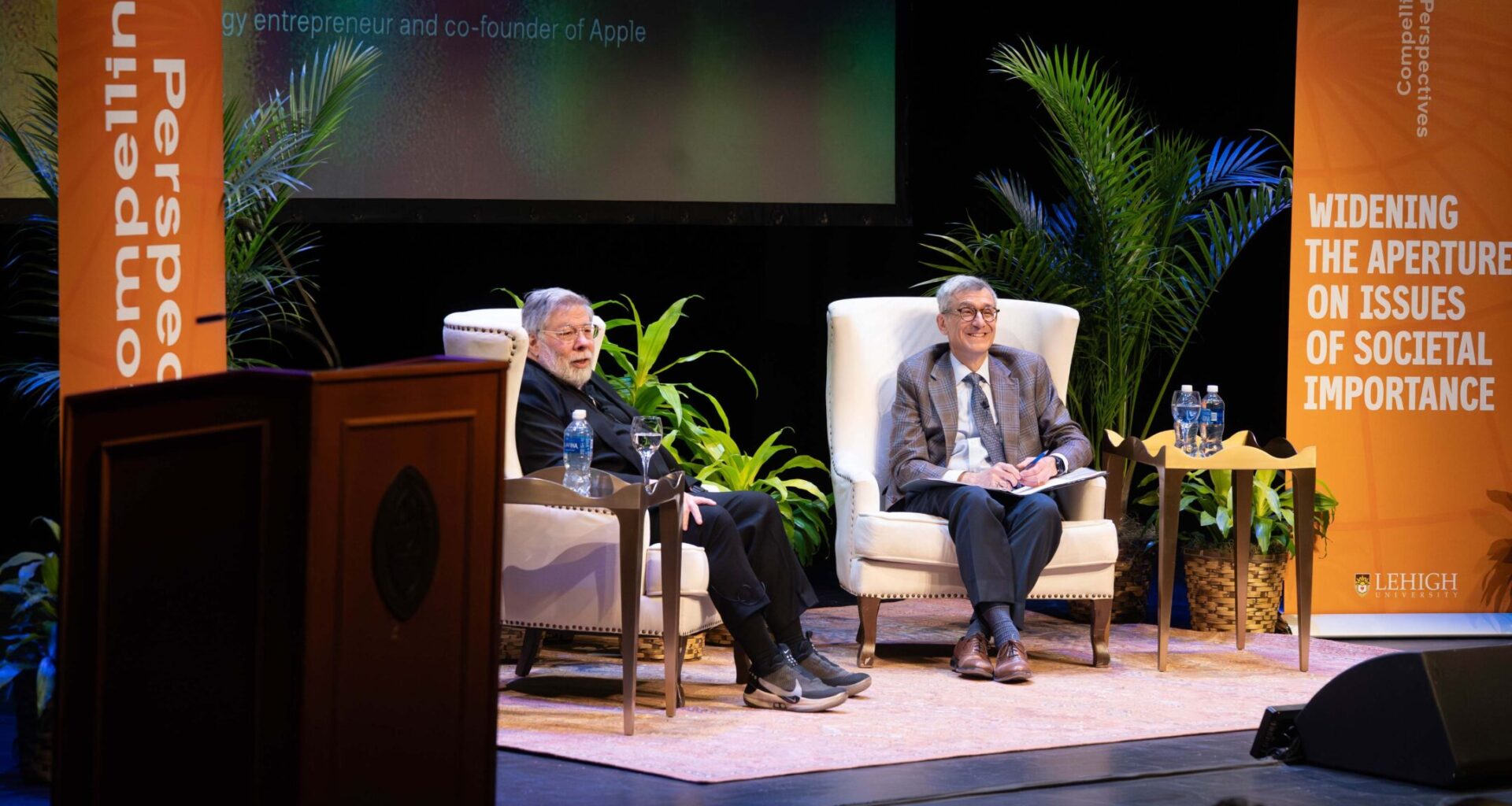
On Thursday, Steve Wozniak, an entrepreneur, author and co-founder of Apple, spoke at Lehigh University’s Compelling Perspective Series in Baker Hall at Zoellner Arts Center to share his thoughts on artificial intelligence and technology.
The series aims to broaden discussions around issues of societal importance by encouraging open conversation and bringing speakers to campus to engage with students and faculty. This year’s theme is “AI: Innovation, Responsibility and the Future We Shape.”
Wozniak spoke about his early interest in technology and how it influenced his career in computer engineering.
In eighth grade, Wozniak built his first digital computer.
He began learning about circuits and how electrons work in fourth grade. As an eighth grader, he competed in an electronics contest for high school students and won the top prize in San Francisco.
It was also in school that Wozniak stumbled upon computer journals and discovered the world of “zeroes and ones” for the first time.
“It was the language of computers, and I would learn how to add them,” Wozniak said. “It was like a crossword puzzle, and I said, ‘this is going to be my passion for life.’”
That early interest led Wozniak to design and patent the Apple I and Apple II computers, along with two other Apple products.
Growing up in San Jose, Calif., in the 1950s and ‘60s, Wozniak said Silicon Valley looked completely different from how it does today.
Wozniak said he recalls riding his bike through apricot, cherry and plum fields that stretched as far as the eye could see.
Despite the rural landscape, he said a love for electronics was common among children in his neighborhood.
His father, an electrical engineer, served as an early inspiration. Watching him work through formulas on paper and learning about electron movement, orbitals and resistance, Wozniak said he decided early on he wanted to follow the same career path.
Wozniak said he once told his father he planned to own a 4K Data General computer because that amount of memory was the minimum needed to solve programming problems.
“My dad said it cost as much as a house,” he said. “(I told him) I’ll live in an apartment.”
Wozniak said he spent much of his free time studying manuals and computer parts, designing chips for every computer model he could imagine.
He taught himself as his knowledge surpassed his father’s and experimented with whatever inexpensive parts he could find.
“I would talk about electronics with half the kids in the small, two-block area development with electronic parents, who had mayonnaise jars full of little parts,” Wozniak said.
Using one of the switches, Wozniak said he once set up a prank on an unsuspecting high school student.
He placed a running metronome in his locker and connected a switch to the lock so that when the locker opened, the metronome sped up. Wozniak said he had to hide his laughter when he was ultimately called into the principal’s office for the joke.
He said he played pranks throughout middle and high school, often aiming to pull “smart pranks.”
Wozniak attended a community college in Colorado because his parents could only afford one year of out-of-state tuition. After his sophomore year, he took one year off to work. During that time, he designed and built his first computer.
Wozniak said he took a year off from school to work, and during that time, executives he worked with learned that he designed computers. Because he couldn’t afford the expensive chips himself, one executive used industry connections to secure the parts, allowing him to design a new computer from scratch.
He built the computer with help from his friend Bill Fernandez and was later introduced to Steve Jobs in Fernandez’s garage.
Wozniak said Jobs was younger and a “hippie,” but the two quickly admired each other.
“(Jobs) knew I could design computers, and he knew that was valuable expertise and appreciated me, and that made him my best friend,” Wozniak said. “I was so shy, I didn’t have any friends so anyone who understood me was a good friend.”
Wozniak said the two drove to concerts together and bonded over their shared love of Bob Dylan.
In 1975, Wozniak worked on the design that would become the Macintosh, the first color personal computer.
At the time, California’s arcade game industry was booming, but games were black and white. Wozniak said he began wondering what it would take for arcade games to be displayed in color.
That question led him to explore how computer numbers could be used to code color on a TV screen.
He said by sending computer data made up of ones and zeroes through wires in four-bit groups, each combination could be translated into a different color on a TV screen.
Wozniak said that idea inspired Apple’s original six-color logo.
When Apple was founded, Wozniak said he never imagined the company would grow to its current scale. The goal, he said, was to build better products that improved human life.
Wozniak said while early computing allowed people to fully own and run their systems, the rise of the internet and cloud-based technology has reduced those benefits.
“Then came the internet, and it turned out so beautiful at first, but such a problem later,” Wozniak said.
He said the ability to choose what to post on social media and which apps to download reflects individual autonomy and creativity.
Wozniak said AI pulls information from existing sources without crediting the original creators and reproduces it without the intuition or understanding of humans.
Wozniak said he’s glad Apple has been slower to adopt artificial intelligence.
AI doesn’t have the capacity to understand and analyze information the way humans do, he said, adding that users should question every AI-generated output.
An attendee asked Wozniak about the role of world leaders in regulating AI.
“How important do you think it is to have the right leaders as more capable AI systems emerge, and what does that leadership look like on the national level as it relates to AI?” she asked.
While technology isn’t necessarily “controllable” right now, Wozniak said there should be clear sourcing behind AI inputs and outputs. He said AI systems should allow users to trace information back to its original sources, with built-in tracking to reduce the risk of misuse or illegal activity.
Throughout the discussion, Wozniak emphasized the importance of humanizing technology and prioritizing innovation.
When reflecting on Wozniak’s life work, President Joseph Helble asked what he was most proud of.
“I did not want to get rich,” Wozniak said. “I did not want to start a company. I wanted other engineers to look at my designs and see that I was a different engineer. I taught myself things differently than in the books.”
Ed Mullen, a computer engineer at Intel, asked Wozniak for advice on turning vision into reality.
Wozniak said there’s no formula for success.
“There are engineers that know things and can do things very well, but there are also inventors,” Wozniak said. “Inventors just have a different kind of spirit. When an idea comes in their head they want to run in a laboratory and try to hook it up and make something out of it.”