
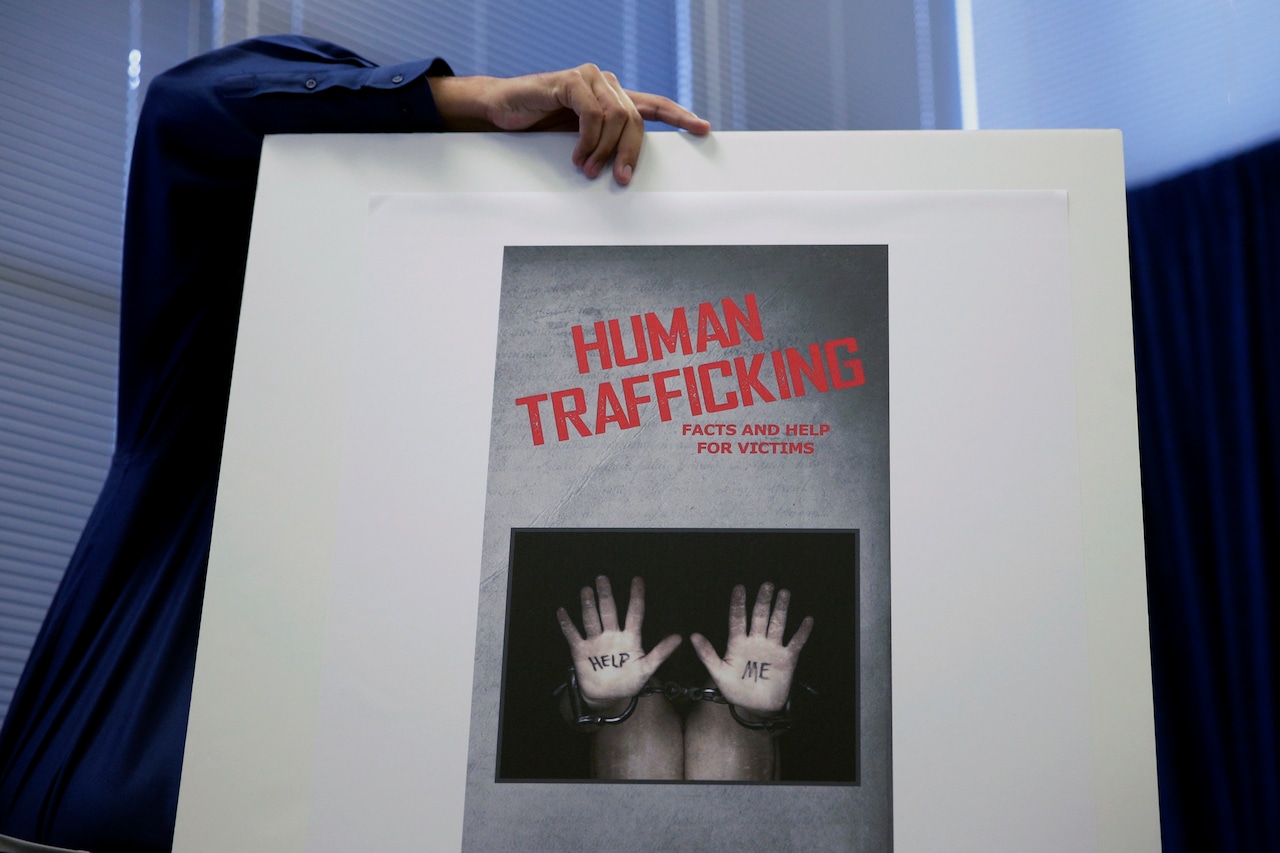
According to the U.S. Department of Homeland Security, human traffickers victimize an estimated 27.6 million people worldwide.
Some of those 27.6 million victims could be in the Lehigh Valley. According to local prosecutors, they have been in past cases.
To try to combat this ongoing issue, local leaders believe the community should be aware and know the signs.
Easton City Councilman and Vice Mayor Frank Pintabone hosted a human trafficking awareness panel Thursday night at the Boys & Girls Club of Easton.
Several panelists, all with varying experiences, discussed how trafficking manifests locally and how it is addressed in the region.
Captain Salvatore Crisafulli of the Easton Police Department said human trafficking today is often difficult to identify because it has largely moved out of public view.
“It’s almost entirely underground, online, arranged where nobody can see it, and they meet up in private, often at hotels,” he said.
According to the Department of Homeland Security, 78% of sex trafficking victims are women and girls while 22% are men and boys. Within forced labor specifically, 33% are women and girls and 67% are men and boys.
Stephen Baratta, Northampton County’s district attorney, emphasized that trafficking is frequently misunderstood and does not require victims to be smuggled across borders.
In many cases, victims of human trafficking are immigrants in the country illegally that are working under harsh conditions. They are threatened with Immigration and Customs Enforcement if they don’t comply with the working conditions, including forced labor and forced prostitution under very minimal pay.
Baratta explained that trafficking centers on exploitation and control, whether for sex or labor, and can occur entirely within a single community or even a single household.
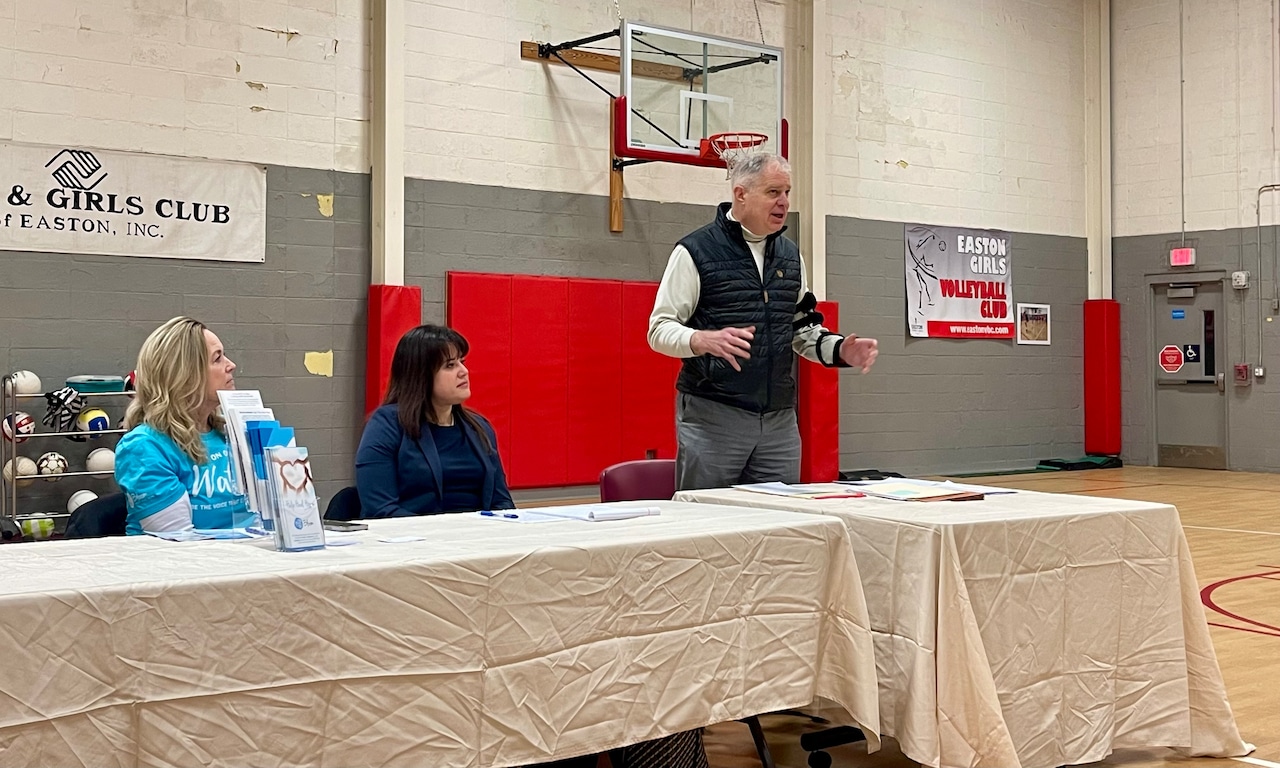 Stephen Baratta (right) discusses signs of human trafficking and common cases where human trafficking occurs during at panel at the Boys & Girls Club of Easton.Chelsea McClure | For Lehighvalleylive.com
Baratta noted that labor trafficking is common in low-wage industries such as construction, domestic caregiving, dishwashing, nail salons, and massage parlors. He said these factors are only potential indicators and should not be treated as proof or used to justify profiling.
Adrianne Doll, a former Northampton County assistant district attorney who now prosecutes cases involving licensed professionals for the Pennsylvania Department of State, outlined warning signs for human trafficking.
These include workers unable to produce state licenses, violations of professional standards or indications that employees may be living inside the business
“Women are coming to the U.S., usually through some sort of larger scale organization, and they’re being told, ‘You cannot have your documents back. You have a $10,000 debt, you need to work it off in order to get the documents back,” Doll explained.
She said in many cases, women are in their 40s, 50s and 60s and forced to live in their places of work.
Crisafulli said Easton police officers receive regular training to recognize trafficking indicators and are taught to view prostituted individuals primarily as victims rather than criminals. He added that officers now rarely make prostitution arrests and instead focus on identifying exploitation and connecting individuals to appropriate resources.
Once trafficking is suspected, Baratta explained that cases often begin under Pennsylvania law and may proceed through Northampton County courts. Federal authorities, including Homeland Security Investigations, may assist or adopt cases when interstate activity or stronger federal penalties apply.
Baratta clarified that local prosecutors and police focus on public safety rather than immigration enforcement and generally do not refer victims to immigration authorities. He said ICE operates separately from county prosecutions.
Doll described how complex trafficking cases can be, pointing to a major Northampton County prosecution in which a trafficker used dating apps, emotional manipulation, drugs and sexual violence to exploit multiple women. The case involved numerous victims and witnesses and ultimately resulted in a conviction and prison sentence.
Baratta explained that human trafficking and drug trafficking often intersect, with traffickers using drugs as a control tool. Many people being trafficked are already addicted, making exploitation the condition for feeding their addiction.
Others are not addicted at first but are drugged or given substances during what they believe will be a normal date or social encounter. Once they are under the influence, they are assaulted and then coerced into human trafficking.
Another piece of human trafficking is victims who are minors.
“Any minor who’s exploited for any reason, that’s considered involuntary servitude,” Baratta said.
Baratta said children are often victimized by predators who groom and solicit them online. He said many individuals who work in law enforcement, who see the dangers of online access first hand, restrict social media use.
“There’s no safe way to allow your child to have unlimited access without any type of supervision on social media,” Baratta said. “A lot of good parents, who work hard and do the best they can to raise good, productive children, don’t understand the danger of allowing them to have a cell phone, because all their other friends have cell phones.”
Once law enforcement identifies human trafficking victims, there is a road to recovery. Carol Andersen is the chief executive officer of Bloom, a nonprofit serving trafficking survivors in the Lehigh Valley focused on the long-term recovery process for victims.
She explained that trafficking often begins with vulnerability, including poverty, addiction, coercive relationships and systemic failures, rather than free choice.
“This is a crime that has affected more people than we would believe, and that while the majority are women, there are many men, children, LGBTQ+ youth that are at incredibly great risk,” she said. “I think we’re only beginning to, as a society, understand some of the complexities that victims experience.”
Andersen said Bloom operates multiple safe homes where women can stay for up to two years at no cost while receiving trauma-informed support, mental health services, substance use assistance, and help accessing education and employment. She noted that survivors define their own healing process and that recovery is often non-linear.
While Andersen said many survivors never experience courtroom justice, she emphasized that many find other forms of restoration through rebuilding their lives, pursuing careers and becoming leaders in their communities. She added that employment pathways have significantly improved program retention and long-term stability.
Speakers encouraged residents to report concerns through appropriate channels rather than attempting to intervene directly. They noted that trafficking thrives in silence and is best addressed through coordinated efforts. If someone is in immediate danger, witnesses should call 911.
For suspected human trafficking activity, panelists urged filing a professional licensing complaint through the PA Department of State, or contacting the local police non-emergency number.
“If you see something, say something,” Doll said. “It’s better for you to be wrong rather than just ignore it.”