
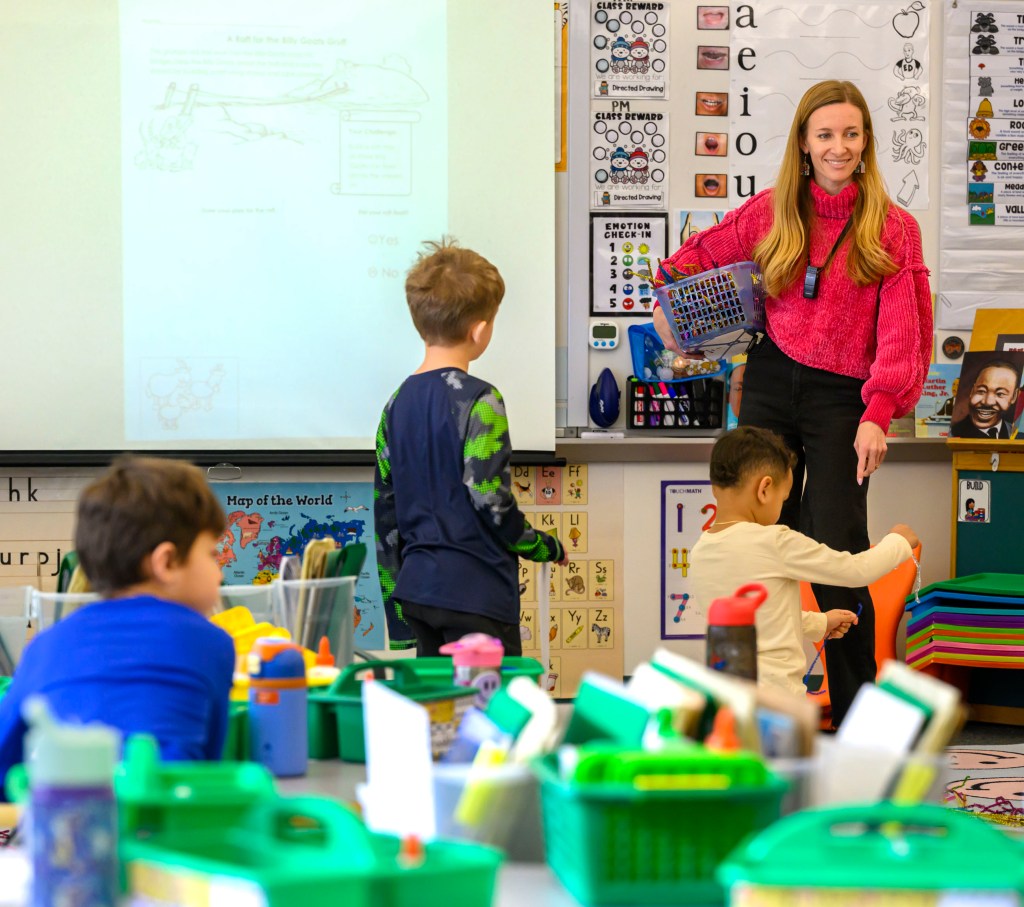
Play kitchens and mock cash registers are among the wish-list items Southern Lehigh kindergarten teachers have requested as they work to integrate “purposeful play” into the new full-day kindergarten program that launches next school year.
Southern Lehigh School District is the last of its Lehigh Valley peers to expand to full-day kindergarten, and registration for next year’s classes opens Sunday.
Teachers and district curriculum leads said the expanded kindergarten day will allow time for unstructured play that builds social skills and helps students regulate their emotions.
Students need to learn how to problem solve, and play that involves teamwork develops both self control and resilience, said Nancy Smillie, a veteran kindergarten teacher who’s been at Hopewell Elementary for 24 years.
“The critical thinking is important cognitive development, and that’ll help in all the academic areas,” Smillie said.
Kindergarten teachers from both Hopewell and Liberty Bell elementary schools told The Morning Call that visits to other school districts, including East Penn, have been helpful in understanding how skills that are explicitly taught in teacher-directed lessons can be emphasized through play.
“We teach these skills, but there’s not a lot of time to practice everything,” Smillie said.
The transition to full-day kindergarten also means moving third graders to the intermediate school, a change that has motivated some parents to express nerves at school board meetings.
Southern Lehigh parent Jamie Caverly will see both sides of the transition, with an incoming kindergartner set to start at Hopewell Elementary and a rising third grader ready to transition to the intermediate school.
Caverly’s emotional investment in her children’s school communities shone through as she talked about the change to come.
“We love Hopewell so much — they are a very close-knit, wonderful school community, so I’m sad that my daughter doesn’t get the fourth year there,” Caverly said, “but I’m not nervous because my son’s already at the intermediate school, and I know that they’re a great school as well, and they’re preparing very nicely for the third grade to move up there.”
Caverly lobbied school board members to switch to full-day kindergarten after realizing her daughter, a second grader with an individualized education plan that supports her special needs, could have benefitted from a longer kindergarten day with more opportunity to build soft skills.
“Our school district has always been top-notch with academics, so it just kind of now puts it all together,” Caverly said, calling full-day kindergarten “the final missing puzzle piece.”
Caverly has been advocating for the change for two years, but district discussions trace back at least a decade, when Southern Lehigh piloted a full-day program for a limited number of kindergartners who were not meeting learning targets.
Fellow full-day kindergarten advocate Julie Bird, the mother of a first grader and a fourth grader, said “the soft skills of life” taught through play are “as important as learning letters and numbers, learning to read.”
Advantages of full-day kindergarten
Implementing full-day kindergarten in Pennsylvania is up to individual school districts. According to a 2020 study by the American Institutes for Research, student enrollment in full-day kindergarten programs grew from 68% in the 2009-10 school year to 81% by 2018-19.
The study found that students in full-day kindergarten programs exhibited more confidence and were better prepared for later grades than those in half-day programs. Cost is a major barrier, however; full-day kindergarten programs cost more in material, classroom equipment and staff, the study found.
At Southern Lehigh, the expanded schedule will spread out learning from 9 a.m. to 3:30 p.m. instead of limiting kindergarten teachers to a two-and-a-half-hour window, Smillie said.
Adding recess and lunch will provide students with different opportunities to solve problems, said fellow veteran kindergarten teacher Kim Oakes, who’s been at Hopewell for 30 years.
There will also be time to integrate social studies and science into the school day, said Tamara Solometo, the district’s director of curriculum and instruction.
Students should move on to first grade better versed in content and better able to work together, Solometo said.
Solometo is letting teachers take the lead in suggesting what equipment is needed to make sure all kindergarten classrooms have well-stocked play areas.
Wish-list items teachers mentioned range include toys like trucks, blocks and Play-Doh, and interactive pieces such as dollhouses, kitchens or puppet theaters.
Next year’s curriculum will feature an updated version of the district’s reading program, and a new math program is coming soon, Solometo said.
Kindergarten teacher Megan Valley, in her 10th year at Liberty Bell, said curriculum tends to be written for a full-day model and whittling the activities down can be a lot of work.
“We’re not going to have to cut things to fit the half day,” Valley said.
Having all students on a full-day schedule will also mean that school assemblies need only run once, which should save money and time and minimize disruption for gym classes, Hopewell parent Bird said.
Liberty Bell Principal Brian Mansfield said he’s excited to see what schoolwide traditions he can create now that the whole school will be in the same building at one time.
As a former third grade teacher, Mansfield said he’ll miss those students when they move to the intermediate school, but he said they’re moving alongside teachers who are prepared.
“There’s nothing more important than great teachers,” Mansfield said.
The district’s kindergarten teachers have created a half-day program to be proud of, Oakes said, emphasizing that she doesn’t want families who have gone through that model to feel short-changed.
“We did 110% in our half day,” Oakes said.
Although Oakes said she’d miss having a double roster of students, Smillie said she’s happy to be able to focus on a smaller number of students.
“It doesn’t change our teaching, in our intuition and instincts of teaching,” Smillie said. “We’ll just have a chance to actually — have a chance to really implement it.”