
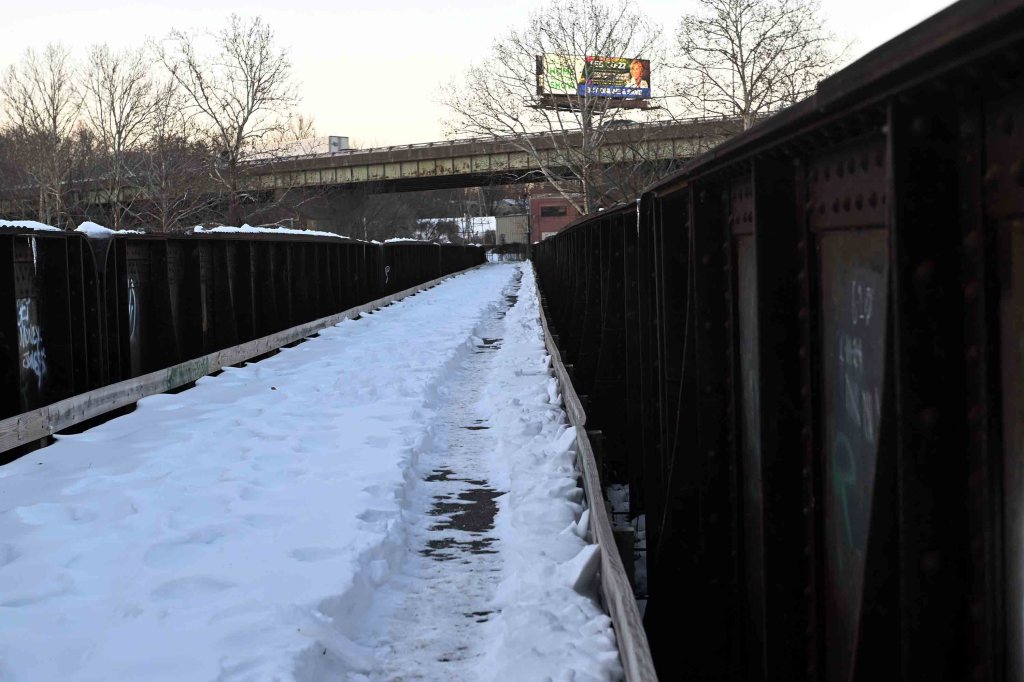
From musical railings and glowing air-quality lights to murals, sculpture and even planetarium-style overhead effects, community members pitched bold and sometimes whimsical ideas as they gathered to help reimagine the Reading Gateway Bridge.
The roughly 400-foot pedestrian span carries the Schuylkill River Trail across the river. Owned by Berks County, it is used by thousands of walkers, runners and cyclists each year under a trail easement held by the Schuylkill River Greenways Association.
The association partnered with community transformation organization Barrio Alegria to host the brainstorming session Thursday night at the WCR Center for the Arts, 140 N. Fifth St.
About 30 participants offered ideas ranging from art installations and creative lighting to performance spaces and interactive environmental displays.
The early stage effort will help guide future design concepts and funding efforts, organizers said.
While the bridge is structurally sound and well-maintained, noted Elaine Schaefer, Greenways executive director, its tall steel sides make it less welcoming than it could be as a gateway feature.
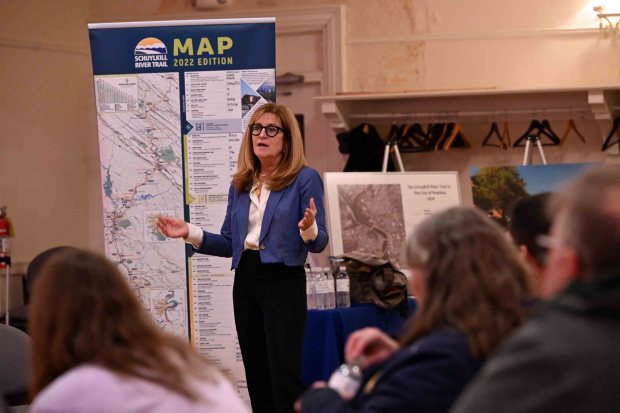 Elaine Schaefer, Schuylkill River Greenways executive director, described the Schuylkill River Trail as a growing region asset during a meeting Thursday, Jan. 29, 2026, at the WCR Center for the Arts, 140 N. Fifth St., on redesigning the Reading Gateway Bridge. (BILL UHRICH/READING EAGLE)
“This is exactly what we want,” Schaefer said referring to the meeting and speaking to those gathered in the WCR Center’s auditorium. “We want the community to come out and be a part of it. This (the bridge) is to be the brainchild of the community.”
Schaefer described the trail as a growing regional asset, noting that it stretches 120 miles from Philadelphia into Schuylkill County.
Connecting sections nearing completion are expected to bring more users into Reading where the bridge should become a more memorable and inviting entry point, she said.
“You should see it and be like, ‘Cool, we’re at Reading,’” Schaefer said.
Emphasizing the community-led approached, Daniel Egusquiza, Barrio’s executive director, guided participants through an engaging and interactive dreaming session. He asked them to move around the room to signal support or opposition to various concepts and to think creatively without worrying about constraints.
“Today is just a dreamy collection of ideas,” he told the group. “We are not designing the bridge today.”
During the session, safety and visibility emerged as top priorities.
When Egusquiza asked whether lighting should be included in a redesign, most participants said yes, though several urged a balanced approach that avoids adding to light pollution and disrupting the nearby natural habitat.
“I think that lighting could be done tastefully, but I wouldn’t want it harsh white,” one attendee said, while another noted the bridge is one of the few darker areas where trail users can still see the stars.
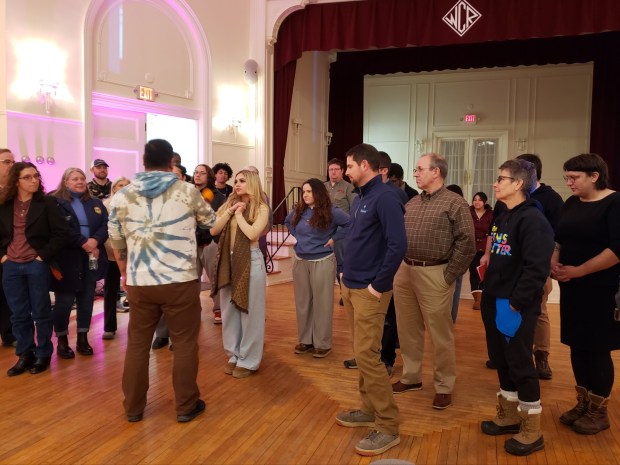 Daniel Egusquiza, Barrio Alegria executive director, gets participants on their feet during a meeting at the WCR Center for the Arts, 140 N. Fifth St., on Thursday, Jan. 29, 2026, about redesigning the Reading Gateway Bridge . (MICHELLE LYNCH/READING EAGLE)
Many participants supported modifying the bridge walls to allow views of the river. Others said any openings should be designed carefully to maintain a sense of security.
When asked whether the bridge should include an artistic component rather than remain purely utilitarian, nearly all participants favored art in some form.
Suggestions included large murals by local artists, sculpture installations, storytelling panels and culturally themed designs that reflect the city’s diversity.
Several suggested art installations at both ends of the bridge to draw people across rather than encouraging them to stop at one side.
Other ideas were more experimental and included musical elements that sound as people move across the span, air and water quality indicators displayed through colored lights, bird-themed features with call whistles and nest shapes and even planetarium-style overhead effects.
Several attendees also recommended adjacent creative spaces, such as small performance areas, seating zones or interactive installations.
Organizers said the notes collected will be grouped into design themes and used to develop preliminary concepts. Two or three additional public meetings are planned over the next three months, along with volunteer committees and community surveys, before any final designs are selected and funding pursued.