

Arnie Weissmann
On the whole, domestic tourism performed dismally last year. Tourism officials across the country are hoping, as they go to work every day, that they won’t see data suggesting 2026 will be a repeat of 2025, akin to Bill Murray’s repetitive predicament in the film “Groundhog Day.”
Last month, I received an invitation that included an opportunity to get insight into how domestic tourism officials are feeling at this relatively early point in the year. I would be able to speak with Rick Siger, Pennsylvania’s secretary of community and economic development, and Kaitie Burger, the state’s executive director of its tourism office.
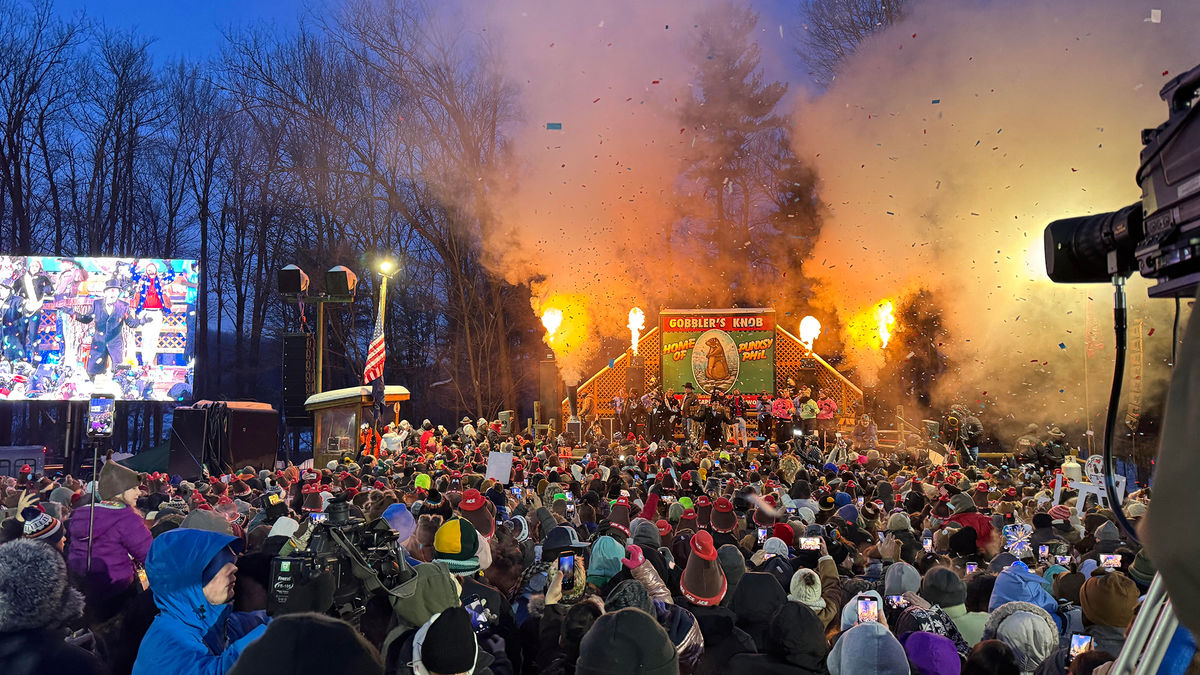
And given fears that 2026 might mirror 2025, it couldn’t be in a more appropriate locale and time: Punxsutawney, Pa., on the eve of Groundhog Day.
We sat down at the local Fraternal Order of Eagles aerie, where rodent weather forecaster Punxsutawney Phil was also in residence for a photo op with members of the local Groundhog Club. The event was a reminder that this is a very geospecific celebration. Although groundhogs are found from Alaska to Georgia, Americans nationwide only care whether one of these critters, living in Punxsutawny, sees his shadow, a notoriously unreliable indicator of whether winter will last another six weeks.
While the accuracy of Punxsutawney Phil’s forecasts are averaging about 38% — a coin flip would be an improvement — both Siger and Burger were making relatively strong predictions. They weren’t cautiously optimistic; they were downright sunny.
Last year, the state performed better than most. The country as a whole saw international visitation drop about 5% last year, but Pennsylvania’s rose 1.2%. That’s particularly impressive because northern states bore the brunt of the 25% drop in Canadian arrivals nationally. Indeed, Burger confirmed that the dip in Canadian visitation hit the state’s northwest and Lake Erie regions particularly hard.
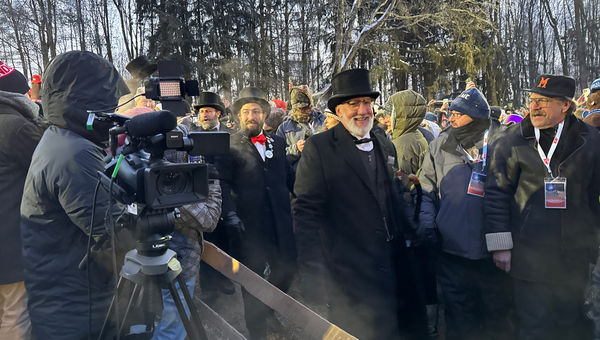
Tom Dunkel, president of the Groundhog Club’s Inner Circle, arrives in Gobbler’s Knob on his way to knock on Punxsutawney Phil’s burrow, where he received the news that winter will last another six weeks.
Tourism is big business in Pennsylvania. Siger put its economic impact at $84 billion. How did the state protect this economic engine? Unlike the federal government, which slashed the Brand USA budget by 80% last year, the state had doubled its tourism budget in 2024 to $30 million and maintained that level in 2025. While that lift was an initiative of Siger’s boss, Gov. Josh Shapiro, the secretary said tourism is supported “on a bipartisan basis. It’s important to folks on both sides of the aisle and both chambers.”
And for 2026, the state has secured an additional $50 million, one-time boost in funding to take advantage of an impressive list of special events across the state, which Burger said included the NFL draft, FIFA World Cup matches, the PGA Championship, Major League Baseball’s All-Star Game and America 250 events in Philadelphia.
Far from reducing promotion to international visitors, as Brand USA was forced to do, the state revved up an international campaign titled “Pennsylvania, the Great American Getaway.”
Addressing the challenge that has vexed other states seemed pretty straightforward to Pennsylvania officials: To attract visitors in a very competitive tourism marketplace, promote the destination.
It’s ironic that the state responsible for the Groundhog Day metaphor of being stuck in a repetitive cycle appears to be the state with the best recipe to prevent that.
The benefit to Punxsutawney (population: 5,600) itself for hosting Groundhog Day is, at a smaller scale, still significant. Burger said the event generates approximately $1 million annually. Visitors from almost every state and 46 countries bought tickets to various Groundhog Day-related activities this year. (My hotel was a 45-minute drive away, an indication that the celebration’s benefits are, to some extent, regional.)
Many of the traditions in the movie, such as the top-hatted committee responsible for organizing the event, are evident during the festivities. But set-jetters who loved the movie’s depiction of Punxsutawney, beware: Groundhog Day was actually filmed in Woodstock, Ill.
I reached out to that town’s chamber of commerce and asked whether Woodstock saw any economic benefits resulting from being the movie’s locale.
“Fans travel from across the country (and internationally) to see recognizable landmarks featured in the film,” replied Brenda Grisolia, the chamber’s member services and event coordinator. “We host an annual multiday Groundhog Days celebration each February that draws thousands of visitors, along with year-round tourism tied directly to the movie’s legacy.”
Perhaps Groundhog Day’s economic benefits are not as geospecific as I thought.
This morning, I got up at 2:30 a.m. and stood for almost four hours in subzero and single-digit temperatures only to hear that Punxsutawney Phil predicted more of the same for another six weeks.
For those states seeing data that suggests its economic pain, too, will linger, it’s good to keep in mind that, to get to Groundhog Day’s happy ending, the protagonist of the film had to learn some lessons and change his ways. For states also wanting to change their ways, I think Pennsylvania is providing a pretty good roadmap.