
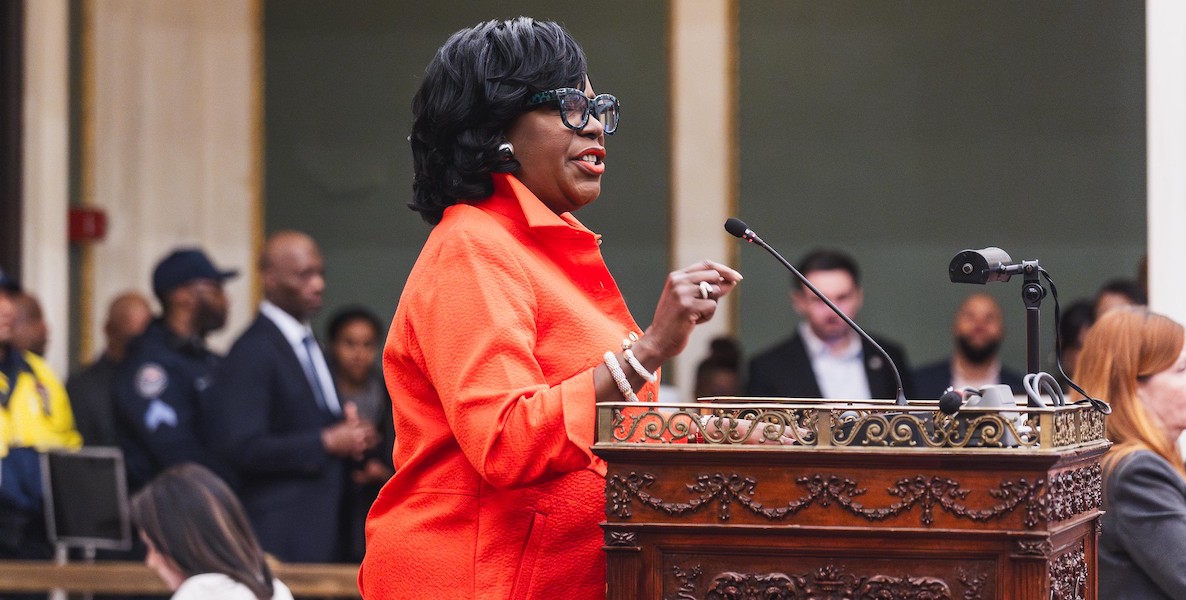
The first funds for Mayor Parker’s H.O.M.E. plan are coming online — $2 billion toward 30,000 units — the most ambitious housing investment Philadelphia has made in decades. It’s the right scale of ambition. It’s also the moment to ask a question we’ve avoided: Who is responsible for telling Philadelphia, year after year, whether its housing system — the stock, the households, and the conditions that keep homes occupied — is holding together?
Philadelphia knows how to do this in other domains. The Pennsylvania Intergovernmental Cooperation Authority (PICA), created after the 1991 fiscal crisis, doesn’t run programs or advocate for policy. It monitors the city’s fiscal health across administrations.
Pew’s Philadelphia research and the Economy League of Greater Philadelphia play similar roles — producing independent analysis that policymakers rely on regardless of who’s in office.”
Housing has no equivalent
In New York, the NYU Furman Center publishes an annual State of New York City’s Housing and Neighborhoods report, tracking conditions over time, regardless of political leadership. It doesn’t make decisions. It makes reality legible. Philadelphia has plans, programs, and partners producing valuable research. What it lacks is a recurring, independent account of housing system health that shows where stability is holding, where it’s fraying, and where investment is and isn’t reaching.
The scale of what sits outside our systems makes this urgent. The Federal Reserve Bank of Philadelphia estimates the region’s home repair backlog at $3.7 billion. Nearly 37 percent of owner-occupied homes and 41 percent of rentals need repairs, with 40 percent of those costs concentrated among lower-income households. A PlaceEconomics analysis found that 67 percent of Philadelphia’s residential buildings were constructed before 1950 — roughly 400,000 structures. Black and Hispanic Philadelphians are disproportionately housed in this older stock. It’s where naturally occurring affordability lives, and where deterioration compounds. It’s affordable not because of policy, but because of age, and that affordability disappears when the home does.
H.O.M.E.’s 30,000 units matter. But they represent a fraction of what’s needed across a housing system this large.
This is not a failure of effort. Philadelphia has one of the most developed home-repair ecosystems in the country: the Basic Systems Repair Program, Whole-Home Repairs, Habitat for Humanity, Rebuilding Together, CDC networks, and more. Consider Built to Last, the Philadelphia Energy Authority’s program that coordinates repair, weatherization, and energy improvements for low-income homeowners. It’s well-designed and effective. It has a waitlist of over 2,600 households. Built to Last sits outside H.O.M.E.’s current structure — one example of how programs operate in parallel rather than as a coordinated system.
Philadelphia has plans, programs, and partners producing valuable research. What it lacks is a recurring, independent account of housing system health.
The stakes go beyond the buildings themselves. New research from Harvard’s Opportunity Insights confirms what this scale implies. A study of the federal HOPE VI program found that what improved outcomes for children in revitalized neighborhoods wasn’t nicer buildings. It was the social fabric, cross-class friendships, access to networks, exposure to different aspirations. Each year a child spent in a transformed neighborhood translated to roughly 3 percent higher adult earnings. Housing is infrastructure for opportunity. But tracking whether investment is producing those conditions, or whether gains in one place are offset by quiet deterioration elsewhere, requires attention the current system isn’t designed to provide.
The problem is that these programs operate in silos, with their own intake systems, eligibility rules, and funding cycles. Residents bounce between them. Capacity doesn’t match need. And no one tracks the cumulative gap between what programs deliver and what the housing stock requires.
H.O.M.E. is a delivery mechanism, and a significant one. But delivery is not diagnosis. It deploys capital after needs are identified. It’s not designed to track cumulative risk, spot early warning signs, or ensure intervention arrives before a home slips into vacancy. These are different functions. When homes are lost in Philadelphia, it rarely happens through demolition. Loss occurs through slow deterioration: deferred maintenance, tangled title, tax delinquency, aging owners with no margin for error. By the time those conditions surface as vacancy, the cost of intervention has risen and the options have narrowed.
As housing investment accelerates, the risk isn’t that Philadelphia lacks effort. It’s that success in some places will mask failure elsewhere until loss becomes visible only after it’s too late to prevent.
The question isn’t whether any single initiative is doing enough. It’s whether the City has a way to understand the housing system as a system: across neighborhoods, across time, across administrations. That’s a governance question worth asking now, while the City can still learn from its investments, not just count them.
Amanda Soskin is a Philadelphia-based consultant who writes about civic infrastructure and neighborhood systems at Neighborhood Fundamentals.
The Citizen welcomes guest commentary from community members who represent that it is their own work and their own opinion based on true facts that they know firsthand.
 MORE ON THE H.O.M.E. PROGRAM
Mayor Cherelle Parker addresses Philadelphia City Council about her housing plan on March 24, 2025. Photo by Chris Mansfield for Philadelphia City Council