
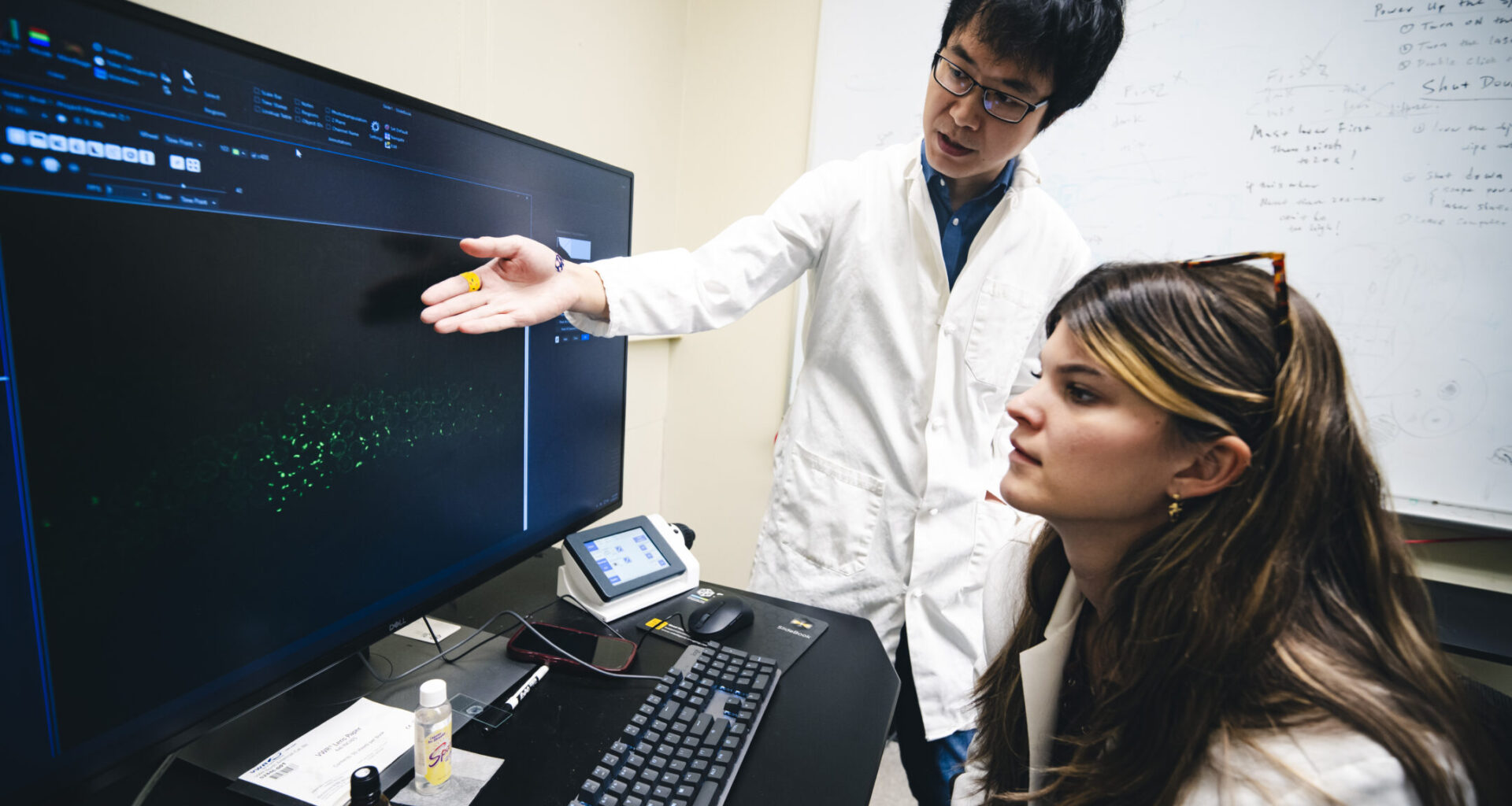
A $430,000 National Institute of Health grant was awarded to Dr. Chenshu Liu, on Aug. 1 to support research into meiotic processes, the cellular mechanisms that ensure healthy sex cell development.
The five-year Maximizing Investigators’ Research award is funded by the National Institute of General Medicine Sciences. Liu received notice of the award July 22, and funding began Aug. 1.
Liu said his research focuses on how egg cells are produced in a way that ensures only high-quality cells survive to pass genetic information to the next generation.
He said the grant allows his lab to pursue key unanswered questions in the field using newly developed methods to study meiotic checkpoints in greater detail.
Using the roundworm C. elegans as a model organism, Liu said his lab studies the genes and molecular pathways that regulate meiotic checkpoints and ensure the production of healthy egg cells, with the long-term goal of advancing reproductive health.
Liu also said the program emphasizes a researcher’s broader vision rather than relying heavily on preliminary data to justify proposed work.
“This is really a high-risk, high-reward program,” Liu said.
Biology department chair Kathy Iovine said the grant is designed to support the researcher rather than a narrowly defined project.
“What’s special about the (Maximizing Investigators’ Research Award) mechanism is that it’s still about the specific research,” Iovine said. “They still want to fund that kind of research, but with more confidence that the NIH has in the specific researcher.”
Gregory Lang, the Ph.D. program director said the structure of the grant funding allows labs to explore new directions as research questions develop.
“We’ve seen that in our lab we’re able to follow our research interests,” Lang said. “Rather than feel that we have to stick to the script of what was exactly proposed.”
However, Liu said the grant wasn’t easy to obtain and the application process was long and required support from his colleagues.
He said strict formatting requirements mean even small deviations can disqualify an application during the administrative review process.
Liu said his research process wouldn’t be possible without the support of his lab team, which includes seven members, a Ph.D. student, a rotating Ph.D. student, a lab manager and undergraduate researchers.
“The majority of the heavy lifting is really done by a talented, motivated and hard-working team of students,” Liu said. “For me, as the PI, a big part of the job is bouncing ideas around with them and empowering each student to drive their project from conception to fruition.”
He said he meets weekly with each lab member to discuss recent findings at the bench or microscope and to provide guidance on data interpretation, next steps and individualized mentorship as students move through different stages of their academic careers.
The grant supports not only Liu’s research, but also the students working in his lab by providing funding for training and research opportunities.
“Anytime any faculty at Lehigh receives federal funding, there’s really a trickle down effect,” Lang said. “Because we use those funds to support our graduate students.”
Both undergraduate and graduate students gain hands-on experience studying meiotic processes in Liu’s lab.
“I have full confidence that (Liu) will achieve the goals of this grant, and his research will add to the body of knowledge about cellular mechanisms of membrane and nuclear integrity,” Iovine said.
Liu said the flexibility of the MIRA grant allows his lab to pursue multiple avenues of research, including questions that weren’t initially anticipated.
“We can keep asking many additional questions based on this research and really push forward the frontier in this particular project,” he said.