
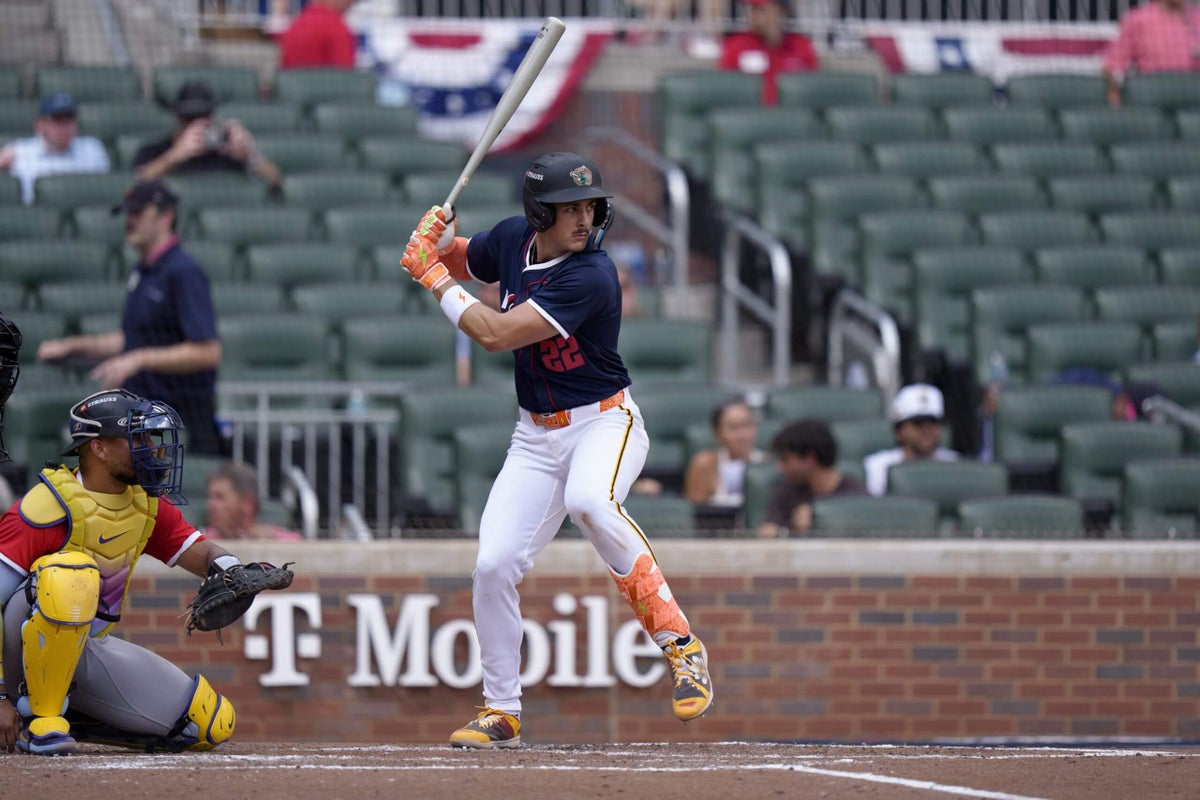
The Pirates’ system is the strongest it’s been in ages, and, as a reader pointed out, they have the No. 1 hitting prospect and No. 1 pitching prospect in baseball right now. They’ve also got quite a squadron of power hitters on the way, and I know Pirates fans will read that three times and still think that I’m making it up.
(Notes: Tools are graded on a 20-80 scouting scale; ages as of July 1, 2026. EV = exit velocity. EV90 = the average exit velocity of the top half of all of a player’s balls in play, ranked by exit velocity — that is, the top 90 percent of his batted balls.)
Height: 6-4 | Weight: 225 | Bats: R | Throws: R | Age: 19
Griffin was the No. 9 pick in the 2024 draft, a toolshed from Mississippi who starred for Jackson Prep as a shortstop, center fielder and pitcher, showing power and speed, but with broad questions about whether he’d actually hit decent pitching. It turns out that he can, in fact, hit decent pitching, and good pitching, and do so with authority. In 2025, he started out in Low A, hit .338/.396/.536 there, then moved up to High A, and hit .325/.432/.510 there, and then moved up to Double A in August just so he’d get some quick exposure to the level where he’s likely to start 2026 … and he hit .337/.418/.542 there in 21 games.
The physical tools are still all there; it’s probably 80 power, it’s definitely 80 run and he’s got at least a 70 arm. Even as he’s filled out a little already, he’s also shown much better instincts and agility at shortstop than you’d expect from a 6-foot-4, 225-pound (listed) guy who’s bigger than Corey Seager or Carlos Correa already. Griffin has also shown exceptional ability to make adjustments, even within games or at-bats, bringing his chase rate down throughout the season and ending the year with a chase rate on pitches well out of the zone of just 21 percent.
I’ve pointed out before that Griffin bars his lead arm, which for most hitters is a hindrance, but nothing stopped Griffin from hitting last year, even when he got to Double A, and he may just be such a good athlete and have such a high aptitude for hitting that it won’t end up mattering. He’s probably going to stick at shortstop and be a plus defender there, while posting high OBPs and hitting 25+ homers a year. I think he’s the most exciting prospect we’ve had in the minors since Mike Trout, and I think he’s going to end up one of the best players in baseball once he gets established.
Height: 6-3 | Weight: 218 | Bats: R | Throws: R | Age: 23
Chandler is the top pitching prospect in the minors right now because of his combination of present ability — with the fastball and changeup alone, he’s a mid-rotation starter — and his ceiling as a true top-of-the-rotation guy if he continues to develop as he has thus far. Chandler sat at 98.9 mph in his major-league debut at the end of 2025, and picked up an extra inch of vertical break over 2024 after some offseason work. Added to a low release height and some deception in his delivery, Chandler’s fastball is an 80, and if he locates it up in the zone, it’s almost impossible for hitters to square up. He pairs it with a plus changeup with fading action, and he’s still developing his command of and feel for the pitch, which will be more effective if he works more down in the zone with it and stays more up with the four-seamer. He’s got a slider and curveball, and should probably ditch the latter because the two pitches blend together. He got his slider up to 91.8 mph and gets more vertical break on the pitch the harder he throws it, which may be the solution for his third pitch.
A former quarterback and shortstop, Chandler is an otherworldly athlete and his arm action is one of the best in the minors, so I expect him to continue to improve his command as he gets more experience and to be able to make further adjustments over time. He’s not a finished product, but has enough present stuff and feel to help the Pirates in 2026, even as he continues to grow as a pitcher.
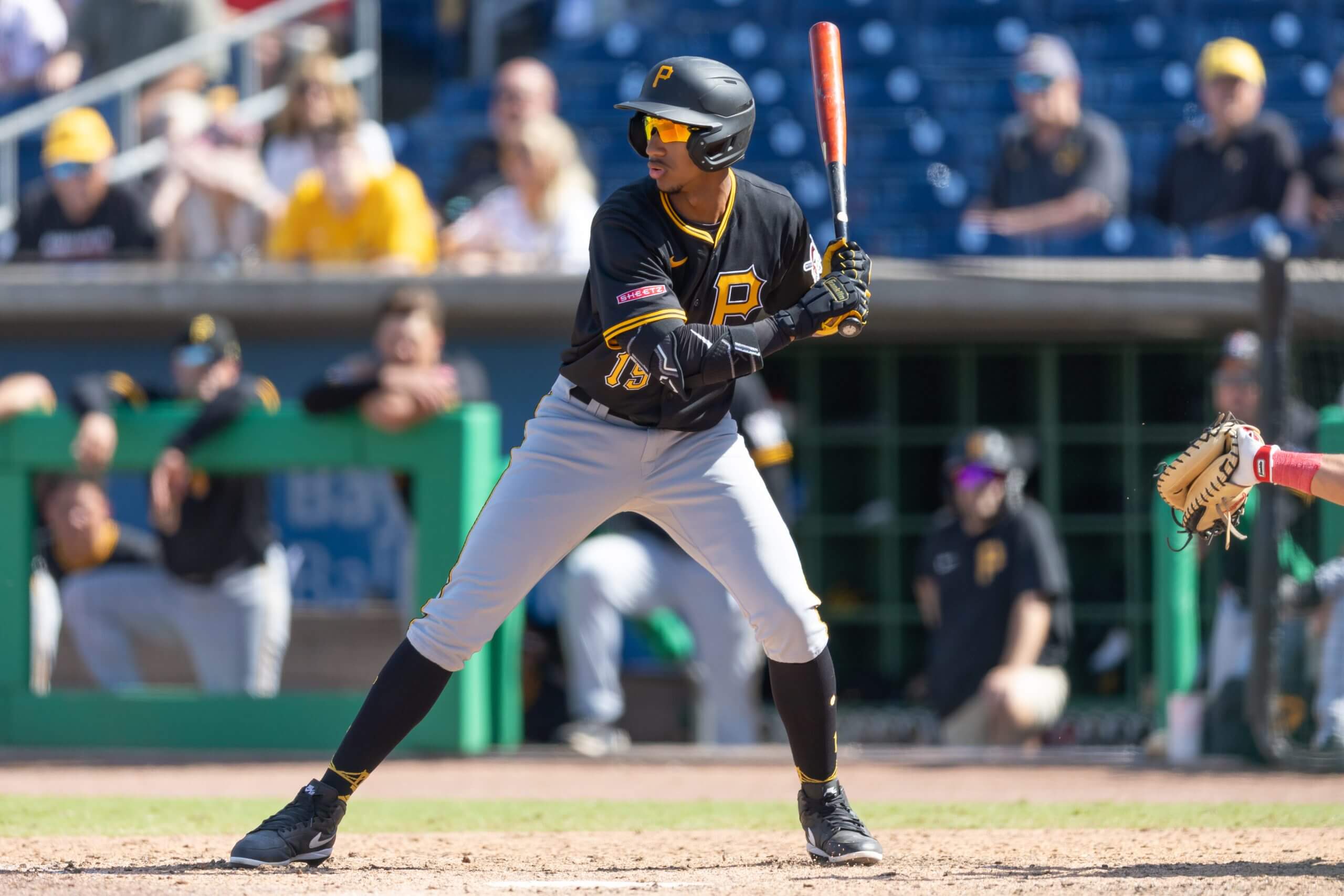
Edward Florentino made a big leap forward in 2025. (Mike Carlson / MLB Photos via Getty Images)
Height: 6-4 | Weight: 200 | Bats: L | Throws: R | Age: 19
Signed in January 2024 for $395,000, Florentino had a respectable debut in the DSL that summer, but it was 2025 when he really broke out, hitting .347/.442/.642 in the Florida Complex League and then hitting .262/.380/.503 in Low A, all before he turned 19. He swings hard and he connects often, with a whiff rate in Low A of just 16.3 percent, while flashing plus power that is only going to increase as he matures physically. He’s a 40 runner who won’t stick in center, even playing some first base in the FCL and Low A last year, as that’s a possibility given what he’s probably going to look like when he’s 24 and fills out his 6-4 frame. He also had a huge platoon split last year, hitting .320/.429/.636 against righties and .169/.286/.203 against lefties, all in small samples. Given his age and inexperience, I’m not concerned about that yet — he has fewer than 100 career plate appearances against southpaws. The ceiling is enormous: a power-hitting corner outfielder or first baseman who hits for a high batting average as well.
Height: 6-4 | Weight: 190 | Bats: R | Throws: R | Age: 20
I have Hernandez lower than the rest of the industry, primarily because of his category (he’s a high school pitcher, the first one selected in the 2025 draft) rather than because of anything about him as a pitcher. He’s been up to 100 and more typically sits 94-97 or so, with a plus changeup that’s at least a 60, an above-average curveball and a slider that shows good spin and plenty of arm speed, just needing some consistency and perhaps some help on finding the ideal shape. The changeup is very hard to pick up and has an extended tumbling action, which should help him carve up Low-A hitters when he gets there this year, and he has an old-school two-plane curveball that those hitters aren’t going to like any better. His four-seamer is very straight, so even high school hitters were often able to put it in play, and there’s some head-snap in his delivery that is often (but hardly always) a harbinger of command issues. He does generate most of that velocity from his lower half, taking a huge stride towards the plate, and once he gets his arm to catch up more consistently both breaking pitches will probably improve. It is No. 1 starter upside if he throws strikes, stays healthy and tightens up the slider.
High school pitchers taken in the first round are as risky a demographic in the draft as there is. They tend to throw very hard, they’ve often pitched quite a bit as amateurs because they’re so good and pitchers just break, period. The only high school pitcher selected in the first round proper in 2023 was Noble Meyer, who is still in A ball and has not had much success at all in the minors. In 2022, we had Dylan Lesko, who blew out his elbow before the draft, was traded shortly after he returned and walked 33 batters in 18 innings last year. That class also included Owen Murphy, who is barely back from his own TJ and still in High A, and Brandon Barriera, who has thrown 27 1/3 career pro innings around conditioning issues, major elbow surgery and now a bone fracture in the elbow. In 2021, we had Jackson Jobe, who has thrown 53 innings in the majors but probably won’t pitch there again until 2027 after Tommy John surgery, and Andrew Painter, who blew out his elbow, missed two years and hasn’t yet reached the majors. In 2020, it was Mick Abel, who debuted last year in the majors and posted a 6.23 ERA. In 2019, it was Quinn Priester, the rare example of a top prep arm who didn’t throw extremely hard, and even he needed six years and two trades to just establish himself as a major-league pitcher.
You have to go back to 2017 to find a draft where the first high school pitcher taken panned out, and that year had two, Hunter Greene, who took seven years but is now a bona fide ace, and MacKenzie Gore, who needed six years and a delivery overhaul, but is now an above-average starter. Every one of these guys was supposed to be an exception to the rule, a high school pitcher whose stuff or command or delivery or some combination of those things would get him to the majors sooner and help him succeed and stay healthy enough to contribute to the big-league club in a reasonable period of time. I hope Hernandez is that exception, truly, but I’m not going to bet on any individual high school pitcher doing so.
5. Jhostynxon Garcia, OF (Just missed)Height: 6-0 | Weight: 163 | Bats: R | Throws: R | Age: 23
I had Garcia as a top-100 prospect last winter and during the summer, but over the course of the process of assembling this year’s list, it was clear he was a tier below that — although he remains a good prospect. “The Password” spent the bulk of 2025 in Triple A, hitting .271/.334/.498 there, showing big power but posting a 29.1 percent strikeout rate. He murders pitches in the zone, but his chase rate at that level was 39 percent, and an outrageous 32 percent on stuff well out of the zone. It’s not impossible, but it is hard to imagine he’ll bring those numbers down to a level where he can post adequate OBPs, so his value is going to primarily come from his power and from defense.
He’s probably not a center fielder, but should be a 55 defender in right, maybe a little better with more time at the position. I wrote at the time of his trade from Boston to Pittsburgh that I saw a 20-homer floor with a sub-.300 OBP, and that still holds. He has the ceiling of an All-Star because of that hard-contact skill, but he needs a major adjustment to his swing decisions to get there.
6. Wyatt Sanford, SSHeight: 6-1 | Weight: 175 | Bats: L | Throws: R | Age: 20
Sanford was a classic Pirates draft pick from the 2024 class, as he’s a high-contact hitter with good instincts on both sides of the ball, while also offering some size and projection to anticipate average power in four or five years. He walked his way out of the Florida Complex League, drawing 15 walks in 79 plate appearances for a hilarious .487 OBP. He then was appropriately challenged in 44 games in Low A, where he hit .238/.342/.378 with some more chase. He has a very good swing that lets him go the other way, although all of his fringy power right now is to the pull side. He’s a plus runner with a legitimate chance to stay at shortstop, with a lower degree of probability given how far away the hit tool appears to be.
7. Esmerlyn Valdez, OFHeight: 6-2 | Weight: 181 | Bats: R | Throws: R | Age: 22
Valdez is a power-over-hit guy who might have enough hit tool to become a quality regular or better. The power is real, with a max EV in his Arizona Fall League stint of 114.4 mph, and he hits everything hard, with a strong pull orientation but some ability to go the other way. He even has something of a two-strike approach, expanding the zone a modest amount but nowhere near as much as I’d expect from a young power-hitting prospect who swings this hard. He’s a corner outfielder and capable in either spot, with first base a possibility if he gets a long runway there. I’ve heard anywhere from bench bat to star from scouts who’ve seen him; I think he’s an above-average regular who gets to 25 to 30 homers, maybe a little on the lower side in average/OBP, with average defense in right field.
8. Termarr Johnson, 2BHeight: 5-8 | Weight: 190 | Bats: L | Throws: R | Age: 22
The No. 4 pick in the 2022 draft, Johnson hit .272/.363/.382 last season, his first full season in Double A, cutting his strikeout rate while otherwise plateauing from his previous performance. He doesn’t have a real position; he played only second base last year and is a 45 there at best, and with the lack of power, I’m not sure where else he could go. He’s still young and will start this year in Triple A as a 22-year-old (by seasonal age), with a decent idea at the plate and some speed to give him a shot to be a regular, especially if he shows some more maturity on the field.
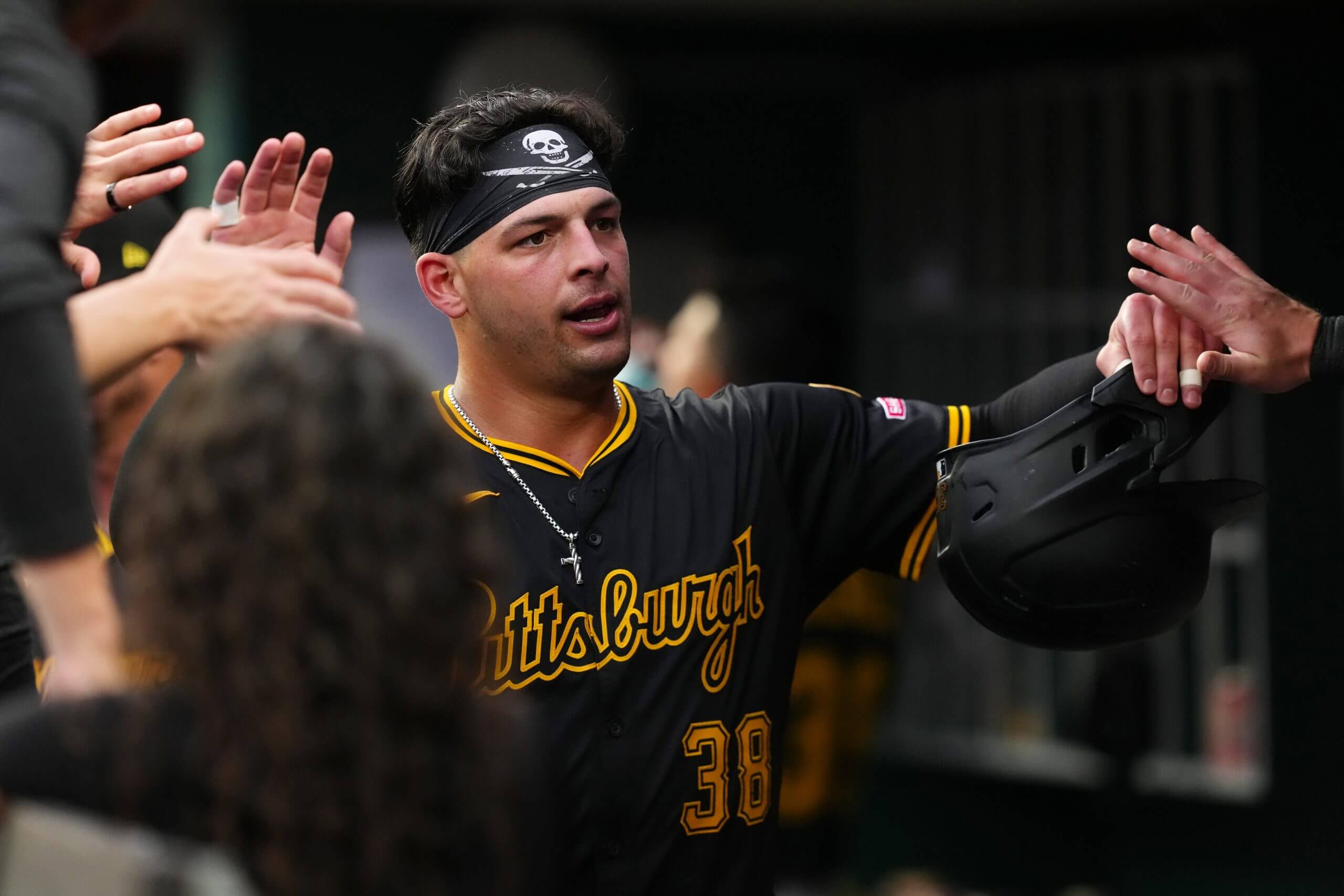
Nick Yorke took a step back last season. (Dylan Buell / Getty Images)
9. Nick Yorke, 2BHeight: 6-0 | Weight: 210 | Bats: R | Throws: R | Age: 24
Yorke took off when he left the Red Sox system via a trade in 2024, but he didn’t carry over those gains into 2025. He had a let-down .287/.348/.406 line as he repeated Triple A, with a higher strikeout rate that was masked because he was still somewhat lucky on balls in play. The Red Sox changed his swing, introducing a big pause in it, and the remnants are still there, like the bruises from an airbag after you’ve been in an accident, although that doesn’t fully explain the dropoff in his batted-ball data across the board. It might have been the lingering effects from an April shoulder injury that cost him only a week on the IL. His average EV in Triple A went from 91.5 mph to 87.5, and his 90th percentile EV from 105.7 to 104.2. His swing path is really good for low line drives, and he should be a consistent hitter for average with maybe fringy in-game power, which would make him at least a regular at second base (where he’s a 45 defender) or a second-division regular in left field. Here’s hoping there are no surprises for him in 2026 and he gets back to his prior level of production, or there will be exit music playing for him as the Pirates’ other middle infield prospects pass him by.
10. Sammy Stafura, SSHeight: 6-0 | Weight: 188 | Bats: R | Throws: R | Age: 21
Acquired in the 2025 deadline deal that sent third baseman Ke’Bryan Hayes to Cincinnati, Stafura looks like a utility infielder who could become a very solid regular at shortstop if he can boost his contact rates, which might be as simple as a small fix to his swing. He’s a plus runner and no worse than an average defender at short right now, projecting to plus with another year or two of reps, with strong command of the strike zone and much-improved contact quality last year. He wraps his bat slightly, enough that it makes him longer to the ball and may explain his 30 percent whiff rate — too high for this type of player. Perhaps now that he’s in a new organization, the different player development group can suggest a new approach and try to shorten him up for more contact, which will help his speed play more and keep his OBP up to give him a chance to be an everyday player.
11. Wilber Dotel, RHPHeight: 6-3 | Weight: 178 | Bats: R | Throws: R | Age: 23
Dotel has been up to 98 and last year showed some real growth as a pitcher, with his secondaries and command improving enough to give him a chance to hold up as a starter. His splitter gets a ton of whiffs, after the Pirates’ player development group helped him shift from a hybrid split-change to a true split. He can baby the slider too much trying to nibble rather than throwing it harder to try to get a whiff. He led the Pirates’ system in strikeouts with 131, and only two of their big-leaguers had more punchouts. His future is probably 60/40 reliever where a year ago it was 80/20.
12. Khristian Curtis, RHPHeight: 6-5 | Weight: 210 | Bats: R | Throws: R | Age: 24
Curtis nearly ended up losing his career to a Tommy John surgery that didn’t take, undergoing a second, longer surgery in 2022 to repair it and pitch in 2023 for Arizona State. The Pirates took him in the 12th round that year, and so far it looks like a tremendous success, as he’s reached Double A and still has a chance to be a big-league starter. He had a horrible April last year, allowing 22 runs in 13 innings, then posted a 2.86 ERA the rest of the way, with his stuff improving toward the end of the season. He has five pitches, sitting 94-96 on his four-seamer with good spin on the slider and cutter and good fade on the changeup. He could probably shelve the curveball and go with just those four, and he needs to use the changeup more. His control is still a 45, improving in each of the last two seasons, and if it ticks up a little more he has the weapons and delivery to be a back-end starter.
13. Rafael Flores Jr., CHeight: 6-4 | Weight: 232 | Bats: R | Throws: R | Age: 25
Flores is a bat-first catcher who most likely projects as a backup, although he has already improved his receiving quite a bit to even get to that point. He has a great swing that’s efficient and produces 55 power, showing plenty of bat speed, while his approach hasn’t held up as well as he’s moved up the chain. He’s a 45-ish receiver with maybe an average arm, moving well for someone who’s quite large for the position. He’s 25 already, having signed as an undrafted free agent at age 21 out of a California junior college, so any growth from here will be on the finer points such as improving his swing decisions or getting him better at receiving and blocking.
14. Thomas Harrington, RHPHeight: 6-2 | Weight: 185 | Bats: R | Throws: R | Age: 24
Harrington’s major-league debut in 2025 showcased why I wrote last year that his most likely outcome was fifth starter: He doesn’t have an out pitch, and the fastball is average, if that. He’s 91-94, and the pitch is pretty flat, so hitters really squared it up, and his lack of deception increased their ability to pull the ball off him. He has better command than we saw in his cup of coffee, or even in his second time in Triple A last year, as he became extremely homer-prone (20 in 96 innings) compared with the prior year (five in 46 innings). I’m sticking with a fifth-starter projection and acknowledging that maybe he’s less than that.
15. Antwone Kelly, RHPHeight: 5-10 | Weight: 183 | Bats: R | Throws: R | Age: 22
Born in Aruba, Kelly is a 5-foot-10 right-hander who can hit 100 with his straight four-seamer, throwing a 55 changeup and fringe-average cutter, as well. He worked hard on his conditioning before last season, getting in better shape and, not coincidentally, showing the best command and control of his career. He comes from a lower slot and gets good induced vertical break on the heater, while the cutter is more of a baby slider that he’s still trying to develop. With his physical improvement and some progress on the secondary stuff, he’s gone from definite reliever to having a chance to start; if he does get into the latter role, he could be a solid No. 4 or even maybe a No. 3 starter. His brother, Jaitoine Kelly, is a pitcher in the Diamondbacks’ system and is every bit of 6-3, 257. Genes are funny.
16. Hunter Barco, LHPHeight: 6-4 | Weight: 235 | Bats: L | Throws: L | Age: 25
Barco is a very low-slot lefty who sits 92-94 as a starter with a 55 or 60 splitter and only fringy breaking stuff, as he doesn’t spin the ball well and relies instead on the lower arm slot to create some angle to the slider and sweeper. He had a reverse platoon split in Triple A last year, as he did in limited time in 2023 while returning from Tommy John surgery. He might be a back-end starter if his sudden spike in walk rate last year was just a fluke — it did coincide with him moving to Triple A, where they use the Automated Ball-Strike system — but I think he’s better suited to relief because he doesn’t have an average breaking ball.
17. Levi Sterling, RHPHeight: 6-5 | Weight: 202 | Bats: R | Throws: R | Age: 19
The No. 37 pick in the 2024 draft, Sterling didn’t turn 18 until that September, and was coming off a spring when his velocity had dropped about 2 mph. He was mostly back last year in the Florida Complex League and one outing in Low A, sitting 92-95 with good feel to spin two breaking balls. His arm slot is up slightly, while he still gets on the side of the ball and misses too much to his glove side. He can show at least an average changeup but doesn’t throw it enough, and he needs to throw it more toward the outer half against lefties — which his arm action and release don’t easily allow. He’s still quite raw but has real upside rotation.
18. Edgleen Perez, CHeight: 5-10 | Weight: 155 | Bats: R | Throws: R | Age: 20
Acquired with Rafael Flores in the David Bednar trade with the Yankees, Perez is a strong defensive catcher with a good eye at the plate and 30 power right now, with a .232 slugging percentage last year and zero homers, all (or none, I suppose) in Low A. He does have some hard contact in his profile, reaching 105 mph EV at his peak, but there’s a lot of weak contact the other way as well as a mild ground-ball tendency that should dissipate as he grows. He’s got to get a lot stronger to go from Edgleen to Edgelord, by which I mean an everyday catcher.
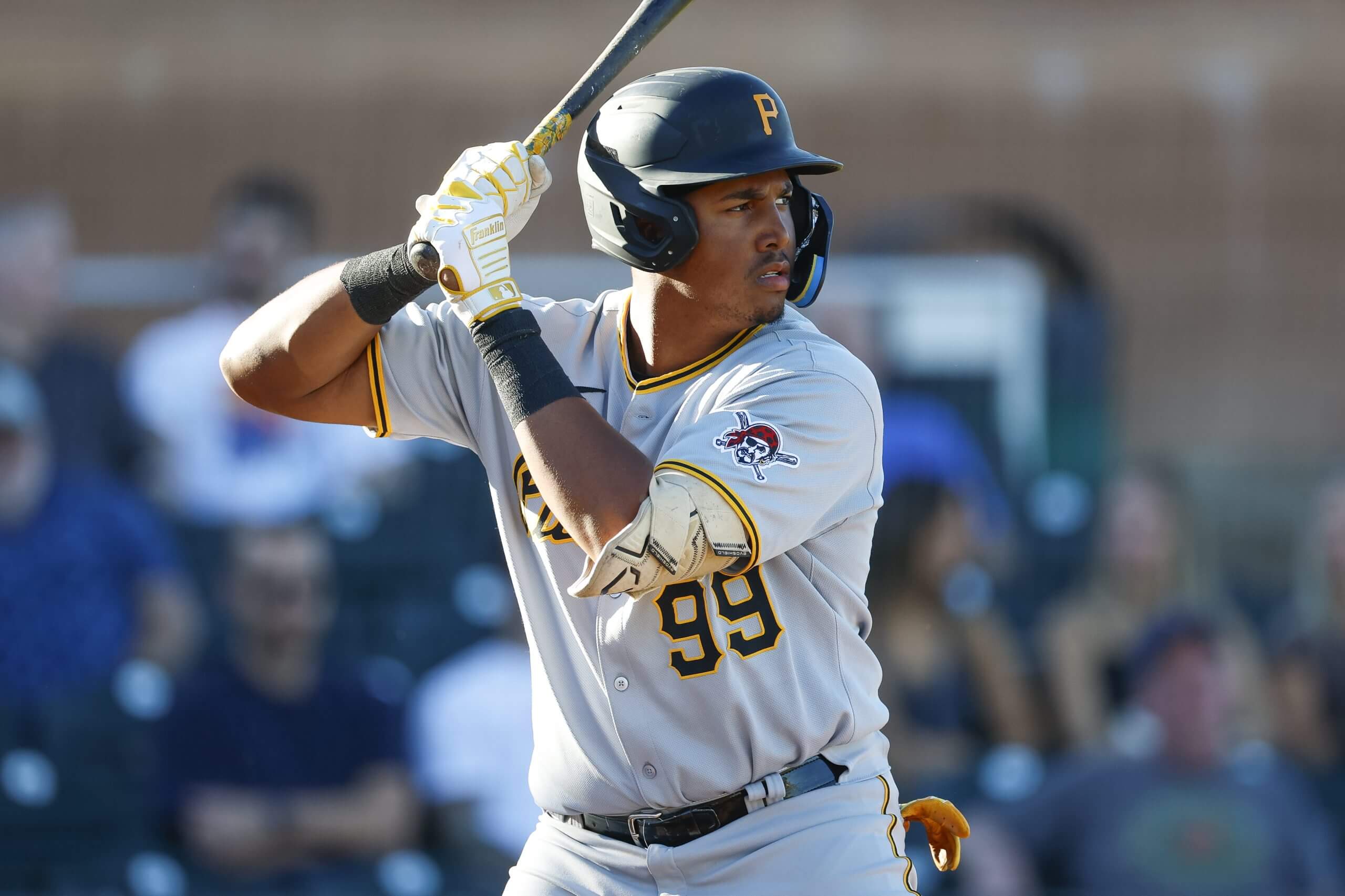
Tony Blanco Jr. posts some impressive exit velocities. (Brandon Sloter / Getty Images)
19. Tony Blanco, Jr., OFHeight: 6-7 | Weight: 243 | Bats: R | Throws: R | Age: 21
Blanco hits the ball as hard as anyone, topping out at 119.8 mph during the regular season last year with an average of 93.1 mph and a hard-hit rate of 54 percent, then besting himself with a double at 120.4 mph in the Arizona Fall League (that I happened to see, and, yes, it was extremely loud and incredibly close). At this point, however, I don’t think he can hit. He is every bit of 6-7 and I’d guess more like 255-260 than his listed 243, with a very top-heavy build, and he’s had a hard time even staying on the field in his time in the minors, with a hamstring injury costing him half of the 2025 season. He also had to deal with the death of his father, former Nationals outfielder Tony Blanco, in the Jet Set Club roof collapse in the Dominican Republic last April. I can’t just dismiss anyone who has this kind of power at this age, especially when he has less than a full season’s worth of playing time over his entire career, but I admit I’m skeptical that he can make it work.
20. Duce Gourson, IFHeight: 6-0 | Weight: 200 | Bats: L | Throws: R | Age: 23
Taken in the ninth round in 2024 out of UCLA, Gourson reached Double A in 11 months and hit .284/.372/.431 at the level, albeit with a 27.4 percent strikeout rate — a big spike from where it was in A-ball. He dramatically increased his bat speed last offseason thanks to the Pirates’ development staff, leading to better contact quality across the board. He also stole 30 bags in 33 attempts despite being a 55 runner. He can handle second, third or first, fitting best at second. He’s probably a bench player rather than a starter, even with the improvements, with a real chance to debut this year.
Others of note
Murf Gray, the Pirates’ Competitive Balance Round B pick last year, has 60 power and raked in the Cape Cod League, posting very high exit velocities. I don’t buy the bat; he has maybe average bat speed and hasn’t hit decent velocity. He played third base at Fresno State and will start there in the pros, with first base his likely destination … Richard Ramirez — he’s from Venezuela, I’m sure his parents didn’t realize it when they named him — is an outstanding defensive catcher who has the opposite problem to Edgleen Perez: Ramirez, 20, has some power already but a much worse approach. Maybe the Pirates can fuse the two in the lab and get an All-Star … Right-hander Jeter Martinez came over from Seattle at the 2025 deadline for Caleb Ferguson; he’s got a power arm, but it’s a stiff delivery and he has never thrown strikes. The Pirates shut him down for a month after acquiring him, after which he had two disastrous appearances where he allowed eight runs on seven hits and four walks in 2 1/3 innings … Catcher Axiel Plaz has huge power, up in the Florentino/Valdez area (but not the Blanco Zone), peaking at 113.9 mph last year in Low A with a hard-hit rate of 52.7 percent; his swing decisions are really poor, even giving him some grace for being a 19-year-old in full-season ball. He’s not going to stick behind the plate, and he doesn’t have another position … Infielder Keiner Delgado had a so-so year, hitting .243/.370/.389 in High A as a 21-year-old, with 24 steals in 26 attempts. He played second and third with a few games at short, and has utility infielder upside now that he’s gotten strong enough to impact the ball a little more … Right-hander David Matoma is likely going to be the first big leaguer from Uganda, or any African country other than South Africa, as he sits 96 and has been up to 99 with a potentially plus slider, working mostly in one-inning stints in Low A last year. I’d like to see him start so he can get more innings … Right-hander Alessandro Ercolani didn’t miss many bats in 21 starts and four relief outings in Double A, and I think it’s time for him to move to the bullpen, as his fastball is a 45 right now. He has enough control to be a solid middle reliever if the fastball-slider-cutter all tick up in short bursts. If he makes it, he’ll be the first big leaguer from San Marino.
2026 impact
Chandler should be in the Opening Day rotation and is a Rookie of the Year candidate. Griffin is going to debut this year, maybe as soon as Opening Day.
The fallen
Left-hander Anthony Solometo was part of the same draft class that landed Chandler, and was a top 100 prospect himself, but he lost his command and some stuff in 2024, then missed nearly all of the 2025 season with a SLAP lesion in his shoulder, with one rehab outing in June where he sat 88-89.
Sleeper
I’m a big Sanford fan, both for the swing and the player.