
When a city announces school closures, one question arrives before the spreadsheets do: Where will my child go? Not in theory — in September. On Monday mornings. In the dark winter commute. In the middle of a year when everything else in the household is already stretched.
Listen to the audio edition here:
That question is hovering over the School District of Philadelphia’s proposed long-range facilities plan: a 10-year blueprint the District has described as a roughly $2.8 billion effort to modernize 159 schools, reduce the number of buildings rated “unsatisfactory” or “poor,” and reorganize the system’s footprint through closures and co-locations.
The most attention-grabbing part is also the most human: The proposal calls for closing 20 schools beginning in the 2027–28 school year — moves that would affect nearly 5,000 students, with additional impacts from mergers, relocations, and co-locations. The District has indicated that it will present the recommendations to the Board of Education on February 26, and the plan would still require board adoption before any changes take effect.
Serious adults can disagree about how the District should manage an aging portfolio of buildings amid enrollment decline and infrastructure challenges. But closures are never only about facilities. They are about routes and routines — about which side of the street a child has to cross, how long a commute becomes, whether a working parent can still make pickup, and whether a student with specialized supports experiences disruption in the handoff. A facilities plan is a set of decisions about buildings. For families, it becomes a decision about daily life.
Philadelphia also has institutional memory here. In March 2013, the state-run School Reform Commission voted to close 23 District schools at the end of that school year, after months of public protest and emotional testimony. Whatever one thinks of that decision, the aftermath made one thing plain: When schools close, children don’t disappear. They redistribute — sometimes into stable, well-supported placements, and sometimes into confusion, longer travel, and frayed continuity.
When schools close, students don’t disappear. The only question is whether the rest of us will act like we understand that.
That pattern is not unique to Philadelphia, but it is unmistakably ours. When District schools close or consolidate, students move across the city’s educational ecosystem. Many remain in District schools. Many enroll in charter schools. Others attend parochial or private schools made accessible through scholarships. Some observers celebrate this churn; others lament it. I’m not interested here in taking sides. I’m interested in naming a reality that should shape how we respond: If closures proceed, the quality of students’ landings will depend less on rhetoric than on planning.
The research on school closures is cautious and often inconclusive. Evidence is mixed on whether closures reliably produce sustained academic gains or major long-term savings; what is more consistent is disruption — especially in neighborhoods already under strain. That disruption can show up as stress for students, logistical burdens for families, and fragile continuity for services that require consistency. None of this is to say closures are never warranted. It is to say the risks are predictable, and predictable risks require intentional mitigations.
I should offer a brief disclosure. I work in a scholarship-supported independent school in Philadelphia. It’s important to say that plainly. But this piece is not about my school — or any one sector. It is about children, and about what happens when systems change faster than families can adapt.
This conversation will inevitably be argued in political terms. But there is also a civic and moral frame that should unite us: Children should not become collateral damage of adult systems reorganizing themselves. Longer commutes, broken relationships with trusted teachers, interrupted supports, and families left to navigate complexity alone — these are not abstractions. They are predictable risks. And they do not belong to one sector alone.
If closures proceed, the question becomes how the city shows up for students during the transition. That means moving beyond critique toward practical support.
Start with transitions, not turf. Transportation assistance, counseling, and enrollment navigation matter as much as seats. A plan that moves thousands of students must treat the handoff as core work, not as a footnote — especially for students with disabilities and students whose families lack time, flexibility, or reliable transit.
Second, encourage cross-sector collaboration where it’s feasible: shared extracurriculars, shared services, shared facilities, and partnerships that reduce the “starting over” feeling for children. If students are going to move across sectors anyway, we should try to make the city feel less like a set of silos and more like a safety net.
There is also a civic and moral frame that should unite us: Children should not become collateral damage of adult systems reorganizing themselves.
Third, insist on accountability that follows students, not buildings. If the District moves forward, it should publish simple annual reporting on where displaced students enroll, mobility rates, attendance patterns, commute times, continuity of specialized services, and academic growth in the years following closures. That information should be clear enough for families to use and robust enough for policymakers and advocates to act on.
Finally, for Philadelphians looking for a concrete way to support student stability, scholarship support is one tool — among several — that deserves a clear-eyed look. Pennsylvania’s Educational Improvement Tax Credit (EITC) and Opportunity Scholarship Tax Credit (OSTC) programs provide tax credits to eligible businesses that contribute to nonprofit scholarship organizations, which then provide tuition assistance to eligible students. OSTC scholarships are tied to students who live within the boundaries of low-achieving schools, and EITC sets income eligibility thresholds.
These programs are not a cure-all, and they are not the only way to help. But in a city where closures and consolidations can push families into rapid decisions, scholarship pathways can sometimes keep a student in a stable environment — particularly when a family is already stretched thin. If supporting scholarship organizations isn’t your preference, there are other high-impact options: Fund transportation support, volunteer as a mentor, or support community groups that help families navigate enrollment and transitions.
A successful transition should not be measured only in renovated buildings or reduced maintenance costs. It should look like this: Students settle into new schools without spikes in absenteeism or mid-year moves; families receive clear communication and support; academic growth continues; no one disappears from the data.
The District’s plan will be debated in hearings, headlines, and neighborhoods. But the baseline obligation should be nonnegotiable. If we are going to reorganize school buildings, we need a citywide commitment — across sectors — to what happens next. Public, charter, parochial, and private schools all serve real children in real neighborhoods. There is need enough to go around, and responsibility enough to share.
When schools close, students don’t disappear. The only question is whether the rest of us will act.
Brandon McNeice is Head of School and CEO of Cornerstone Christian Academy in Southwest Philadelphia. His writing has appeared in Commonweal, Plough, Well-Schooled, The Philadelphia Citizen, and The Philadelphia Inquirer.
The Citizen welcomes guest commentary from community members who represent that it is their own work and their own opinion based on true facts that they know firsthand.
 MORE ON PHILLY SCHOOLS
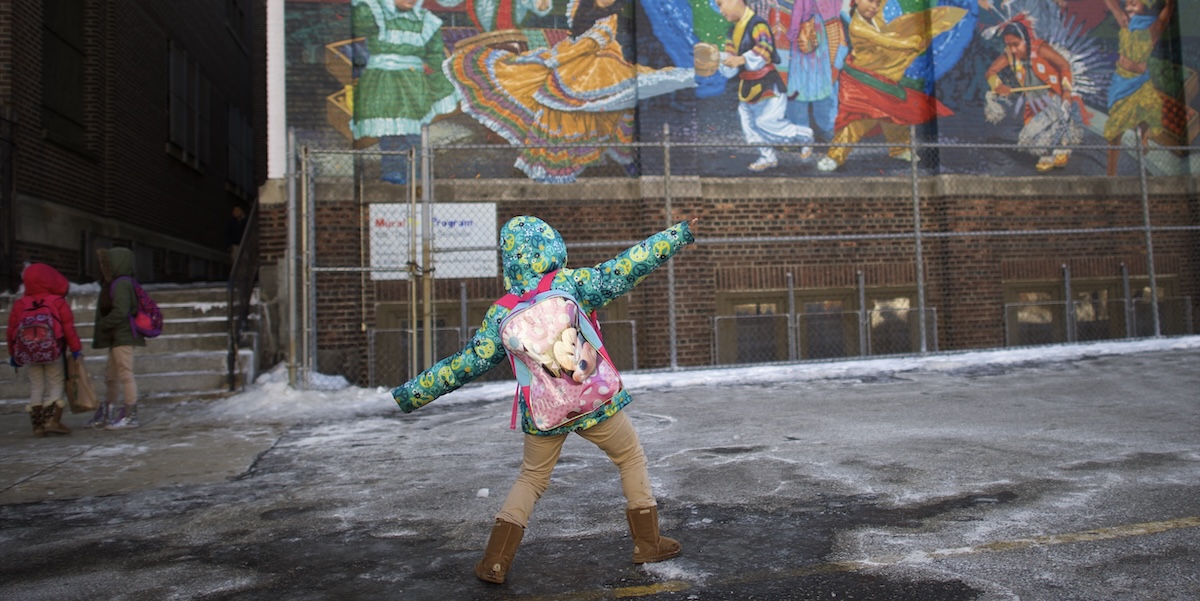
Philadelphia, PA – February 27, 2015. A student slides on the ice after school at Nebinger Elementary School, which has Pre-K through 8th grade, in South Philadelphia. The District of Philadelphia School District has laid off 5,000 employees in the past two years with 31 schools closing. These photos accompany a story on the dismantling of No Child Left Behind.