
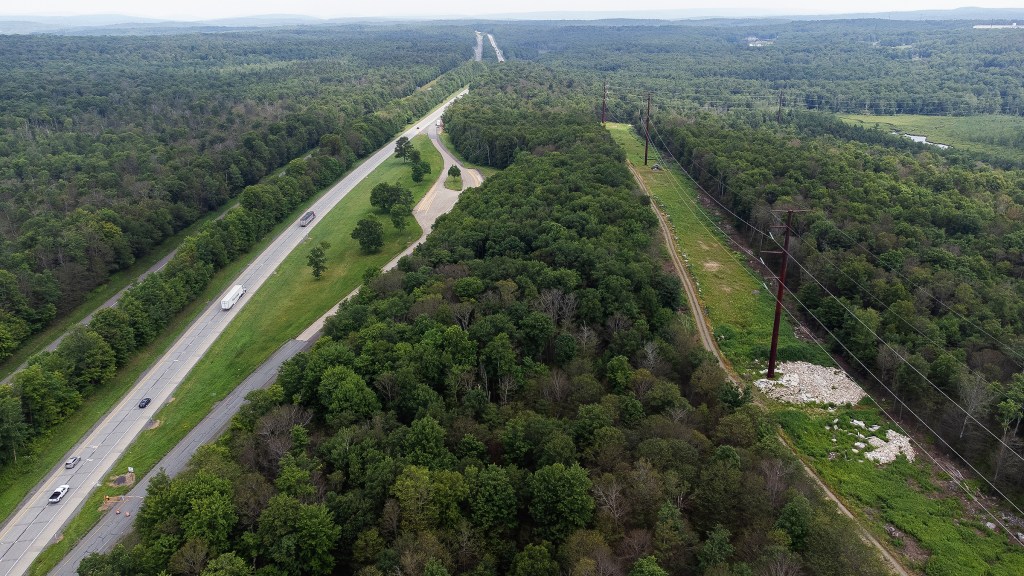
A Lackawanna County judge vacated a settlement agreement between Clifton Twp. and the developer behind a large proposed North Pocono data center campus, halting the agreement after it excluded the township’s zoning hearing board.
County Court of Common Pleas Judge Mark Powell tossed the settlement in a Jan. 30 order, vacating his previous Jan. 5 order that had approved a settlement involving Clifton Twp., data center developer 1778 Rich Pike LLC of Doylestown and property owner JCO LLC of Covington Twp. Powell’s decision came after the Clifton Twp. Zoning Hearing Board petitioned the court last month over not having a say in the settlement — which it opposed — while also determining 1778 Rich Pike prematurely challenged a key zoning hearing board decision denying the developer’s contention that Clifton Twp.’s zoning excluded data centers.
The vacated order does not end the legal battle over the proposed “Project Gold” data center campus that looks to build data centers along Interstate 380 in Clifton and Covington townships; instead, it allowed an amended land use appeal from the developer to move forward.
Powell’s order last week is the latest development in nearly a year of legal challenges against Clifton Twp. by 1778 Rich Pike LLC, 2003 S. Easton Road, Suite 304, Doylestown, and JCO LLC, 207 Drinker Turnpike, Covington Twp.
Clifton Twp. solicitor Geoffrey S. Worthington declined to comment. Attempts to reach Covington Twp. solicitor Joel Wolff and 1778 Rich Pike attorney Matthew McHugh were unsuccessful Tuesday afternoon.
Legal history
1778 Rich Pike at first proposed building nearly three dozen data centers, each up to three stories high and around 125,000 square feet per floor, on Interstate 380 just north of Clifton Beach Road as part Project Gold. Subsequent plans attached to the now-vacated settlement agreement indicated there would only be five data centers in Clifton Twp., though each 65-foot-tall building would have a much larger footprint, ranging from 160,000 square feet to nearly 685,000 square feet. The plans did not include Covington Twp.’s portion of the project.
The data center firm filed its initial zoning challenge — a substantive validity challenge — on April 17, alleging Clifton Twp.’s zoning ordinance unlawfully excluded data centers, private power generation facilities and related uses. The township amended its zoning a month later on May 22 by defining data centers and designating them as conditional uses in its industrial zoning district, but the developer especially took issue with a 35-foot height restriction and noise restrictions.
The following month, on June 20, 1778 Rich Pike and JCO filed a procedural validity challenge that asked the court to declare the data center ordinance void due to alleged procedural issues, including the township failing to properly post an agenda 24 hours ahead of the May 22 special meeting and failing to have the township planning commission review the ordinance at a public meeting, among other contentions.
The Clifton Twp. Zoning Hearing Board unanimously voted on Nov. 19 to deny the April 17 challenge. The board’s written decision determined the zoning ordinance was not exclusionary because data center uses were encompassed in other permitted uses in the township, as well as ruling that the developer could construct data centers that comply with the township’s existing height and noise restrictions.
“Although sound and height limitations contained in the zoning ordinance may not permit the most profitable data center, ‘the economic profitability of a use … is irrelevant to our analysis of the constitutionality of an ordinance,’” the board wrote in its decision, citing previous case law.
1778 Rich Pike challenged that decision by filing a Dec. 1 land use appeal, arguing the board’s decision was an abuse of discretion because it “was not supported by substantial evidence and, in fact, was contrary to the significant evidence presented by the developer.” The filing asked a judge to reverse the board’s decision.
Before a judge ruled on the land use appeal, Clifton Twp. supervisors and 1778 Rich Pike reached a settlement agreement on Jan. 2 that ended 1778 Rich Pike’s legal challenges, and in exchange, the township would permit the developer to use the property for data centers and battery storage without the need for conditional use approval, though the settlement included numerous stipulations and conditions required for the township to approve its land development plan.
New developments
Powell initially approved the settlement stipulation and agreement on Jan. 5. The following day, Covington Twp. petitioned the court to intervene. A filing from Covington Twp. on Jan. 27 argued by barring the developer from building infrastructure like power stations, water wells and sewage treatment in Clifton Twp., it effectively shifts them to Covington’s half of the roughly 1,000-acre site.
Covington’s petition further contends the changes resulting from the settlement would increase groundwater withdrawal, risking aquifer depletion, impacting private wells and straining shared regional water resources.
“The settlement will impose uncompensated burdens on Covington’s natural resources, such as water supply, air quality, infrastructure, public safety, and fiscal resources, including increased demands on utilities, roads, and emergency services from the cross-border development,” attorneys Joel Wolff and Samantha Hazen wrote in the filing.
The Clifton Twp. Zoning Hearing Board then filed its own petition on Jan. 13, asking the court to strike and/or vacate the Jan. 5 order allowing the settlement. The board, through its solicitor, attorney Thomas S. Nanovic, pointed out that it was not a party to the settlement, and a motion from 1778 Rich Pike asking the court to approve the settlement incorrectly alleged, “The parties have reached a full and final settlement of all claims and issues,” despite the zoning hearing board opposing it. The board also noted that 1778 Rich Pike filed its Dec. 1 land use appeal before the board had rendered its written decision — which it issued on Dec. 30.
On Jan. 27, 1778 Rich Pike LLC, through its law firms, Philadelphia-based Klehr Harrison Harvey Branzburg LLP and Pittston-based Joyce, Carmody & Moran P.C., filed a supplemental land use appeal, noting it did file its appeal before the board’s written decision, but that it has the right to supplement the appeal upon receipt of the decision. The developer argued it can file the appeal prior to a written decision, and despite seeing the supplemental appeal as unnecessary in light of the Jan. 5 settlement order, it filed the supplemental appeal “out of an abundance of caution and to affirmatively address any alleged jurisdictional defect with the appeal.”
The appeal reiterated the developer’s contention that the zoning hearing board “committed an abuse of discretion and error of law” by ruling that Clifton Twp.’s zoning ordinance was not exclusionary to data centers.
In his order to vacate the settlement last week, Powell referenced the zoning hearing board’s argument, writing, “Although presented as a stipulation by all parties, the Clifton Township Zoning Hearing Board was not a signatory.”
Directly quoting previous case law, Powell continued, “A municipality cannot settle disputes that fall within the exclusive jurisdiction of the local zoning hearing board. … If that were so, municipalities could supplant every decision of a zoning board by stipulation.”
Powell’s order also notes that “adding to the procedural thicket,” 1778 Rich Pike filed its Dec. 1 appeal prior to the board’s Dec. 30 written decision. The filing was premature, Powell wrote.
However, he allowed the Jan. 27 supplemental land use appeal to move forward.
The supplemental appeal asked the court to reverse the zoning hearing board’s decision and to grant site-specific relief to permit data center uses on the property.