
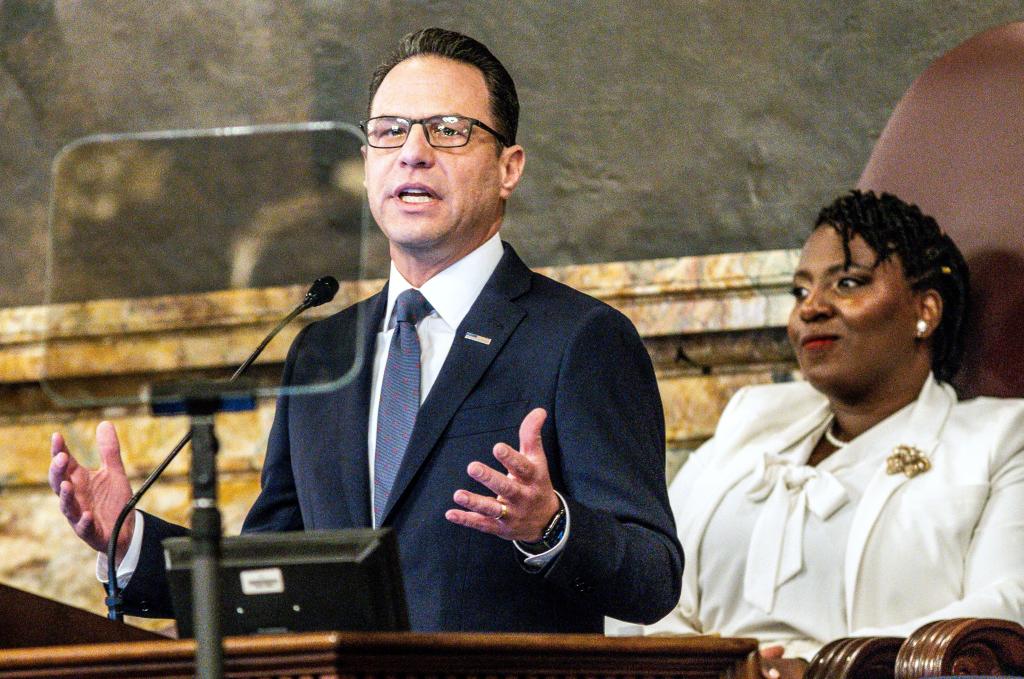
As data center developers continually propose new facilities throughout Northeast Pennsylvania, Gov. Josh Shapiro recognized their importance to the state’s economy while also stressing the need to ensure they’re meeting stringent regulations within individual communities during his 2026-27 budget address Tuesday.
Shapiro announced the GRID — Governor’s Responsible Infrastructure Development standards — developed by his administration, in consultation with the community, to hold data center developers accountable to strict standards if they want full support.
Specifically, Shapiro laid out four main requirements data center developers must follow, including committing to bringing their own power generation — or paying entirely for the new generation; committing to transparency standards and community engagement; hiring and training local workers; and committing to the highest standards of environmental protection, especially water conservation.
As one example of the demand data centers would place on resources in local communities, the Wildcat Ridge Data Center Campus in Archbald would use 1,600 megawatts of power, and to offset its water demands that top out at 3.3 million gallons per day, the data center campus is exploring tapping into the mine water below as a source of cooling for its computers.
Tamara Misewicz-Healey, who founded the Stop Archbald Data Centers group along with her husband, Justin Healey, believes Shapiro’s standards could be beneficial, but also stressed they must be followed through completely.
“I think there’s potential in all of them, but it’s the fine details that really matter with any of them,” she said. “Transparency has been a huge problem within the state, and even local, level. I think that is kind of the emotion behind why residents even feel so upset and scared. There are a lot of questions, there are very little answers, and there is little opportunity for members to even participate. They’re creating a lot of bills right now, but they’re just kind of doing it on their own and pushing it through, rather than opening it up for public review and maybe a town hall to ask questions about it and give feedback on it. People want to know what’s going on and they want to be a part of it to ensure it fits our future, and that it considers us in that future.”
Misewicz-Healey noted it’s especially crucial that developers be held to strict environmental standards.
“Sustainable, responsible development is absolutely important for human survival,” she said. “We have to get this right. We can’t be reckless about this.”
She also would have liked to see Shapiro propose a one-year moratorium to limit the number of new data center projects.
“What we need, more than anything, is to slow this down and properly review it,” Misewicz-Healey said. “I think, above all else, that’s what all the residents want to hear right now.”
Supporting emergency responders
Shapiro’s budget proposal includes a $30 million investment in competitive grants through the Office of the State Fire Commissioner — doubling annual funding — to support recruitment, retention, and capital needs for volunteer and professional fire companies.
Scranton Fire Chief John Judge expressed optimism that the funding will come through this year.
“Fire departments across the state are struggling with funding for improvements to aging infrastructure,” he said. “Anytime they can set money aside in a competitive grant process, we definitely support that. Hopefully they can take the $6 million they continue to send to the western part of the state for Urban Search & Rescue teams and possibly add that to the $30 million. I’m encouraged that he’s continuing to put it in and hopefully the legislature will keep that funding stream in there for a competitive grant so we can update boiler systems, generators, and garage doors — the basic needs in fire stations across the Commonwealth.”
Housing demands
Scranton Mayor Paige Gebhardt Cognetti attended Shapiro’s address in Harrisburg and believes his plans for meeting the housing demand lines up with the city’s efforts.
“His comprehensive plan for housing really goes hand-in-hand with what we’ve been doing in the city with making sure we’ve streamlined our permitting department and permitting fees,” she said. “The governor is also focusing on permitting reform and working with localities to make sure it matches the need for housing going forward.”
Sen. Dave Argall, R-29, who serves Schuylkill, Carbon, and southern Luzerne counties, also agrees with Shapiro that housing remains a critical issue in Pennsylvania.
“I am committed to expanding public-private partnerships to deliver more housing in our region, and we need policies that promote homeownership and remove unnecessary regulatory barriers,” he said. “As a member of our state Senate’s majority leadership team, I will continue to advocate for honest budgeting, restrained spending and policies that help more Pennsylvanians achieve the American Dream throughout this large district in Carbon, Luzerne and Schuylkill counties.”
Higher education
Shapiro emphasized expanded access to education and training, investing in career and technical education, strengthening higher education pathways and addressing workforce shortages, according to a release from Luzerne County Communtiy College.
He cited the growing demand for adult education and GED programs, noting that more than 700 individuals are currently on the waiting list at LCCC alone — a powerful example of both the challenge and the opportunity facing the state.
“Governor Shapiro made it clear today that Pennsylvania’s future depends on education that is accessible, affordable, and directly connected to workforce needs — and that is exactly what community colleges like LCCC deliver every day,” said John Yudichak, President, Luzerne County Community College. “When you invest in community colleges, you are investing in local talent, local employers, and local economic growth.”