
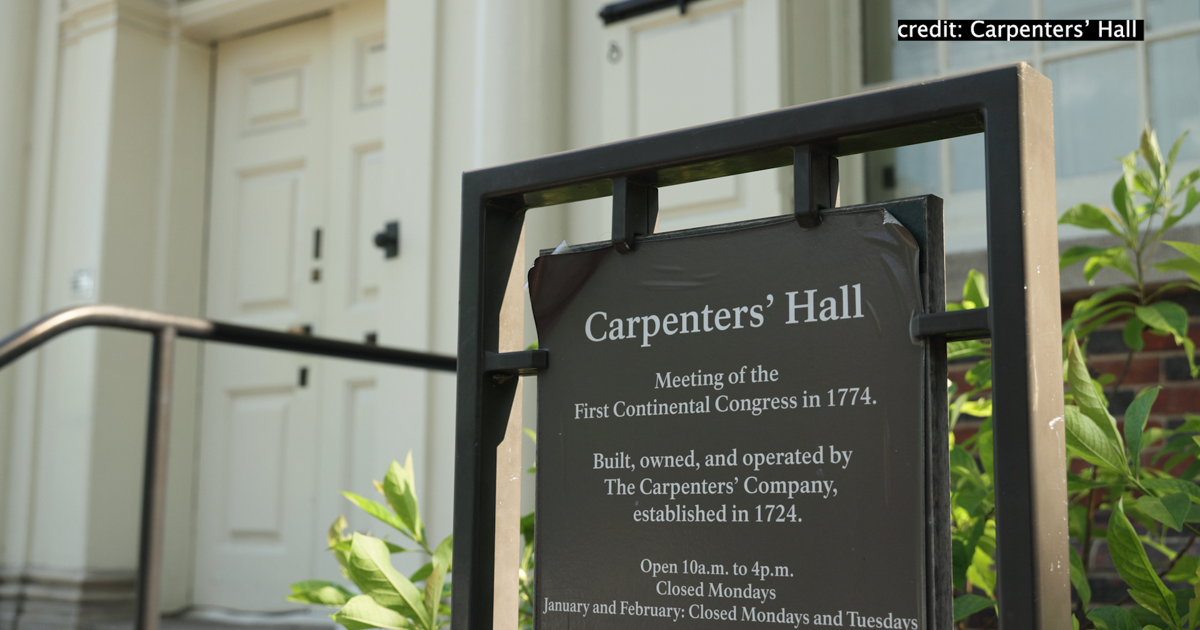
1776 was a busy year. July 4th marks the birth of a new nation—but the same year was also when thirteen colonies each declared their own independence to become “states”.
Today, Carpenter’s Hall and America 250 PA announced a yearlong commemoration of Pennsylvania’s own statehood.
Multiple historical societies, think tanks, and civil rights groups are hosting events honoring the Pennsylvania Provincial Conference and Pennsylvania Constitution.
“There is a year’s worth of events to let people throughout the commonwealth know about that history and about why it’s so important,” said Brent Landau, executive director of the Public Interest Law Center.
In the summer of 1776, the Philadelphia Carpenters’ Company- a guild of craftsmen in the area- thought they’d make some passive income on the building they owned.
“Tthe hall was built as their meeting place,” said Michael Norris, the current executive director of the Carpenters’ Hall. “We rented it out to the first Continental Congress, thus becoming famous and important.”
A second, less discussed delegation met in the hall that same summer though.
Under political pressure, Pennsylvania’s colonial government dissolved in late May of 1776.
“The Continental Congress actually called on the colonies to have these individual convenings,” Norris said.
Representatives from all 12 counties that existed at the time met on June 18 for Pennsylvania’s Provincial Conference. The next day, they declared independence and set about making a new state government.
“If the colonies individually voted for independence, it sort of gave them [the Continental Congress] cover to also, you know, to adopt the declaration,” Norris said.
Later that year, Pennsylvania’s first constitution was ratified.
“There’s not much of the 1776 constitution left in today’s document,” Norris said. “Our current document was last majorly reformed in 1968.”
Fast forward to now– the commonwealth is remembering its roots. This year’s commemoration events include lecture series, town halls, and even polling on reforms to Pennsylvania’s current constitution.
“The idea is for the community to be able to interact and ask questions and and share their views about it, too,” Landau said.
Events will review history, but also educate on how today’s state constitution protects Pennsylvanian’s rights.
“For us, it’s all about- how do you take the history of how our country was founded,” Norris said, “and turn that into a reason for people to want to become civically engaged or more civically engaged today?”