
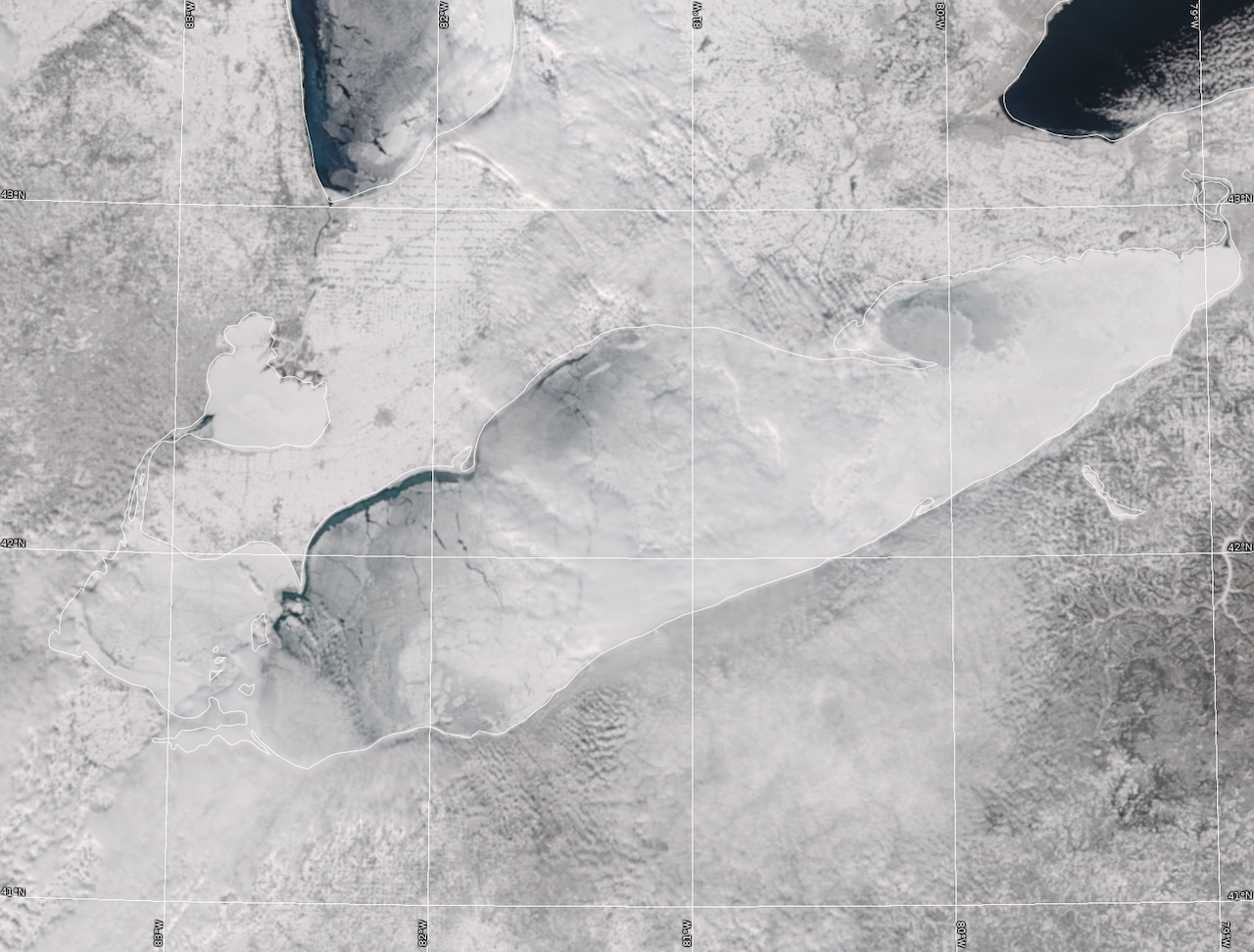
CLEVELAND, Ohio — Clear skies over the Great Lakes on Wednesday gave satellites an unobstructed view of Lake Erie’s rapidly expanding ice cover, revealing just how close the shallowest Great Lake has come to freezing almost entirely.
Recent satellite imagery showed ice blanketing most of Lake Erie, with only small pockets of open water remaining. The view came as the lake’s ice coverage surged well above seasonal averages following weeks of persistent Arctic cold.
Data from NOAA’s Great Lakes Environmental Research Laboratory show Lake Erie’s ice coverage surged from under 2% on Jan. 14 to nearly 85% by Jan. 21 during a prolonged period of Arctic cold. Coverage has increased since then, hovering near or above 95% since late January.
That puts Lake Erie within striking distance of a complete freeze-over. The lake has fully frozen only three times in the modern record, most recently in February 1996.
Cold and calm conditions accelerate ice growth
Meteorologists say Lake Erie’s rapid freeze has been driven by repeated blasts of Arctic air combined with periods of lighter wind, which allow ice to consolidate rather than fracture.
“From mid-January through early February, temperatures have consistently been 10 to 25 degrees below historical averages, aiding in a rapid expansion of ice coverage,” said Brandon Buckingham, AccuWeather’s Great Lakes expert.
Even with sustained cold, whether Lake Erie briefly reaches 100% ice coverage may depend on wind.
“Gusty conditions can shove ice downwind and reopen pockets of open water, preventing the lake from fully sealing over,” Buckingham said.
Ice coverage far above average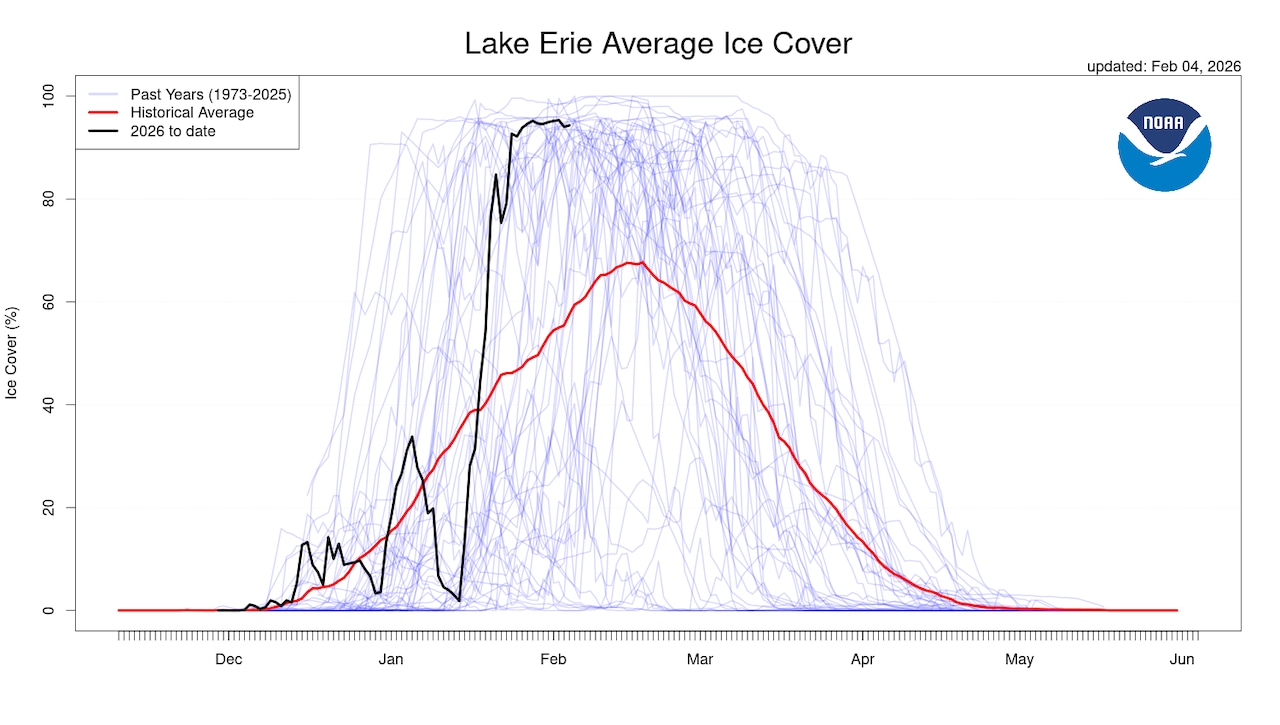 Lake Erie ice coverage as of Wednesday, Feb. 4, 2026.Courtesy NOAA
Lake Erie typically peaks between 65% and 70% ice coverage during a normal winter. This season’s coverage is well above that benchmark and continues a pattern of sharp year-to-year swings.
In recent years, Lake Erie has approached full ice coverage multiple times, including in 2025, 2018, 2015, 2014 and 2011, according to NOAA. In contrast, the lake peaked at just 11% ice coverage in 2023.
The western basin — the shallowest part of the lake — freezes first in most winters, but prolonged cold has allowed ice to expand across much of the central and eastern basins this season.
What comes next
AccuWeather meteorologists say the window for a complete freeze-over may be narrowing as temperatures trend closer to seasonal norms later this month.
“Signs point toward a bit of a warmup in mid-February that may limit the chances of completely freezing if it does not do so over the next week or so,” Buckingham said.
Extensive ice coverage can have ripple effects into spring, especially for shoreline communities. Large ice packs can delay warming near the lake, keeping temperatures cooler into March and April and limiting early-season thunderstorm development.
Despite the frozen appearance, meteorologists continue to warn that the ice is dangerous.
The National Weather Service in Cleveland advises against walking on Lake Erie ice, noting that thickness can vary widely and that shifting winds can rapidly open cracks, even during periods of extreme cold.