
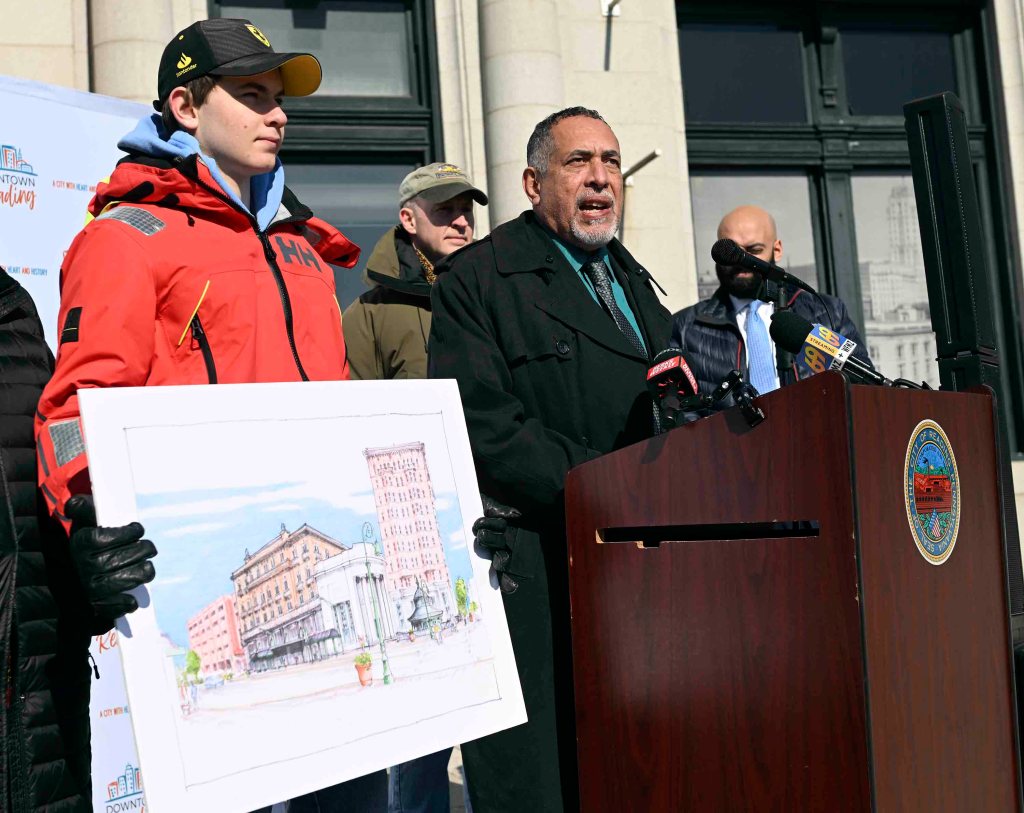
A long-awaited redevelopment plan for a string of vacant buildings at Fifth and Penn streets is a turning point for downtown Reading, city officials said.
Mayor Eddie Moran and developer Alan Shuman in a joint conference announced the $52 million Fifth and Penn Project, a major mixed-use development expected to bring new housing, retail space and restored historic architecture to the heart of the city.
“This is one of the most visible and important corners in our city,” the mayor said, speaking outside the buildings on the northwest corner of Penn Square on Thursday. “And for far too long, it reflected a delayed state of progress. Well, that changes today.”
The project involves a series of parcels from 431 to 443 Penn St., which the city purchased for $2.6 million in 2013. The buildings remained empty and deteriorating for more than two decades despite multiple attempts to spur redevelopment.
Last year, the city demolished two of the buildings, 431 and 433 Penn St., in the interest of public safety.
An adjacent third building has been slated for demolition since June, due to several critical structural issues that pose public safety risks, officials said.
Demolition begun on 2 Reading-owned buildings on Penn Street
The project, Moran said, represents a significant investment in Reading’s downtown corridor and a step forward in broader revitalization efforts.
Shuman, whose firm Shuman Development Group has completed two award-winning restoration projects in Reading, said the Fifth and Penn plan will blend preservation with new construction.
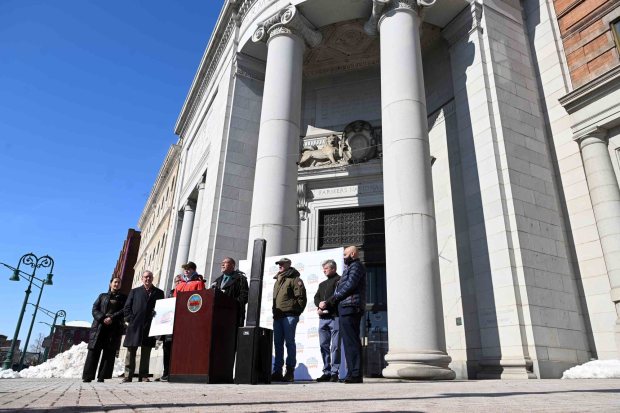 Reading Mayor Eddie Moran announces with developer Alan Shuman a plan for the redevelopment of the properties at Fifth and Penn streets during a ceremony on Penn Square Thursday, Feb. 5, 2026. (BILL UHRICH/READING EAGLE)
“We plan on doing the exact same thing with the two buildings behind us here,” Shuman said, referring to the former bank buildings at 441 and 445 Penn St. “We’re going to be doing historic restorations of the two buildings.”
In addition, Shuman said, a new five-story in-fill building is planned.
Another Penn Street building will be demolished, Reading officials say
Shuman said full development is expected to include about 150 residential units and 53,000 square feet of ground-floor retail space, with a total project cost estimated at $52 million.
The project will require a complex financing package combining private investment, historic tax credits and support through Reading’s City Revitalization and Improvement Zone program, commonly known as CRIZ.
CRIZ is a state economic development tool that allows certain local and state tax revenues generated within a designated zone to be reinvested into that same area to support redevelopment projects.
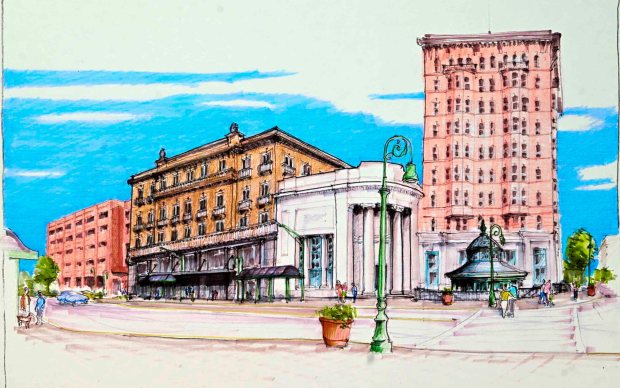 An artist’s rendering of plans for the development of Fifth and Penn streets. (BILL UHRICH/READING EAGLE)
Rather than relying solely on grants, CRIZ helps projects access loans and financing that can be repaid using future tax growth created by the new development.
Peter Rye, chairman of the city’s CRIZ Authority, said the program can be understood as a hybrid that blurs the line between public and private investment.
Rye noted that major development projects often depend on multiple funding sources.
“When it comes to big projects, the funding is always complicated,” he said. “There’s many pieces to it.”
Shuman said some of the private financing is already secured and work could begin next month, at least on stabilizing the most endangered structure, the former bank building at 443 Penn St.
Other pieces requiring CRIZ designation will take time, he noted.
The block is designated as a Keystone Innovation Zone, Rye explained. It needs to be decertified for that program and recertified for CRIZ, a process Rye estimates could take 18 months.
City Council President Donna Reed and Councilman O. Christopher Miller, a preservation advocate whose district includes downtown, hailed the plan as a balance of progress and historic preservation.
They and other city leaders emphasized that the development is part of a broader strategy aimed at strengthening Reading’s downtown economy.
“This project will add residential density downtown, activate street-level space and preserve defining architectural elements,” Moran said.
Moran called the announcement a new chapter for the city center.
“It’s a new day,” he said. “Reading is ready, willing and able to move it forward.”