
First Reading is a Canadian politics newsletter curated by the National Post’s own Tristin Hopper. To get an early version sent directly to your inbox, sign up here.
TOP STORY
This week, B.C. premier David Eby announced that he was appointing an extortion czar to help manage the worsening problem of violent extortions.
Former Mountie Paul Dadwal would be placed in charge of a new community advisory committee to “close any gap between community members and police” in regards to frequent instances of B.C. businesses being shaken down for cash by gangsters.
It’s but the latest sweeping public gesture made by a government official in reaction to news that Canada is increasingly losing control of a major city.
In September, the federal government declared that the Lawrence Bishnoi gang — an organized crime group from India that has been linked to many of the alleged extortions — would henceforth be a designated terror entity. Last week, Public Safety Minister Gary Anandasangaree said he had deputized two RCMP helicopters to help stem the crisis.
And in late January, Surrey City Council called for their community to be placed under a state of emergency.
But the extortion crisis is underlain by two problems that are worsening crime almost everywhere else in Canada.
First, foreign criminals have been able to exploit a porous and overwhelmed Canadian immigration system. Second, a justice system is proving chronically unable to send these foreign criminals home or even keep them in jail.
The result is that Surrey, B.C. is now plagued by threats, shootings and arsons by criminals predominantly targeting the South Asian community.
Criminals send crudely worded demands for cash to homes or businesses, and if the money isn’t paid the victim is met with violence.
When the attacks were first starting up in 2023, the B.C. RCMP circulated an example of what a typical extortion letter looked like. A sheet of paper topped with the word “WARNING,” it explained “we are Indian gang members, we want our share from your business like protection money.”
The letter then adds, “we have links all over do not ignore us, it will efect you realy bad.”
The extortions started with small businesses like auto shops, but in recent months began expanding to more brazen targets such as local media. The studios of Surrey’s Swift 1200 AM were targeted by a shooting attack last September.
And then, starting just after New Years, the attacks massively accelerated. Almost every day this year has seen Surrey Police announce some new shooting, threat or arson attack believed to be perpetrated by extortionists.
On Jan. 19, for example, Surrey Police announced they were investigating a business in the city’s East Cloverdale neighbourhood that had been peppered by gunfire overnight. The next day, a near-identical release concerned a business in the city’s Newton neighbourhood being hit by gunshots.
In January alone, Surrey Police tracked 36 separate extortion attacks.
And those are just the ones being reported to the police. In January, a police investigator told independent journalist Sam Cooper that extortion targets, many of whom are often repeat victims, were losing faith in Canadian law enforcement.
“I’m hearing of people living in hotels and they’re footing the bill for themselves, or they’ve left the country,” he said.
Or, in some cases, they’re reportedly shooting back. Last month, Surrey Police announced that homeowners believed to have fired at alleged extortionists were under investigation for “vigilantism.”
The dual problems of lax immigration and a toothless criminal justice system were probably best highlighted in December, when Surrey Police arrested 15 Indian nationals suspected of extortion-related crimes, only for all 15 to immediately claim status as refugees.
Such an obvious exploitation of Canada’s asylum system drew public condemnation from all three levels of government, with Eby calling the whole thing “ludicrous.”
But it worked; even as Immigration, Refugees and Citizenship Canada vowed in a recent media statement that asylum claims would not shield criminals from punishment, the claims did indeed throw a wrench into Canada’s normal removal procedures for accused criminals.
Reversing such “misuse of the system,” said IRCC, would require an Act of Parliament.
Prior extortion arrests have revealed suspects who entered the country on student visas, capitalizing on an unprecedented surge of temporary migration into Canada that often left immigration officials unable to perform even basic screening.
Vikram Sharma, an Indian national accused of two Bishnoi Gang extortion attacks, was one of hundreds of thousands to enter Canada on a student visa in 2022. That was the same year that the number of study permit holders in Canada would soar to a record-breaking 807,000.
Meanwhile, last month, Crown prosecutors revealed the details of an accused double murderer alleged to have killed a Guelph, Ont., couple in a robbery “less than a month” after arriving in Canada as a student.
Two of the alleged hitmen accused of carrying out the 2023 assassination of Sikh nationalist Hardeep Singh Nijjar in Surrey, B.C. had similarly entered Canada on student visas that the suspects themselves would boast had been “obtained in a few days.”
All the while, in a law enforcement pattern that is now routine in every corner of Canada, arrested suspects are usually given bail. That was the general theme of a small anti-extortion protest in Surrey this week, with protest organizer Rasinder Kaur telling the CBC “the fear in our community is because (perpetrators) are not getting punished.”
“The problem we have is we have criminals knowing that they’re going to come into Canada, commit crimes, get bail, claim refugee status. It’s a matter of fact, it’s not even up for contention,” Ron Chhinzer, a Conservative activist and former anti-gang investigator, told The Hub in an interview last month.
IN OTHER NEWS
Speaking of public trust in law enforcement, the Toronto Police just announced the details of a particularly cinematic instance of Canadian police corruption. Seven Toronto Police officers have been accused of running a criminal enterprise on the side, complete with alleged drug trafficking, murder plots (the photo above is from a police raid related to one such plot) and the handing over of police intelligence to organized crime.
Conservative MP Jamil Jivani has just wrapped up one of the more bizarre foreign adventures by an opposition backbencher. Within hours of announcing that he was heading to Washington, D.C. to try and break the impasse between Canada and the U.S., the National Post obtained a photo of Jivani with U.S. Vice President JD Vance. Jivani also relayed a message home from U.S. President Donald Trump. That message is: “Tell the Canadians I love them.”
It would be hard even for a premier to get this kind of access. When Canadian organizations such as the secessionist Alberta Prosperity Project boast of meeting with White House officials, they’re only ever meeting unnamed low-level functionaries. Jivani is probably managing it because of his friendship with Vance, which goes back to their law school days.
Nevertheless, the Carney government has dismissed the whole thing, and even the Conservative Party doesn’t seem too pleased about it. None of the party’s social media channels made any mention of the trip, nor did leader Pierre Poilievre.
Which is sort of a pattern with Jivani, who is still relatively new to the caucus and doesn’t really jibe with its usual system of lockstep messaging. Right at the start of the 46th Parliament, Jivani came out with a solo campaign to end the temporary foreign worker program, reportedly without prior approval from Tory higher-ups.
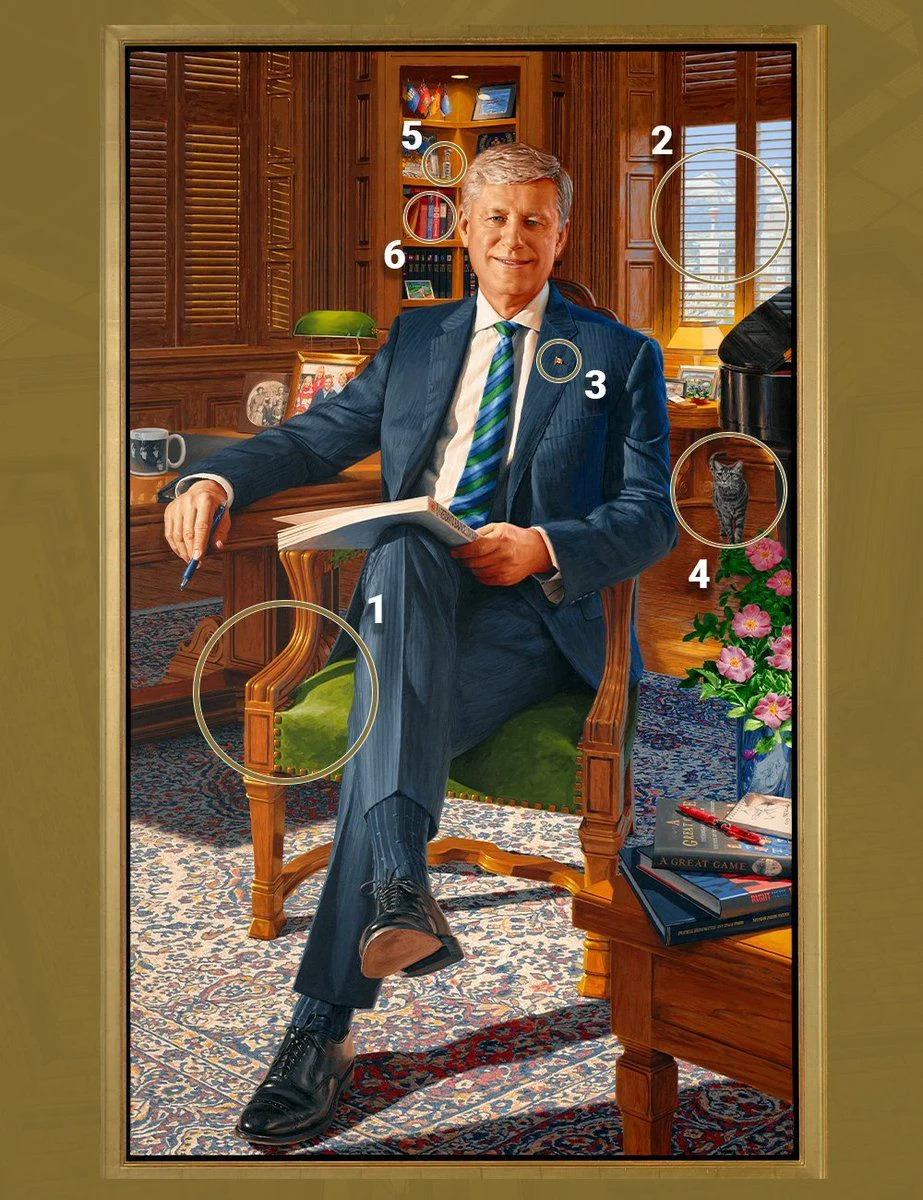
Earlier this week, this newsletter covered the fact that former prime minister Stephen Harper’s portrait was unveiled in the House of Commons. Unmentioned was that the painting was designed to be a Where’s Waldo-style tableau of hidden messages. An official breakdown above, compiled by the Parliament of Canada, notes that the Calgary skyline is outside the window, a French dictionary is on the bookshelf to symbolize Harper’s success at learning the language in adulthood, and his still-alive cat Stanley is in the background. The books in the foreground are all things that Harper has written, including his master’s thesis. And he’s holding the 2015 budget, Canada’s last to be balanced.
First Reading is a Canadian politics newsletter curated by the National Post’s own Tristin Hopper. To get an early version sent directly to your inbox, sign up here.