
The brisk autumn Bethlehem air snaps against the synthetic fabric of Ryan’s tent, the relentless flapping loud enough to wake him. He unzips the oval door of his makeshift shelter and braces for another day of figuring out how he’ll eat.
He calls 211, a nonprofit that connects people to local essential services, and is directed to the Allentown Rescue Mission in search of shelter. But when he arrives, staff tell him there are no openings. With the Supplemental Nutrition Assistance Program facing cuts that affect access to food stamps and no place to stay, Ryan puts it bluntly: He has nothing.
A town over, Rory — newly discharged from the hospital — asks himself, “Where am I sleeping tonight?”
He also calls 211, is driven to a shelter and is turned away. It’s full. He ends up back on the street.
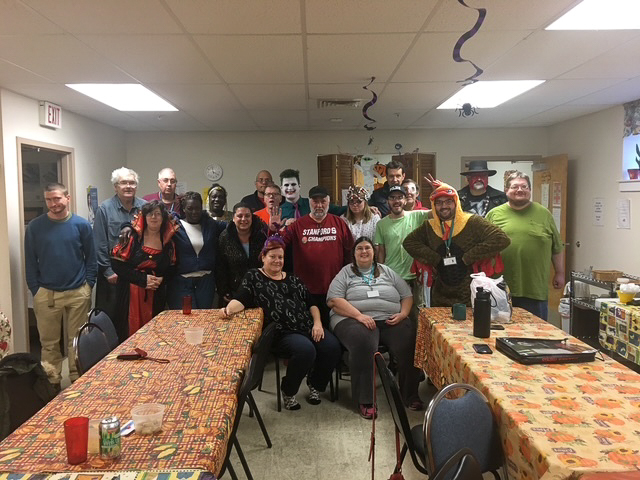
The two men are strangers, yet their parallel struggles lead them to the same place: Recovery Partnership, a Bethlehem nonprofit offering mental health support, community and a place of belonging for people in crisis.
Clients who become friends
Recovery Partnership, located at 70 W. North St., was founded in 1998 under the direction of Bethlehem resident Scott M. Kiefer. The nonprofit was originally funded by Magellan Behavioral Health of Pennsylvania and the Northampton County Department of Human Services. The group’s first initiative — Consumers Networking for Satisfaction — gives discharged patients from the former Allentown State Hospital a voice in their mental health care through surveys and check-ins.
From the start, the organization was peer-run. Every employee had either received mental health services themselves or supported a loved one who had. That lived experience, Kiefer said, shapes the organization’s work and inspired him to lead the project.
In 2001, Kiefer filed articles of incorporation, formally establishing the team as a nonprofit. As services expanded with drop-in centers and a 24-hour support line, the organization rebranded as Recovery Partnership in 2007.
Today, the nonprofit works with thousands of residents annually, completing roughly 700 surveys for Magellan that provide patient feedback. Its Bethlehem and Easton drop-in centers and hotline serve hundreds each month. Anyone in Northampton County age 18 and older living with a mental illness is welcome. Staff refer to them as “the friends.”
Ryan, who’s been homeless for seven years, said he’d heard about Recovery Partnership years ago but didn’t consider it an option for him. Now that he’s actively working toward recovery, while trying to survive without food stamps or housing, he’s been utilizing the organization’s services.
“The community here is top notch, and the people here are so supportive,” he said. “They help me get through hard times.”
But even a passionate, community-driven organization can’t withstand certain pressures on its own.
The consequences of the budget impasse
Every year, Recovery Partnership faces challenges when state or county budgets are delayed. But this year’s Pennsylvania budget impasse pushed the organization to its lowest point.
According to the Commonwealth of Pennsylvania, Pennsylvania must pass its budget by June 30. If lawmakers fail to do so, the state is prohibited from releasing payments until a budget is enacted.
In 2025, the impasse lasted until Nov. 12, leaving organizations like Recovery Partnership without funding for 134 days as they struggled to pay rent, insurance, payroll and operating costs.
For the first time in 28 years, Recovery Partnership laid off employees, and remaining staff were asked to work without the guarantee of a paycheck. The Easton drop-in center closed, and the Bethlehem location stayed open with reduced hours because staff volunteered to work unpaid.
Kiefer’s wife, daughter and sister all work for the Recovery Partnership and felt the financial strain. But he said what hurt the most was how the cuts affected the people who depend on the center.
“We have gone through these tight spots before, but it’s never affected anyone else, and that’s what gets me,” Kiefer said. “I’ve been trying to rebuild trust in our longtime staff and reassure them that this was an exceptional time, not something that will occur year after year.”
Typically, the organization keeps four months of operating expenses in reserve, but the impasse outlasted that buffer. Kiefer and three staff members agreed to continue working without guaranteed pay just to keep doors open.
A dark place of uncertainty
One of those staff members was Kristen Bertucci, the director of human resources, whom Kiefer calls the organization’s “bulldog.” She protested the impasse at the state Capitol wearing an American flag straitjacket.
Bertucci, who’s permanently disabled due to a mental health condition, has been with the organization since 2017 and said it provides her stability and acceptance that she hasn’t found elsewhere.
“Having a place where you’re supported and have the ability to be authentically yourself, and celebrated for a disability, was something new,” Bertucci said. “I used to be in and out of the hospital, and this helped me. But the budget impasse almost pulled me back into that dark place.”
As hours shrank and shelters filled, she became the one delivering bad news to both staff and friends. Clients called asking if they could come in to use the bathroom or charge their phones, and she had to turn them away. She also had to inform longtime staff of the layoffs.
The consequences of the impasse were only exacerbated by the threat of furloughs for human services case workers and potential cuts to Supplemental Nutrition Assistance Program benefits, according to Lehigh Valley Live.
Bertucci said the instability extended from federal-level shutdowns to the county level. According to Lehigh Valley Live, Northampton County didn’t take a treasurer’s loan, which delayed payments an additional month even after other counties resumed receiving funds. Still, she said, staff didn’t lose hope.
“For me in a professional capacity, it was a whole new beast I had never encountered before,” Bertucci said. “It’s hard to come into work with your lunch, faced with the daily choice of watching people starve or saying to yourself, ‘I can skip my lunch today,’ but that’s the reality of it.”
She felt discouraged being the point of contact for staff without having answers. She initially believed layoffs would only last a few weeks. Instead, they stretched into another month.
She also said Kiefer typically shields staff from administrative stress, but this year that was unavoidable.
Advocacy despite frustration
Amid the instability, Kiefer and Bertucci started writing letters to state legislators, senators and community partners. They took out personal loans to travel to rallies across the state for mental health and drug and alcohol funding and attended city council meetings to advocate.
Some lawmakers — including state Sens. Nick Miller, Jay Costa and Lindsey Williams — responded to their letters, though no funding changes followed.
“Advocacy is one of those things where how long can you really continue?” Bertucci asked. “How sustainable is it when it doesn’t seem like anyone is listening. We may be listened to, but we are not heard because action is not taken, and this is not sustainable for one person or one organization that isn’t for profit.”
Rep. Steven Samuelson visited the drop-in center to hear from staff and friends. Kiefer said the goal was to provide a small measure of visibility, knowing no immediate solution would come of it.
Still, both Kiefer and Bertucci said they were frustrated that most responses from officials and community partners were the same: encouragement to advocate more.
“We’re probably the loudest voice coming out of this area,” Kiefer said. “It’s sad that the response we got from funding sources was, ‘Maybe you should advocate.’ That’s all we’ve been doing. Every opportunity we had to advocate, we did.”
Layoffs, stress and isolation
Amanda Brennan, a certified peer specialist and drop-in center employee, was laid off in October but continued to volunteer without pay and took out loans to support her two children and grandchild.
“I was anxiety-riddled,” Brennan said. “If Northampton County doesn’t want to fund a place like this, a place that supports our entire community, if they think social rehabilitation is not important, there’s seriously something wrong with them.”
She said she was consumed by worries about paying her bills and whether staff and drop-in center friends could afford food and housing. It saddened her to see Kiefer, who she said gives so much to the community, struggling.
Mary, a drop-in center friend who attends at least three times a week, said reduced hours during the impasse cut her off from routine and social interaction. The center has allowed her to make friends, learn to cook and enjoy leisure activities such as checkers and cards.
“Elected officials don’t care about any of us, anyone with a mental, physical or financial disability,” Mary said. “They don’t care if we live or die, if we have our medication, if we have a place to live, if we have food to eat. They still get paid.”
Another regular, Michael, uses the center for anger management and coping support, learning skills from staff and working with a behavior specialist. During the impasse, he said he couldn’t reach anyone from the shelter.
“When I have bad moments and a bad temper, I talk to the people in the drop-in center to help me,” he said. “The funding affected me in a lot of ways, and when it got done, I was so happy.”
What next year brings
Through persistent advocacy and reliance on community partners, Kiefer said Recovery Partnership has rebuilt roughly six to seven months of financial cushion for the next fiscal year.
While another budget impasse would still be upsetting, he said the organization would be less vulnerable. He said he hopes the relationships built during the crisis will help in the future.
Bertucci hopes for a policy change that would redirect lawmakers’ pay during an impasse to the Department of Human Services and said it’s unconstitutional for the government to withhold funds because of its failure to produce a budget.
For now, the organization continues leaning on one another. As a peer-led program, many staff members and friends consider each other family — spending holidays together and providing support during crises.
“The support we give out to the community strengthens everyone around us,” Brennan said. “We support a part of the community that nobody cares about, and we are like family to each other.”