
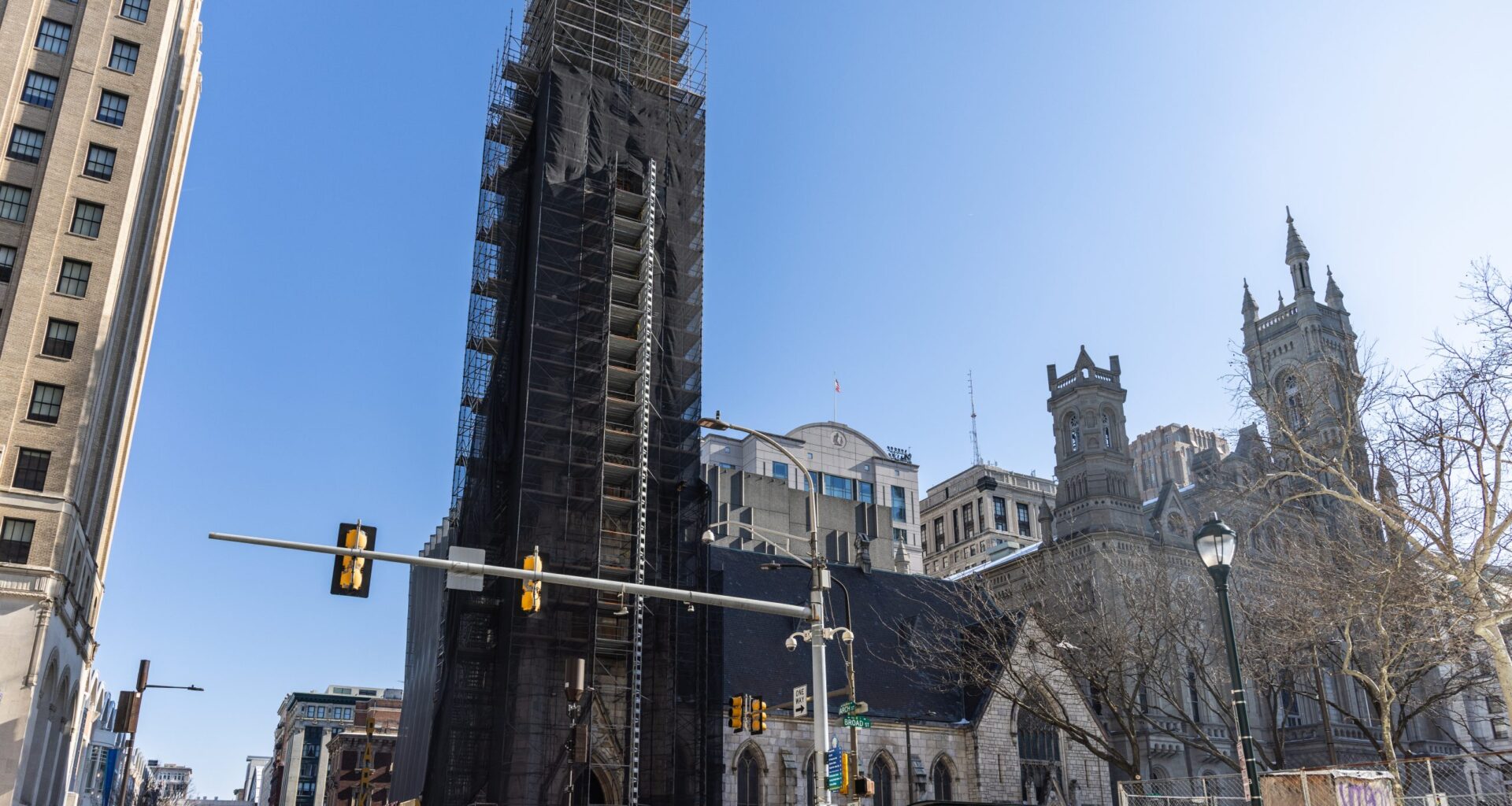
Rev. Robin Hynicka took a chilly ride on a snow-covered construction lift up the side of Arch Street United Methodist Church last Wednesday afternoon. He clanked up metal stairs through five levels of scaffolding and ascended a ladder to emerge on a platform surrounding the marble cross topping the building’s steeple.
Standing about 210 feet above the corner of Arch and Broad streets, he surveyed the view — William Penn looming over City Hall just to the south, Broad extending north to the horizon, a crowd of skyscrapers to the west — and recalled making his first visit to the top of the church last year.
“Jokingly, someone said to me, ‘That’s probably the closest you ever got to God,’” Hynicka said with a grin. “I said, ‘No, I get close to God every day.’”
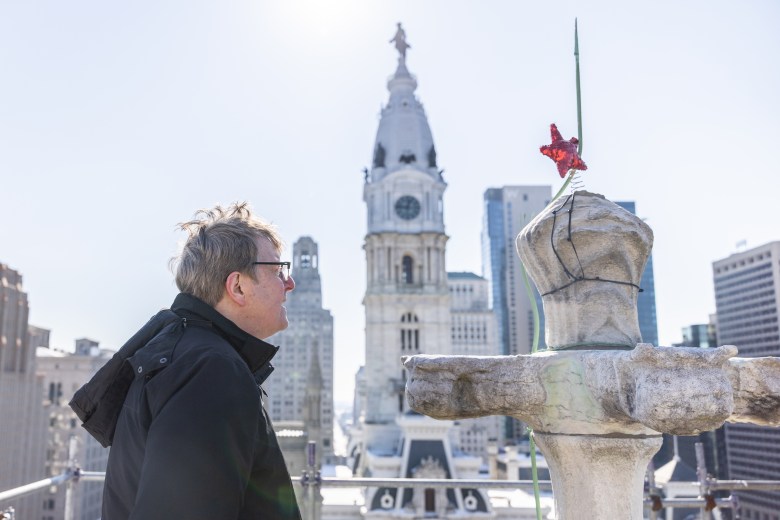 Arch Street United Methodist Church lead pastor Robin Hynicka at the stone cross on top of the church nearby Philadelphia’s City Hall (Kimberly Paynter/WHYY)
He and his flock do that largely through worship, Bible study, and the advocacy work that is a hallmark of United Methodist congregations. The “radically inclusive” church provides space for social justice activists to hold meetings and runs a busy daily drop-in center that offers hygiene supplies, hot showers, health care and housing counseling for Center City’s unhoused residents.
But Hynicka said the church’s ongoing, $6.7 million renovation project — which has kept the landmark, 155-year-old building surrounded by scaffolding of one kind or another for nearly eight years — is also playing a critical role in Arch Street UMC’s sacred work.
“We have a unique place in the midst of the hospitality industry, municipal government and commerce, to be a symbol of equity, a symbol of justice, a symbol of loving kindness. We’re also a center where folks gather to contemplate and prepare to act in ways that bring greater justice and equity into the world,” he said. “And if we don’t maintain this building, that goes away.”
After several years of fundraising, the church finally launched construction last year. Workers erected the scaffolding, replaced or repointed deteriorating bricks, and started addressing damage from a 2024 electrical fire covered the interior with smoke and soot. When the weather improves, they’ll replace the roof and fix worn exterior marble and buttresses.
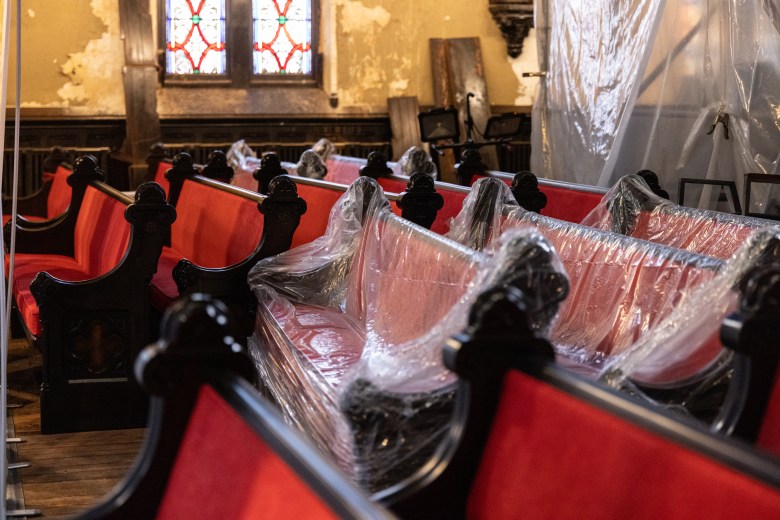 The Arch Street United Methodist Church had parts of their church pews transformed to honor the history of the church. (Kimberly Paynter/WHYY)
Hynicka said he’s hoping the work will be largely finished by late spring, just ahead of his scheduled retirement in June, after 21 years at the church.
It’ll be up to his successor and the congregation to do additional needed work — plastering, painting, replacing carpet and reconfiguring the main sanctuary — under the protection of the refurbished spire and newly installed slate roof.
“It’s gratifying to know that it’s not going to leak for 100 years. You have 100 years to get all that done over time,” he said. “That’s really a legacy I’m glad I can leave.”
Key congregational support
When Hynicka became Arch Street’s pastor in 2004, he knew there was plenty of deferred maintenance to address, as there is at many of the city’s historic religious sites. The trustees ordered up an architectural master plan and raised funds to restore the main stained glass window on the sanctuary’s south wall.
In 2017, an inspection revealed problems with the external masonry and the church put up scaffolding over the adjacent sidewalks to protect passers-by while repairs were made, Hynicka said.
An inspection of the steeple two years later, done in part with a drone, found loose tiles on the exterior, worn marble elements, and potential for spalling or chipping of bricks due to weakening mortar inside the cone of the spire. While the structure was basically stable, the city issued safety citations that could have forced the building’s closure. The church spent about $150,000 to install a giant net over the building.
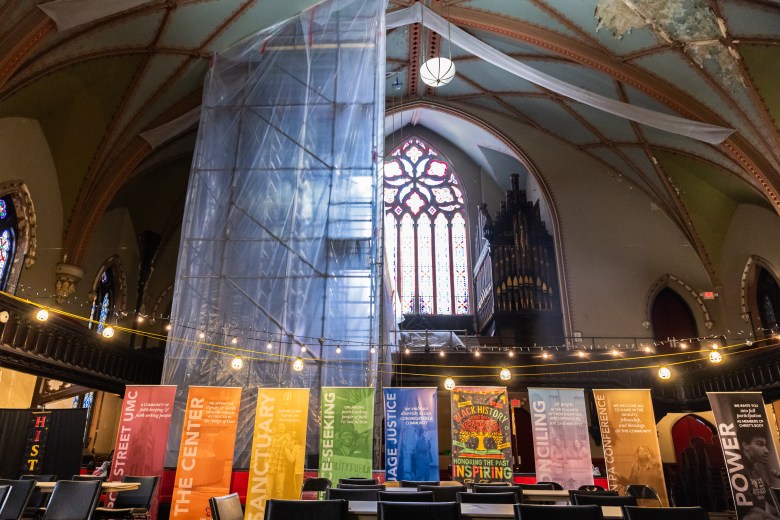 Scaffolding built inside the Arch Street United Methodist Church during a multi-million dollar restoration. (Kimberly Paynter/WHYY)
“That was because of how long it was taking, really, to raise the money and to get all of the construction documents ready,” Hynicka said. “We just did that extra measure of protection so that we could report out to the city that we were doing our due diligence. It’s such a mammoth project to be able to raise that kind of money.”
Funding slowly trickled in. The Philadelphia-based National Fund for Sacred Places awarded the church a $125,000 matching grant and the state’s Redevelopment Assistance Capital Program provided another $1 million.
But the bulk of the dollars — more than $5 million so far — ended up coming from Arch Street UMC’s core congregation of about 70 members, and the 100-plus Sunday meal volunteers and others who make up the church community. Contributions exceeded expectations, allowing the church to add the roof replacement project.
One member, who has chosen to remain anonymous, provided a crucial donation of more than $4 million, Hynicka said.
“It’s the historic preservation, it’s the community engagement work that we do, and it’s the serving of our most vulnerable neighbors: those three points hit that person’s sensibilities in a way that they wanted to make that kind of investment,” he said.
A symbol of God’s creation
The construction firm CVMNEXT installed the tower scaffolding last fall. Its long steel legs pierce the sanctuary roof, fill a corner of the ornately decorated, high-ceilinged space, and go through the floor to rest on shoring props in the basement.
“As disruptive as that looks, they’ve made it the least disruptive we could possibly do it, because even downstairs, there’s much of our daytime services, programming with unhoused, unsheltered neighbors,” Hynicka said. “That has not been disrupted at all.”
Outside, the protective ground-level scaffolding, a fixture of the neighborhood over the previous seven years, was dismantled. The sidewalks at Arch and Broad were fenced off to create a construction staging area and barriers placed in the street to form a pedestrian path.
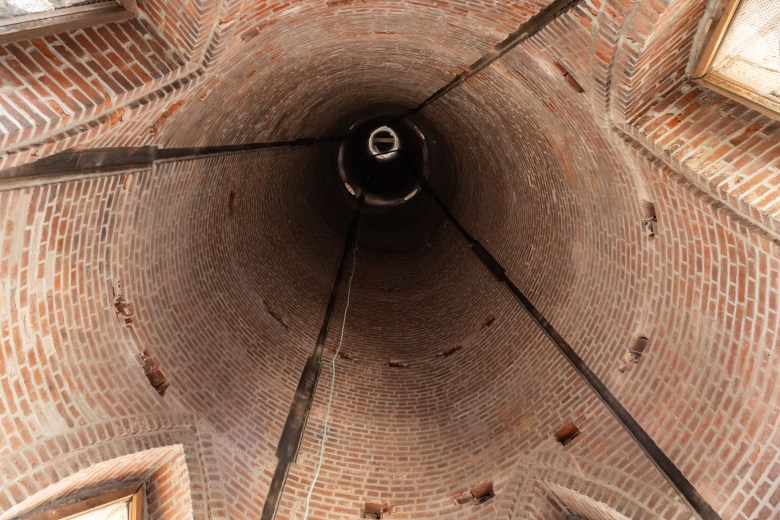 Completed brick pointing along the spire of the Arch Street United Methodist Church during a multimillion restoration in 2026. (Kimberly Paynter/WHYY)
For months, workers took the lift up to the spire and climbed inside the structure to painstakingly restore the cone, project supervisor Mike McKain said during a tour Wednesday. “There’s two layers of brick between this and the marble on the outside,” he said, pointing to a newly built section of the interior wall. “All of it was repointed. Some of it was replaced.”
As he and Hynicka continued climbing up steps, the pastor pointed out boarded-up windows, buttresses, and worn marble ornamentation slated for repair once the weather improves.
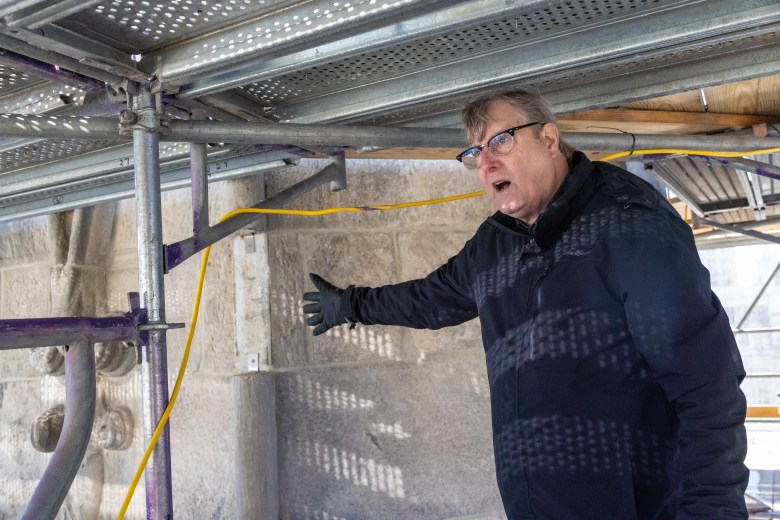 Arch Street United Methodist Church lead pastor Robin Hynicka gestures to the church’s stone exterior high up on the scaffolding during a multi-million dollar restoration project. (Kimberly Paynter/WHYY)
“We’re waiting now to fabricate the marble rolls that go on the edge. Some of them are replaced completely, some of them are partially replaced,” he said. “No two are the same, so you can’t just create a template for one and manufacture all the ones you need. They are all different. Again, adding to the intricacy of the whole job.”
They reached the final platform, where a marble cross tops out the building, its tip reaching 218 feet above the street, not counting a lightning rod and a shiny red Christmas star McKain added at the request of Russ Alexander, president of the board of trustees.
The cross’s four extended arms end in deeply weathered bulbs that Hynicka said may have once been animal faces or other sculptured figures. “All I know is it does symbolize sort of God’s creation, and care for creation,” he said. They will be removed and new marble pieces will be fashioned to replace them, McKain said.
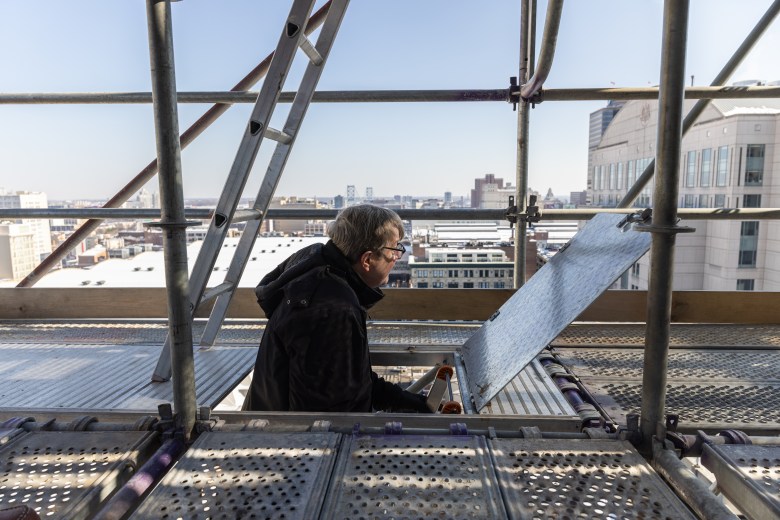 Arch Street United Methodist Church lead pastor Robin Hynicka climbs the scaffolding installed for a multi-million dollar restoration project. (Kimberly Paynter/WHYY)
A bird’s-eye view panorama of Center City spread out around them. The scaffolding swayed slightly in the cold wind.
“You don’t get [a view] like this unless you work in a high-rise office building or can afford a pretty hefty rent, or own a condo on the top floor,” Hynicka said. “Even still, the unobstructed view of all of Arch Street east and west, a pretty much unobstructed view of Broad Street north and south— it’s pretty phenomenal.”