
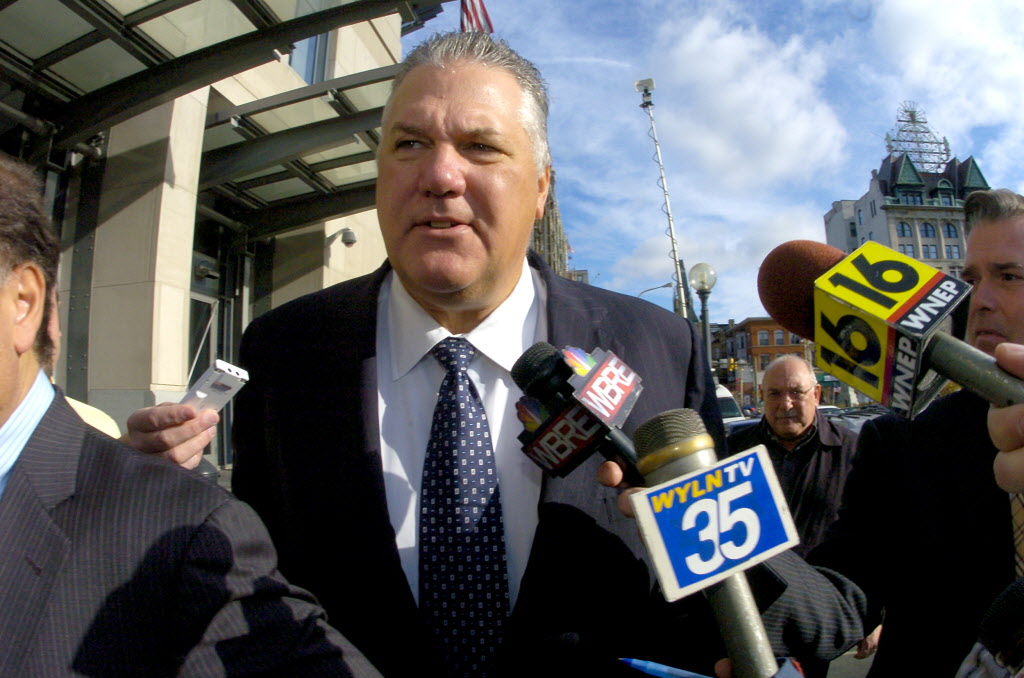
Former area attorney and kids-for-cash figure Robert Powell was sentenced Thursday to four years in federal prison for evading millions in taxes and using his ill-gotten gains to live a lavish lifestyle in a Florida mansion — driving luxury vehicles and sending his children to prestigious private schools.
Powell, 66, of Palm Beach, Florida, pleaded guilty in August 2024 to evading taxes connected to over $18 million in legal fees he earned over a 12-year period at his former Luzerne County-based firm, The Powell Law Group.
While the exact amount of tax loss remained disputed, the parties agreed for sentencing purposes that Powell failed to pay somewhere between $1.5 million and $3.5 million in taxes.
During Powell’s sentencing hearing Thursday afternoon, U.S. District Judge Malachy E. Mannion characterized the now-disbarred attorney as a “recidivist” and a “fraudster” who was motivated by his own greed.
“You wanted to make sure you kept more and paid less,” Mannion said. “Instead of a Maserati, try a Mazda next time.”
The judge went on to chide the Powell for “liv(ing) in the lap of luxury” and evading taxes after having previously served time in federal prison in the kids-for-cash case.
“It’s almost flabbergasting to me, but it is indicative of a disease called greed,” Mannion said.
The U.S. Attorney’s Office had asserted that Powell owed the government more than $7 million he failed to pay during a tax evasion scheme of “staggering” scope.
In a sentencing memorandum filed ahead of Thursday’s hearing, prosecutors noted that Powell used the money to purchase a variety of luxury items, including a $2.6 million mansion in a Palm Beach Gardens gated community, a $1.25 million sportfishing yacht, and multiple high-end vehicles — a Maserati, a Land Rover and a Mercedes-Benz.
Powell used the money to put his children into “various prestigious private high schools and universities” and lodged one of them in a “high-end, off-campus residence” that cost Powell $115,200 in rent, wrote Assistant U.S. Attorney Ravi R. Sharma and Alexandra K. Fleszar, a trial attorney with the Justice Department’s tax section.
In addition, Powell ensured that his family received monthly payments of $30,000.
“As Powell Law Group and its employees struggled to keep the lights on, Powell lived large,” the prosecutors wrote.
They argued that the “complexity and intricacy of the defendant’s scheme cannot be overstated” and urged the court to impose a sentence of five years in prison — the maximum — followed by three years of probation.
The prosecution also sought to have Powell pay $5.6 million in restitution — $3.5 million in unpaid taxes plus $2.1 million in interest.
“The defendant evaded taxation on more than $18 million worth of income for over a decade and then doubled down on his misconduct by lying to the IRS, all after having served a term of imprisonment for prior felony offenses, including a tax crime,” the prosecutors wrote. “This is egregious conduct that warrants a significant term of incarceration.”
Powell’s attorney, Stephen S. Stallings, has argued that the government’s estimate of $7 million in unpaid taxes was off the mark by more than $4 million due to accounting “mistakes.”
In court Thursday, Stallings sought a lesser term than the maximum five-year sentence Powell faced. While prosecutors argued Powell’s actions amounted to a sophisticated scheme, Stallings contended a mere failure to file taxes is “the opposite of sophisticated.”
He also maintained that Powell has continued to file his tax returns — as required by his plea agreement — because of the financial cost as well as a potential “incrimination situation” that could have arisen.
Fleszar countered that Powell did in fact take sophisticated steps to evade paying his taxes, including lying to auditors and shuffling money between various accounts.
“It’s not a matter of simply not filing tax returns,” she said.
Prosecutors asked the judge to impose the maximum sentence due to his history and the “sweeping scheme” he set into motion.
“His conduct makes clear that to Mr. Powell it did not matter who pays the consequences,” Fleszar said. “The defendant cared only about lining his own pockets at the expense of others.”
Powell chose not to address the court about his conduct, offering only a brief expression of appreciation to his attorney.
“Mr. Stallings has done everything that I think is appropriate from a legal standpoint,” Powell said.
In imposing the sentence of four years in prison followed by three years of probation, Mannion took exception to the defense suggestion that Powell’s crime was based in an oversight.
“There’s no mistake here,” Mannion said. “Robert Powell, unfortunately you’re a fraudster. You’re a recidivist.”
In addition to the prison time, the judge ordered Powell to pay $3.5 million in restitution, but he waived the interest payments requested by the prosecution.
Powell will also be required to pay a $100,000 fine as part of his sentence.
Mannion ordered him to report to the federal Bureau of Prisons to begin serving his sentence Feb. 27.
Powell previously served a year and a half in prison for failing to report a felony and being an accessory to a conspiracy in connection with Luzerne County’s infamous “kids-for-cash” case.
Prosecutors say Powell paid $770,000 to two corrupt county judges, Mark A. Ciavarella Jr. and Michael T. Conahan, who in turn funneled juvenile defendants to two private, for-profit detention centers Powell partly owned.
After being sentenced to 17½ years in prison on racketeering conspiracy charges, Conahan, 73, saw his sentence commuted in December 2024.
Ciavarella, 75, continues to serve a 28-year prison sentence at Federal Correctional Institution-Butner in North Carolina on honest services mail-fraud charges.
He is scheduled to be released on June 18, 2034.