
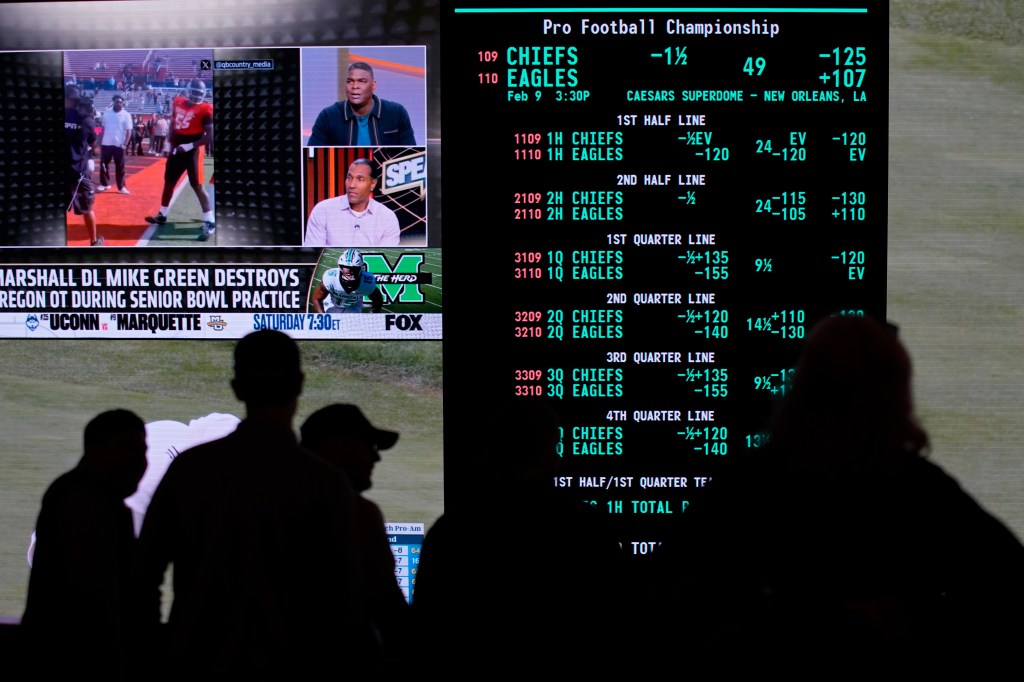
When the U.S. Supreme Court struck down the Professional and Amateur Sports Protection Act enabling states to set their own regulations for sports betting in 2018, Pennsylvania’s Gambling Hotline received 35 calls and 1,600 requests for self-exclusion.
In 2025, it received more than ten times the number of phone calls and almost four times the exclusion requests.
As the state prepares for a record-breaking betting weekend with the Super Bowl on Sunday, local recovery experts are left worried that the “ground surge” of online gambling is outstripping the state’s ability to treat it.
This leaves those who lose more than just the game out to dry.
“Sports betting didn’t really exist in Pennsylvania before 2018, except in the form of a few, small, under-the-table businesses,” explained Doug Harbach, the Director of Communications at the PA Gaming Control Board. “Since then, though, it’s just exploded, with operators popping up all over the state and internet.”
Today, sports betting is currently the fastest-growing form of gambling in the country, outstripping both brick-and-mortar casinos and I-game gambling apps, with total wager values only ever increasing.
In Pennsylvania, the industry has found a ready home, making the state the 5th-highest source of sports wagers in the country, and with Sunday’s Super Bowl, the state is about to place its most wagers of the year.
In 2018, the PGCB reported that the total amount wagered on sports betting was approximately $245 million; in 2025, the total reached $4.5 billion, 96% of which was placed through online operators, such as FanDuel, DraftKings and BetMGM. The other 4%, comprising $206 million, was split between retail casinos across the state, such as Mohegan Casino in Plains Twp., which handled $1.1 million in wagers last year.
With so much money involved, betting operators have made advertising a priority. In 2021, online gambling operators spent $1.4 billion on TV advertising, according to Nielsen Media Research, though much of that has since shifted to other media platforms.
“The PGCB regulates gambling ads very rigorously; we have whole teams dedicated to making sure that companies don’t mislead their audiences,” continued Harbach. “What we don’t regulate is who views the advertisements, or what platforms they use to broadcast their advertisements.”
Many sports betting advertisements appear on social media, in phone applications, or even on the jumbotron screens in sports arenas, all in addition to the television advertisements already filling the media sphere. Often, they will display ongoing in-app promotions, such as free bets or welcome bonuses, to entice prospective players or instill a fear of missing out.
However, these are not the only tactics betting operators use to attract new customers.
“Since regulations were reduced in 2018, we’ve definitely seen an increase in the number of gambling advertisements people are seeing, as well as a shift in the tone,” explained Michael Gagliardi, the Drug and Alcohol Administrator for Luzerne County. “Nowadays, a lot of companies are portraying sports betting as a fun activity to do with friends; a way to enhance the viewing experience. It leads to a lot of younger people getting drawn into the idea of gambling, even before they’re able to gamble themselves.”
In Pennsylvania, a person cannot bet on sports events until age 21, and the activity is heavily regulated by the PGCB. Online gambling operators are required to maintain strict “Know Your Customer” systems, which require a person to verify their age, identity and physical address before they are allowed to gamble money.
“The trouble is that these ads prime kids towards gambling before they’re old enough to understand the risks. Then, when they reach adulthood, they make an account and gamble their money away,” said Gagliardi.
“Social media can play a part in this, since kinds of chat groups these teenagers will hang out in will often brag about their wins while keeping quiet about their losses.”
But some addiction recovery workers feel it goes further than that, arguing that non-gambling media is also playing a role in the spread of gambling.
“A lot of online video games these days include what are called ‘loot box’ mechanics, where you can pay in-game or real-world currency to buy boxes of game rewards that can have jackpot prizes or near-worthless ones,” detailed Eileen Panzerella, the Prevention Director at the Pathway to Recovery addiction clinic in Hazleton. “This trains kids to feel comfortable with risk and desensitizes them towards feelings of disappointment when the risk doesn’t work.”
The PGCB maintains a gambling hotline where people can call in to receive immediate support in locating addiction recovery resources, as well as a self-exclusion list, which people can use to ban themselves from online and in-person gambling operators. Both systems have seen a dramatic increase in usage since sports betting was legalized in 2018
“The issue is that the population of gamblers in the state has grown faster than the support network used to help them. The state runs a training program to teach therapists how to work with people suffering from a gambling disorder, but the slots are always full,” stated Panzerella. “Fortunately, support does exist, so once a person realizes they have a problem with gambling, there is a way for them to find at least some help.”
When asked about when people realized they had a problem, Gagliardi simply replied: “When it’s too late.”