
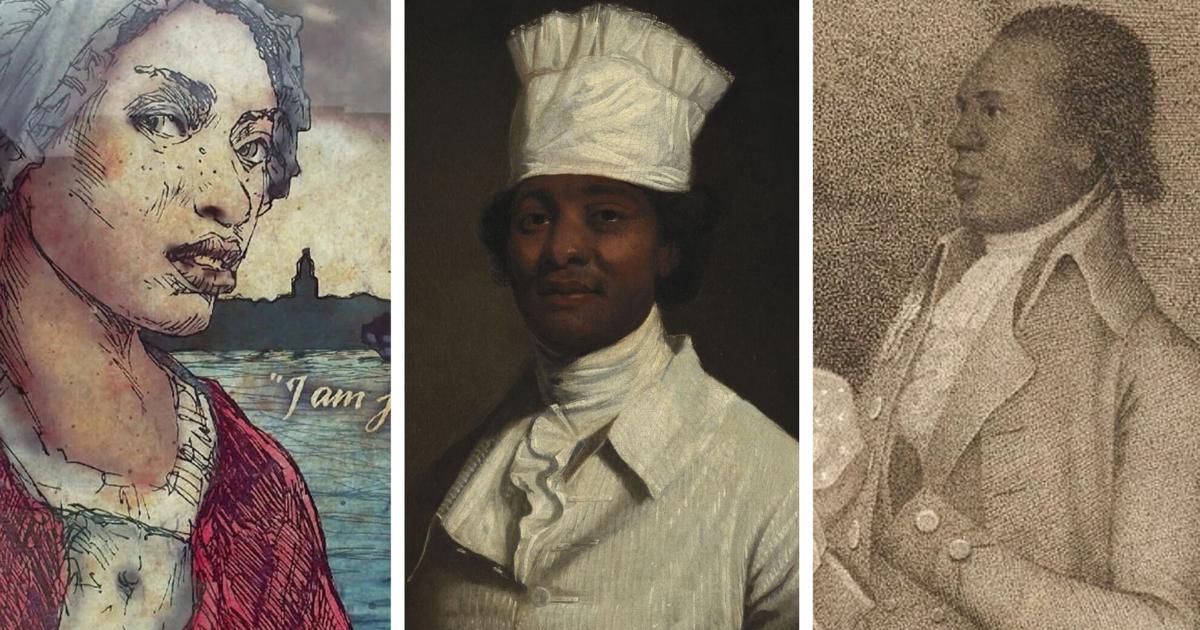
At the center of the controversy in the tearing down of the President’s House exhibit at 6th and Market streets are the nine Africans, who were enslaved by our nation’s first President George Washington.
It’s been almost two weeks since workers from the National Park Service stripped informational panels at the memorial following executive orders by President Donald Trump, who flagged the area and others like it across the country, that focused on slavery. In his explanation, Trump flagged the exhibits for portraying the nation in a negative fashion.
The city has since filed a lawsuit against the federal government for breaking a contract that states communication is mandated between the city and the federal government in case of changes to the exhibit. The federal government has argued the contract expired.
Little was known about the nine enslaved persons until a local group of grassroots and political leaders such as attorney Michael Coard and Rosalyn McPherson, came together to establish the memorial 15 years ago.
Since imagery, technology and photography were almost nonexistent during the time of Washington’s tenure in office, images of each person are almost nonexistent.
Their names were Austin, Christopher Sheels, Giles, Hercules, Joe Richardson, Moll, Oney Judge, Paris and Richmond.
In addition to the nine enslaved at the house in Philadelphia, Washington owned about 100 slaves, though he repeatedly voiced opposition to slavery in personal correspondence, according to “Slavery and Washington’s Presidency.”
However, Washington did not go so far as to make the abolition of slavery a cause during his presidency from 1789 to 1797. He considered ways to purchase freedom for his own slaves, although he didn’t in the end. He tried to sell or lease property at Mount Vernon and elsewhere in order to gain money to finance losses that would have been incurred from setting his slaves free.
In the end, the sale of Mount Vernon fell through, and Washington held on to his slaves. He also considered purchasing slaves owned by his wife’s family, the Custis Estate, and setting them free, but he discovered that he did not have the legal authority to do so.
In a larger societal way, Washington said he believed the union was too fragile to push for major change, at the time. In 1793, Washington signed the Fugitive Slave Law making it a federal crime to assist those who had escaped slavery or to interfere with their capture across state lines. He also signed the 1794 Slave Trade Act, which restricted U.S. participation in the trafficking of human cargo.
“The common denominator of the problems they had with the site was telling the horror of slavery, not just the captivity, not just the harsh labor, but we talked about the beatings, the whippings, the lynching and the rapes and the sodomy,” Coard said of Trump and the memorial. “He didn’t like it because it graphically exposed exactly what slavery was about.”
Austin
He was the infant son of Betty, a woman who was enslaved to Martha Washington before she married President Washington. The first lady brought Austin and Betty with her to her new home with the president at Mount Vernon in Virginia.
According to the White House Historical Association and The Rubenstein Center, Austin was likely the son of a white man and considered to be fair-skinned. He became an enslaved waiter inside the president’s mansion and was occasionally a carriage footman.
According to Rubenstein, after he was brought to Philadelphia to work at the President’s House, he may have passed messages between Black family members who lived in Philadelphia and Virginia, where he had additional siblings.
Some records indicate Austin may have had a wife and five children who were all inherited by George Washington Parke Custis, the first lady’s family, and were moved to Arlington House. Austin died in December of 1794, shortly after he suffered a stroke while riding his horse.
Ona Marie Judge
She was the half sibling of Austin. According to the Library of Congress and a book by Erica Armstrong-Dunbar, Ona was responsible for drawing Martha Washington’s bath, preparing her clothing, brushing the first lady’s hair, tending to her when she was ill and traveling with her on social calls.
Ona disappeared while the Washingtons were sitting down to dinner. A $10 reward was offered for her return, in a newspaper advertisement that read: “She may attempt to escape by water. All matter of vessels and others are cautioned against receiving her onboard … She will probably endeavor to pay as for a free woman — and it is said that she has the wherewithal to pay her passage. Ten dollars will be paid to any person (white or black) who will bring her home, if taken in the city, or aboard a vessel in the harbor. And a further reasonable sum, if apprehended and brought home — for a greater difference and in proportion to the defiance.”
According to “Timeless: Stories from the Library of Congress,” Ona ran away when she learned that she was to be given away as a wedding present to the first lady’s granddaughter, Elizabeth Parke Custis Law.
Ona, whose mother was interracial and whose father was a white English tailor, was nearly captured two years later, but she fled with her infant child when she received a warning. She somehow made her way to New Hampshire where she married a free Black sailor named Jack Staines and had three children.
She lived the rest of her life as a free woman, according to Mount Vernon historians. During an 1845 interview with the “Anti-Slavery Bugle,” newspaper, Ona, was quoted as saying that she just “wanted to be free.”
Christopher Sheels
He was the son of an enslaved spinner at the Washingtons’ Farm House. Sheels had eight siblings and was close to his uncle William Lee who was Washington’s former manservant.
Sheels later became Washington’s sole attendant in Philadelphia, for a brief time. According to records, Sheels was literate and was able to read and write.
The president may have been concerned he would learn about the 1780 Gradual Abolition Laws that legally set slaves free, in Philadelphia after a six-month residency requirement.
In September 1791, Washington sent Sheels back to Virginia, from Pennsylvania, permanently.
Hercules
He served as a cook for the Washington family and was charged with preparing elaborate dinners for the first family.
Hercules started as an 11-year-old errand boy who worked in the kitchen and was also a chimneysweeper. He eventually served the Washington family in Philadelphia with his own son, Richmond, whose siblings Evey, 8, and Delia, 5, remained in Virginia at Mount Vernon.
Washington was surprised when Hercules ran away on the president’s birthday on Feb. 22, while he was assigned to lay bricks.
Hercules was never found and he was believed to have escaped using money tucked away from the approved sale of “leftover slops” from the Washington family’s dinner table.
Hercules is believed to have run away to New York and lived there for 15 years until he died in May 1812. Records show he was buried at the Second African Burial Ground in Manhattan, New York.
Richmond
He was Hercules’ son, who was caught stealing. Washington had worried Richmond was trying to steal funds in order to escape slavery. The president demoted Richmond from domestic work to field hand to make him an example.
Moll
She was an enslaved woman with whom first lady Martha Washington also brought with her to Mount Vernon with her when she married the president in January 1759. Moll worked as a seamstress and nanny for the first lady and her children and grandchildren.
Moll likely slept on a thin, straw mattress at the foot of Washington’s bed.
Joe
He joined the President’s House in Philadelphia after 1790 and slept in the stables with the other grooms, postilions, carriage drivers and footmen.
Joe married Sall, with permission from the president. He was in his early 20s when he left for Philadelphia and was forced to leave Sall and their three children Henry, 7, Elijah, 3, and Dennis, 1, all who remained in Virginia.
Joe and other enslaved workers were sent back to Virginia, periodically, to avoid emancipation laws that would have made them free had they remained in Philadelphia.
According to “Slavery and Washington’s Presidency,” the first U.S. president instructed his secretary to move the slaves “in a way that will deceive both them and the public.”
Giles
He was President Washington’s footman and occasional driver. Giles often wore a fancy livery uniform with a coat, vest, and breeches in the colors of Washington’s coat of arms.
In 1778, Giles accompanied the first lady to Valley Forge and in 1787, he went to Philadelphia to tend President Washington’s horses and drive his carriage while the president attended the Constitution Convention.
As the president’s trusted messenger, Giles made multiday journeys across several states. He accompanied the president on tours of the Northern and Southern states and was one of only a few enslaved men to ever visit all 13 U.S. states.
Giles was sent back to Mount Vernon after he injured his knee during a tour of the South and was no longer able to ride a horse. He died in Virginia a few years later.
Paris
He worked closely with Giles as a position. The two likely wore matching livery uniforms and may have roomed together in slave quarters near the stables.
Washington was critical of Paris, calling him “lazy, self-willed, impudent,” and added that Paris “had no sort of government in him,” and would do nothing that he was ordered to do. He was sent back to Mount Vernon and died in 1794 when the plantation was hit by a wave of disease.
Stay informed and connected — subscribe to The Philadelphia Tribune NOW! Click Here