
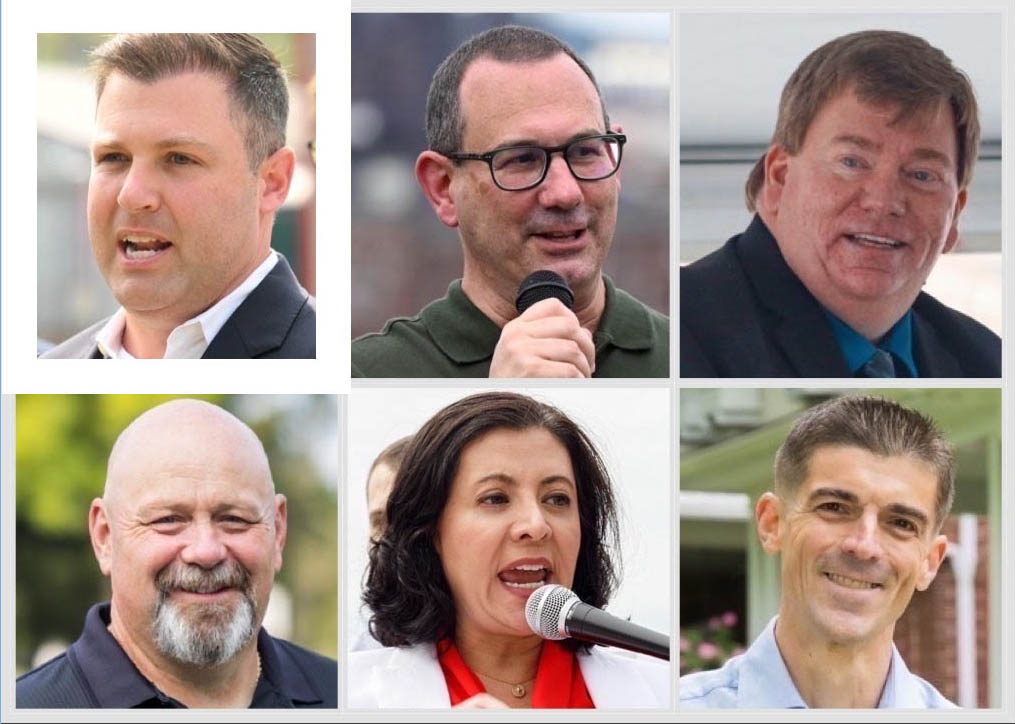
U.S. Rep. Ryan Mackenzie and the crowded field of Democrats vying to replace him in Congress drew their donations from local CEOs, major political action committees and other notable individuals.
The race is considered one of the most competitive in the country and could determine which party has control of the House of Representatives next year.
Here is a close look at where the candidates’ money came from in the final three months of last year, and how they spent the contributions.
Ryan Mackenzie
Mackenzie brought in just over $651,000 in campaign contributions in the fourth quarter, which covers October through December.
Notable donors to Mackenzie’s campaign include Stephen Schwarzman, billionaire CEO of the private equity firm Blackstone, who gave $7,000; and Howard Leach, business executive and former U.S. ambassador to France, who gave $5,000.
Locally, Mackenzie received donations from James Deiter, president of local HVAC contractor Deiter Bros.; former Lehigh Valley Health Network CEO Brian Nester, now chief operating officer of Jefferson Health; and Douglas Woosnam, executive vice president of the Eastern Pennsylvania Energy Association. Via a joint fundraising effort, Mackenzie also received $7,000 from David Jaindl, owner of Jaindl Farms and Jaindl Land Co.
Major political action committee donors include $7,000 from Associated Builders and Contractors, which represents the nonunionized construction industry; $7,000 from the American Hospital Association; and $1,000 from Koch Industries, a multinational conglomerate corporation. Mackenzie’s donors also include committees representing corporations such as CVS Health and DoorDash.
His campaign spent $255,000 in the final quarter of 2025. Major expenses include $28,690 in digital fundraising expenses, $38,700 in direct mail fundraising including postage, and $87,500 in fundraising commissions for several firms that assisted with fundraising efforts.
His campaign began 2026 with $1.8 million on hand.
Ryan Crosswell
While Mackenzie led fundraising among all the candidates, Crosswell, a former federal prosecutor and Pottstown native, bested his fellow Democrats in fundraising efforts.
His campaign posted $443,800 in the last quarter of 2025, over $100,000 ahead of his closest Democratic opponent, Bob Brooks.
Notable individual contributors to Crosswell’s campaign include Sarah Feinberg, former administrator of the Federal Railroad Administration, who gave $7,000, and Rajeev Date, former deputy director of the Consumer Financial Protection Bureau, who gave the same amount.
Locally, Crosswell received support from Susan Yee, former chair of Lehigh Valley Public Media, and Joseph Fitzpatrick, attorney at prominent local law firm Fitzpatrick Lentz and Bubba.
He received two political action committee donations: $5,000 from Cross Partisan PAC, which supports Democrats, and $2,000 from the Duane Morris Government Committee, which represents prominent Philadelphia law firm Duane Morris.
His campaign spent around $265,000 this past quarter, including $96,000 across various firms for fundraising consulting services, around $35,000 in salaries to three campaign staffers, and $25,000 for strategic research from firm Northside Research.
Crosswell’s campaign had $612,000 on hand at the end of last year.
Bob Brooks
Brooks, the former Bethlehem firefighter who leads the Democrats in prominent endorsements, brought in just over $300,000 in the last quarter of 2025.
Some of Brooks’ largest campaign donations came from his wife, Jennifer; prominent local lawyer and prolific political donor Ray Lahoud; and billionaire Nvidia board member and philanthropist Tench Coxe. Each gave the maximum $3,500 one-time donation.
Brooks received political action committee contributions from the group Medicare for All, Save Democracy PAC and Blue Hen PAC, which is associated with U.S. Sen. Chris Coons, D-Delaware. He also received contributions from committees representing unions including the International Association of Sheet Metal Workers and the International Association of Machinists and Aerospace Workers.
Unlike most of his opponents, who are largely building up their war chests and have yet to do any major advertising spending, Brooks spent $89,000 on advertising via firm Ascend Digital and $22,000 for media production to LC Media. Other major expenses include $30,000 in salary expenses to two staffers and $8,600 on financial compliance services.
His campaign spent $204,500 last quarter, and ended the year with $341,000.
Lamont G. McClure
Former Northampton County Executive McClure, who was the first candidate to jump into the race in early 2025, continued to lag behind his opponents in fundraising, posting about $22,000 in fundraising for the last quarter of 2025.
Prominent McClure donors include Christopher Weiler, owner of Easton-based Weiler Abrasives, who gave $2,500; Diana Morganelli of Morganelli Real Estate, who gave $1,500; and Maureen and Jack Weiner, owners of Northeast Business Consulting, who gave a combined $4,000.
McClure received one PAC donation: $500 from Friends of Stephen Barratta, which represents the Northampton County district attorney’s campaign.
His campaign spent $22,500 this past quarter, including $10,000 on financial compliance consulting and $3,200 on fundraising consulting.
His campaign has $287,000 in the bank, which includes most of a $200,000 personal loan McClure lent his campaign in September.
Carol Obando-Derstine
Obando-Derstine, a former PPL engineer who joined the race with the support of former Lehigh Valley Democratic Rep. Susan Wild, brought in just over $100,000 in campaign donations during the reporting period.
Notable donors who gave a maximum $3,500 donation include Annette Cumming, executive director of the Cumming Foundation and member of the Planned Parenthood Federal Action Committee; Antoinette Turnquist, chief operating officer of Omaha Public Schools; and David Meehan, physician with Lehigh Valley Physicians Group.
Obando-Derstine also received support from PACs including the Latino Victory Fund, Elect Democratic Women and Barragan for Congress, which represents California Rep. Nanette Barragan.
Obando-Derstine spent just under $105,000 last quarter, including $37,000 in digital consulting, $33,700 in payroll fees and taxes and $6700 in text messaging services.
Her campaign ended 2025 with $123,000 in the bank.
Mark Pinsley
Pinsley, Lehigh County’s controller, brought in $52,088 in campaign contributions during the period, all of which came from individual donations.
Notable donors include Jeff Huggett, senior vice president of Minneapolis real estate firm Dominium, and Nat Kreamer, CEO of solar energy software company Clean Power Finance, each of whom gave $1,000 to Pinsley’s campaign.
Major expenses to Pinsley’s campaign included $2,065 for campaign staff, $1,400 in freelance labor via Upwork, $13,000 in consulting fees and $3,100 in digital consulting.
Pinsley’s largest expense was a $32,000 unexplained expenditure to Capital One Bank, out of $56,000 in quarterly spending. According to a Pinsley campaign spokesperson, the Capital One spending is a series of expenses charged to a credit card, but the Federal Election Commission has not yet processed the campaign’s data, which is why details were not included.
Pinsley’s campaign ended 2025 with $50,000 in its coffers.
Two additional Democratic candidates, Aidan Gonzalez and Lewis Shupe, did not file finance reports for end-of-year 2025, as they entered the race in January.
The primary election is May 19 and general election takes place Nov. 3.
Reporter Lindsay Weber can be reached at Liweber@mcall.com.