

Lake Erie has developed a crack so large it’s visible from space, after almost the entire lake froze solid.
The great lake, situated between the border of the United States and Canada, froze almost completely solid in February amid freezing cold weather.
The lake is 94 percent frozen this year, far above the average of 65 to 70 percent in peak winter, according to the National Weather Service Cleveland. Lake Erie froze over completely in February 1996, but in recent years has come close multiple times.
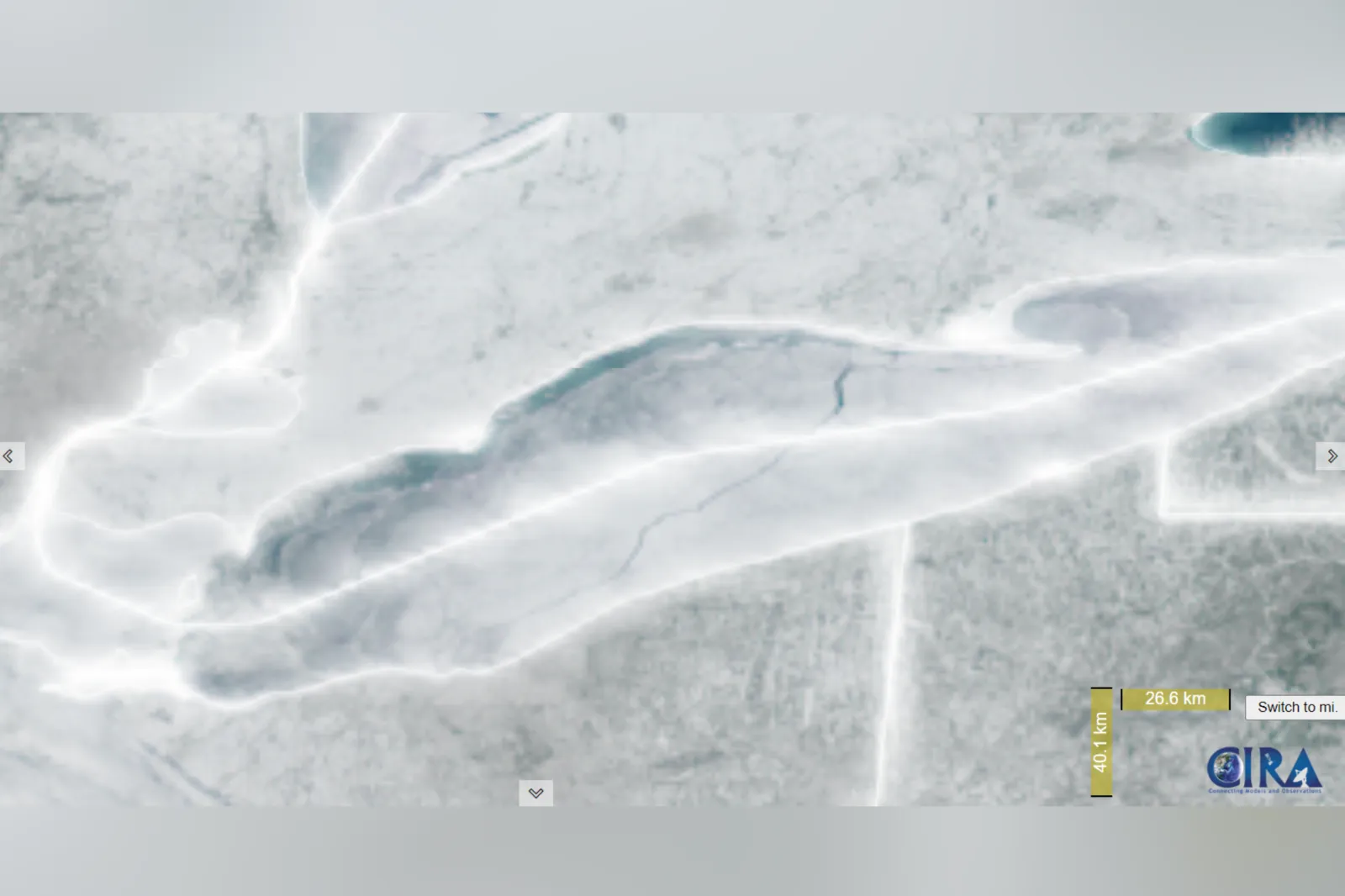
This big freeze has now seen a massive crack develop in the ice—so large it can be seen in satellite images taken from space.
Meteorologist Chris Vickers, chief meteorologist with WTOL, shared images to his Facebook page on February 8, and told followers: “In just a few hours Sunday, a massive crack over 80 miles long formed in the ice in central Lake Erie.
“This crack is so large, it’s visible from GOES-19 Satellite in space!”
Vickers’ post had a big reaction, being liked thousands of times, as locals shared their own experience.
One user shared: “I was off Huron and it felt like a dang earthquake.. I’ve ice-fished Lake Erie for 35+ years and never felt or heard the ice do what it did.”
Another claimed: “At 1:00 today I heard a sound like a cannon shot and the ice moved back and forth like an earthquake. I think this is where was hearing.”
The crack is visible on the DIS STAR Satellite Application and Research website via the GOES Image Viewer. A time-lapse animation shows the crack appearing and separating the ice.
Lake Erie is one of the largest freshwater lakes in the world, at over 9.910 square miles—however, it is also relatively shallow. Because of this, is usually the first of the Great Lakes to freeze over in winter, and the first to thaw in spring, according to NASA.
Frozen lakes’ ice cracking isn’t unusual, but the sheer size of the crack in Lake Erie has led to major interest.
According to Clean Lakes Alliance, lakes can often be noisy in winter, due to ice fractures and cracks forming through the cold months, with noises ranging from an echo to an explosive bang.
Newsweek has contacted Chris Vickers for comment on this story.
Do you have a tip on a science story that Newsweek should be covering? Do you have a question about weather? Let us know via science@newsweek.com.