
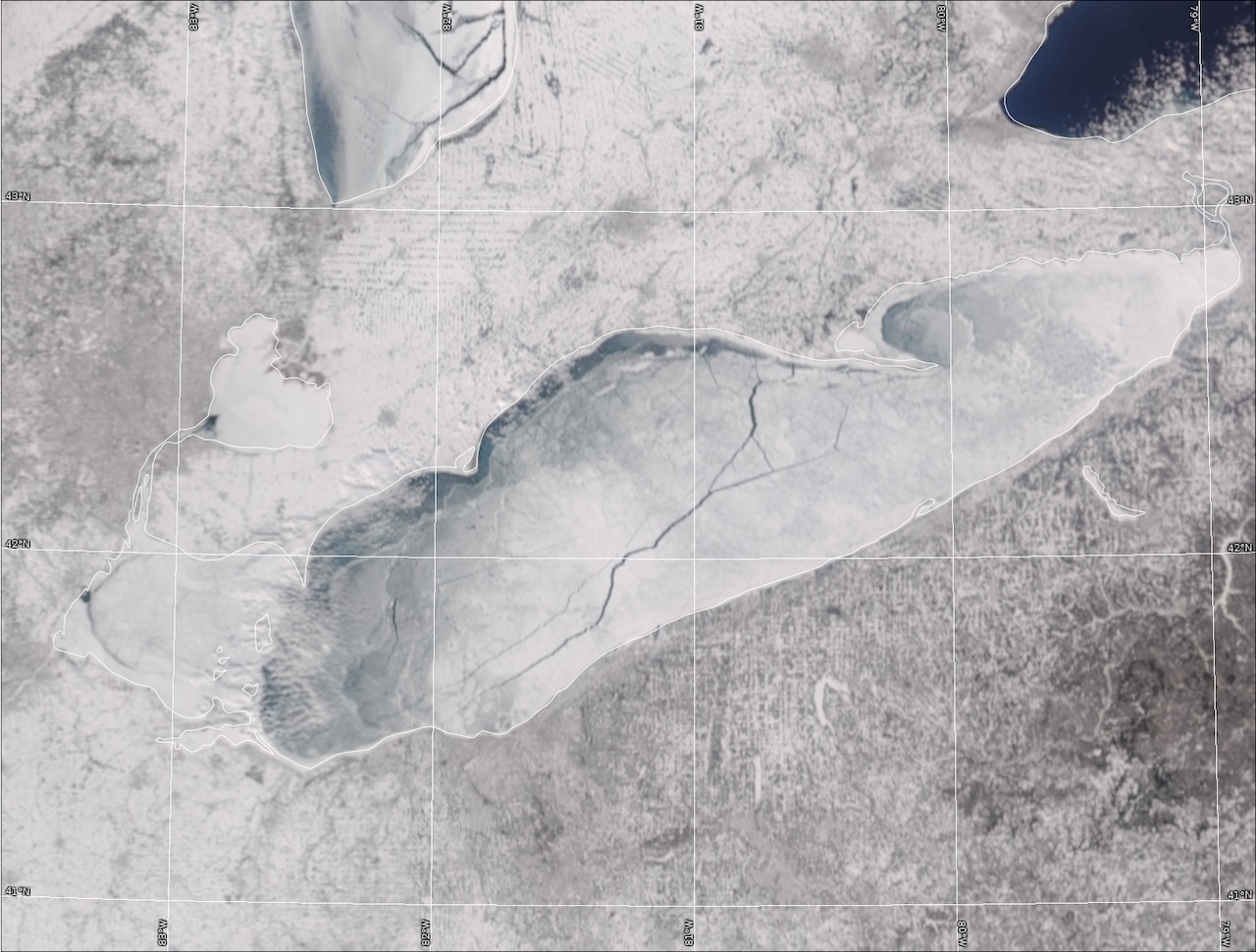
CLEVELAND, Ohio — A massive crack more than 80 miles long split Lake Erie’s ice cover over the weekend as strong winds pushed and pulled at the lake’s frozen surface.
The break, which could be seen from satellite imagery, stretched from Port Burwell, Canada, to west of Cleveland. It developed over just a few hours as wind stress cracked open what had been a single continuous ice sheet covering much of the lake, according to WTOL meteorologist Chris Vickers.
Gusty winds swept across the Great Lakes Friday and Saturday, shifting Lake Erie’s ice southward and opening areas of water along the Canadian side. The crack
Those same winds also forced ice into the south shore, where it piled up in places along the Ohio coastline.
Despite its striking appearance, large cracks are a known feature when Lake Erie is heavily frozen. When winds shift direction or ease, broad sheets of ice can drift, collide or pull apart, creating long openings even during prolonged cold.
Ice coverage remains near rare territory
The fracture comes as Lake Erie remains close to a rare milestone. As of Sunday, the lake was about 95% ice-covered, according to the NOAA Great Lakes Environmental Research Laboratory.
Lake Erie has reached 100% ice coverage only three times since record-keeping began in 1973, most recently in February 1996.
Although Arctic air has dominated the region for much of late January and early February, wind has played a critical role in preventing the lake from fully sealing over. Gusty conditions can fracture consolidated ice and reopen pockets of water even as temperatures remain well below normal.
Whether Lake Erie briefly reaches full ice coverage may hinge on a very narrow window before warmer temperatures and a shift toward southerly winds this week — including a brief warmup along the Ohio shoreline that could push highs near 40 degrees — reduce the chances of a complete freeze.
“Signs point towards a bit of a warmup in mid-February that may limit the chances of completely freezing,” AccuWeather Great Lakes expert Brandon Buckingham said.
What happens next
Extensive ice coverage can influence spring weather around the Lake Erie by delaying shoreline warming, particularly for communities closest to the water.
Strong winds also can shove ice into ridges along the shoreline, creating hazards in vulnerable coastal areas even as the lake appears largely frozen.