
Jake Zebley spends a lot of time driving around the Philadelphia region. He works as a ride share driver. Sometimes, he has to pull over to wait for someone to hail a ride.
He says that’s what he was doing in September at 22nd and Spring Garden.
“I’m sitting there, waiting for a ride and a bus goes by,” Zebley said. “I didn’t think anything of it.”
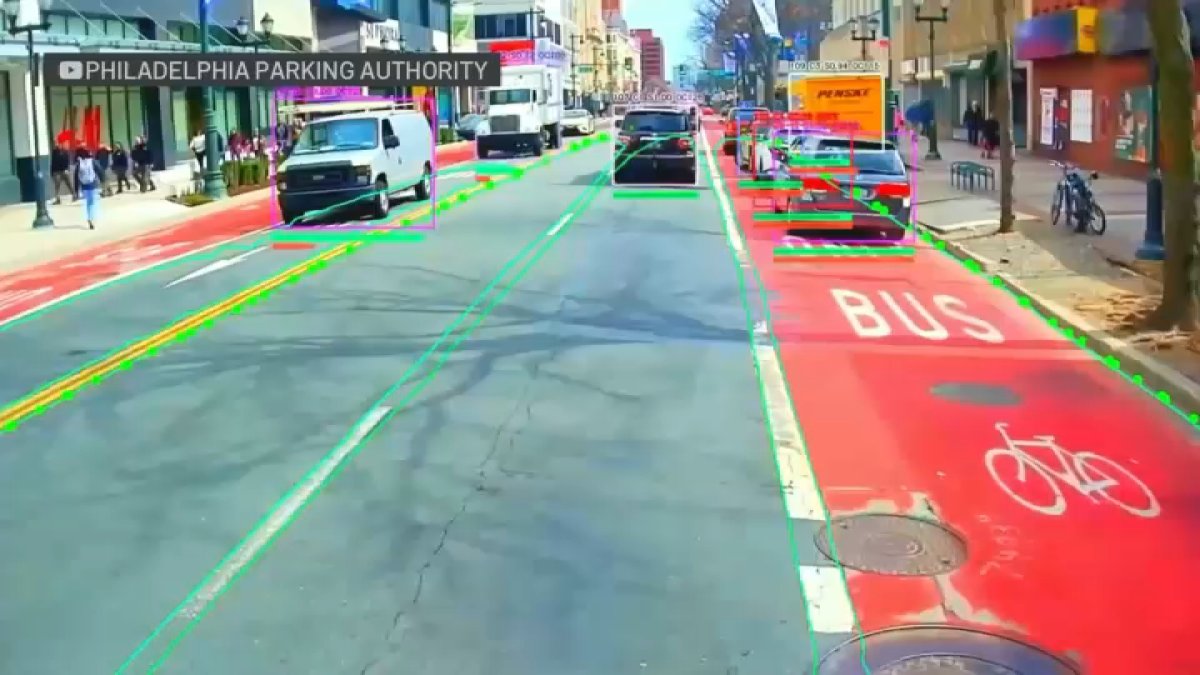
A week later, though, he received a $76 ticket and a link to a video of his car idling at the bus stop. The video shows his car pulled over with its flashers on. The moment was caught by a camera mounted inside the SEPTA bus.
“I gave [the ticket] the middle finger when I received it,” said Zebley.
He isn’t alone when it comes to receiving one of those tickets. More than 112,000 citations were issued in the first seven months that SEPTA buses have had these cameras, according to data the NBC10 Investigators received from the Philadelphia Parking Authority (PPA).
“It’s important to make sure those bus lanes stay clear,” said Andrew Busch, a spokesperson for SEPTA. “That helps us not only provide reliable service, but it’s a safety issue as well.”
Cameras are mounted to more than 100 SEPTA buses that travel around Center City and University City. Using artificial intelligence, the cameras identify cars illegally parked or idling in bus lanes or at bus stops. Then a PPA officer reviews the images and video, verifying there was an infraction. After that, the driver receives a ticket in the mail.
The bus lanes where the most violations have occurred are along major roadways in the city including Chestnut and Market around Center City. The PPA has issued more than 26,000 violations just in the top 10 locations.
SEPTA says they’re already seeing minor positive improvements in travel times in the Center City enforcement zone. The agency reports that bus times have gotten 3 to 6% faster along routes where tickets are being distributed. For comparison, the transit authority reports citywide bus travel times have slowed slightly during the same time period.
Even though the cameras are on SEPTA buses, it doesn’t get any of the money. Fines go to the PPA and the city since the parking authority is the agency running the program.
“The way the city code is all on street operations funding goes to the city,” said Rich Lazer, the Executive Director for PPA.
Lazer says this is a different way for the agency to issue tickets without having parking enforcement officers on the streets. The PPA is contracting with HaydenAI for the program.
The NBC10 Investigators looked through that contract and found that the agency pays about $400,000 per month for the cameras and other services. So far, the bill for the first seven months of the program hit nearly $2.8 million.
At the same time, people have paid more than $4.3 million in fines. The fines vary depending on where they’re issued. Tickets are $76 in Center City and $51 outside of that enforcement zone.
HaydenAI tells NBC10 the data already shows there has been a reduction in double parking, bus stop and no stopping violations since the program began. The PPA expects compliance to increase and the number of tickets – and revenue – to taper off.
“I think the goal at the end of the day is to really have folks being compliant so sometimes you have to pay for costs,” said Lazer when asked if the program was going to be cost effective in the long term.
Philadelphia is among 10 major cities now using HaydenAI’s technology on its buses.
“This [technology] is something that has actually been very well studied in the machine learning field,” said Eric Wong, a researcher at the University of Pennsylvania. His expertise is in Safe AI – the field that works to make artificial intelligence beneficial for humans by preventing the misuse of the technology.
He says while the technology works well, it isn’t foolproof.
“One of the big challenges with all machine learning or AI-based systems is that they’re never 100% accurate,” Wong said. “There’s always that tiny 1% chance that it gets something wrong. And as a result, if it gives a ticket to a car that was not actually blocking the bus, that is obviously not a good thing to happen.”
The PPA has seven to eight people dedicated to reviewing the footage and issuing tickets.
The authority reports that less than 1% of the tickets issued so far have been overturned after being appealed.
Lazer says they’re working with the city to create drop off zones for rideshare and delivery drivers so there are more spaces for people who are working to pull over and not risk getting a ticket for idling in a bus lane.