
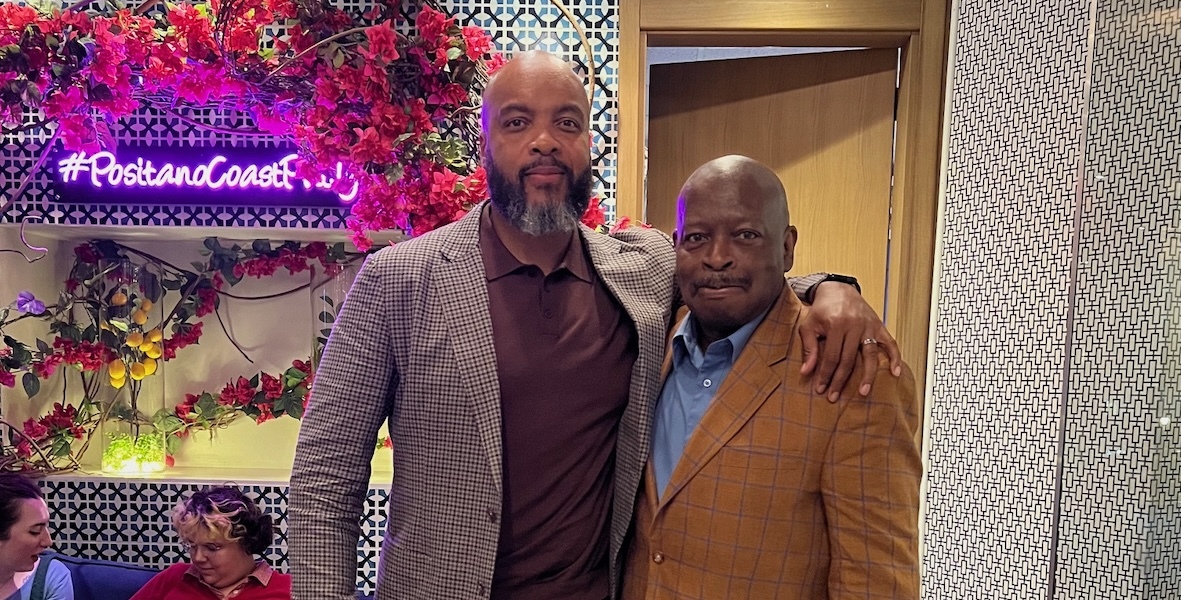
When I landed an internship at The Philadelphia Daily News back in 2003, just weeks after graduating from Rowan University, I knew my life would be forever changed. By grace and grit, I’d lifted myself up from a fumbled football career at Shippensburg University, three self-funded years at Camden County Community College for a two-year degree, and finally to my bachelors degree from Rowan. Landing that internship would fulfill the only professional dream I’d had in the whole world: I was going to get paid to write.
Little did I know just how strange a world I would find myself in. I come from working class people who put food on the table by way of calloused hands or by punching a clock. Growing up, I can’t recall a single person in my orbit who worked in an office or wore suits and ties or smartly fashioned dresses — let alone those who wore those fancy clothes in offices where White folks were the majority. But there I was, a Black alien hurtling toward some uncharted galaxy far away from my own.
But in the chaos of new names and faces, experiences and expectations, I found a North Star. That guiding light was Michael Days, one of the paper’s top editors. Week in and week out I’d watch Mr. Days float through the newsroom, always impeccably dressed and with an elegant power that belied his smaller stature. I never heard him raise his voice or indulge in the kind of coarse or salty language common in newsrooms a quarter century ago. But his presence, his manner, spoke volumes.
Before long I found myself at his office door with questions about reporting. Then about how to navigate the newsroom, in particular a white newsroom, as a Black man. And before long I was asking him about life. He always had an answer. Mr. Days had a way of being both wise and accessible, blending good counsel with good comfort. He gave me confidence and a battery in my back that I’ve never had to recharge. But even more than wise words, Mr. Days always gave his time.
My time at The Daily News was the foundation from which my entire career has sprung. I’ve worked across the country at some of the nation’s most prominent newsrooms and won a pile of awards along the way. And with each step, I returned to Days for guidance. He was always an email or phone call away. In moments of triumph and moments of trouble, I knew I could always call on him. But Mr. Days wasn’t just my North Star; he helped an entire generation of young Black journalists find our way in an industry that hasn’t always reflected us or respected us. Mr. Days was a role model; he was a man.
Now, Mr. Days is gone.
On Saturday October 18, Mr. Days, 72, passed away unexpectedly at his home in Trenton. I got the news the next morning by way of another Black journalist who was shaped by his mentorship, and it took everything in me not to drop my coffee. I couldn’t keep my heart from doing the same.
My time at The Daily News was the foundation from which my entire career has sprung. I’ve worked across the country at some of the nation’s most prominent newsrooms and won a pile of awards along the way. And with each step, I returned to Days for guidance.
In the days since, I’ve read over his obituary and the write ups in the Philly papers, about his rise from North Philly to become a legendary reporter-turned-newspaper executive at The Philadelphia Inquirer and The Daily News, where he led an investigative team to a Pulitzer Prize. How he was kind yet direct. Passionate but pointed. How he was forever amplifying Black stories and Black storytellers. I’ll remember all of that with great esteem.
But more than that I’ll remember what he told me more in recent years: that he was proud of me.
The last time I saw Mr. Days was in early September. I’d just released my first book, A Thousand Ways To Die, and he joined members of the National Association of Black Journalists-Philadelphia at a reception in my honor at the Free Library of Philadelphia. As he offered kind words about my accomplishments and career, I couldn’t help but want to snatch the microphone and give him his flowers.
There’s zero doubt that without Mr. Days I would not be the journalist that I am. It was his seeing in me what I may not have even seen in myself in those early days that helped propel me. And now that he’s gone I know, we all know, what he’d want — for us to be guiding lights for the next young Black journalists who have found themselves in galaxies they haven’t been invited to, but where they belong, nonetheless.
Later that night at the library, a few feet behind the long line of people with books for me to sign, I saw him standing there watching with the warmest smile on his face. I dropped my pen and gave him a big hug.
“I’m so proud of you,” he said. And in that moment, nothing else mattered.
Trymaine Lee is an MSNBC contributor and author of A Thousand Ways To Die: The True Cost of Violence on Black Life in America.
The Citizen welcomes guest commentary from community members who represent that it is their own work and their own opinion based on true facts that they know firsthand.
 MENTORS AND REMEMBRANCES
Trymaine Lee, left, with the late Michael Days