
The Brief
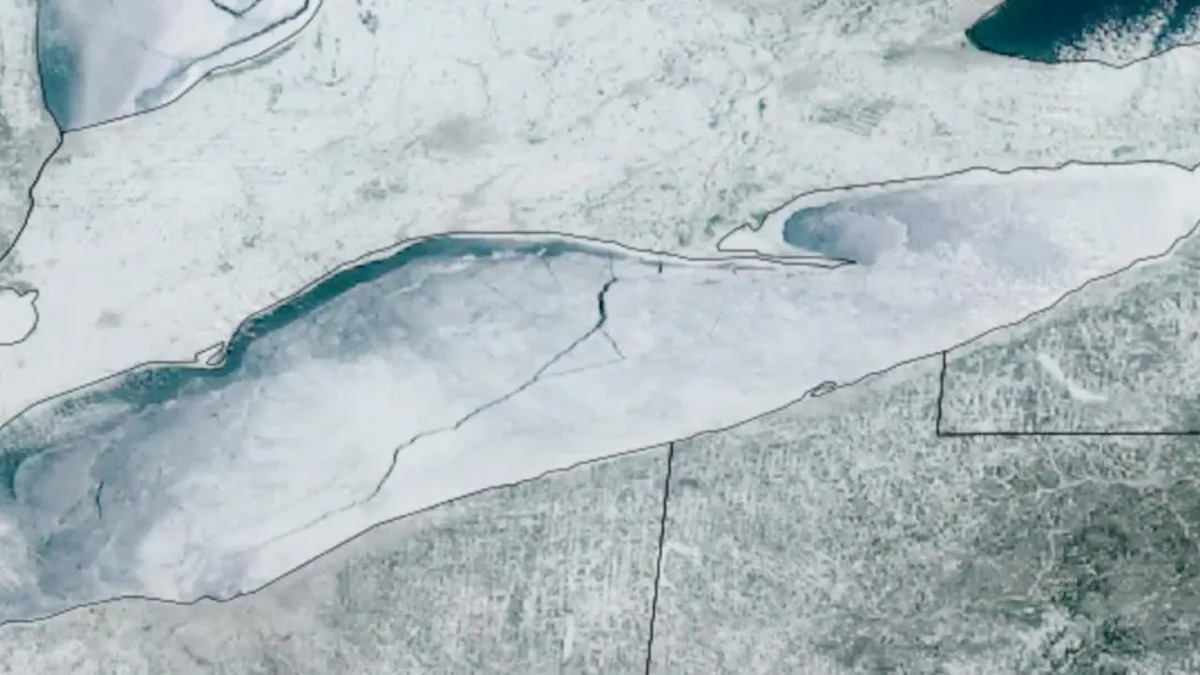
Satellite imagery from GOES-19 captured a massive crack forming across Lake Erie’s ice on Feb. 8.
Ice cover matters because it heavily impacts Great Lakes shipping – a multi-billion-dollar industry – and also supports winter recreation like ice fishing and skating.
While Lake Erie reached about 95% ice cover after a recent Arctic blast, NOAA scientists say the levels, though above average, are not unprecedented.
Satellite imagery captured on Sunday showed a “massive crack” forming across the frozen surface of Lake Erie.
Lake Erie ice crack forming
Big picture view
Timelapse footage from the Cooperative Institute for Research in the Atmosphere (CIRA) shows the crack forming.
CIRA said the “massive crack” and impressive view was captured by satellite GOES-19 earlier on Feb. 8.
Why you should care
Great Lakes residents and businesses watch the ice levels because ice has powerful effects on commercial shipping, which is a multi-billion dollar industry in the Great Lakes region and moves over 130 million tons of raw material, such as iron ore, cemen and steel each year.
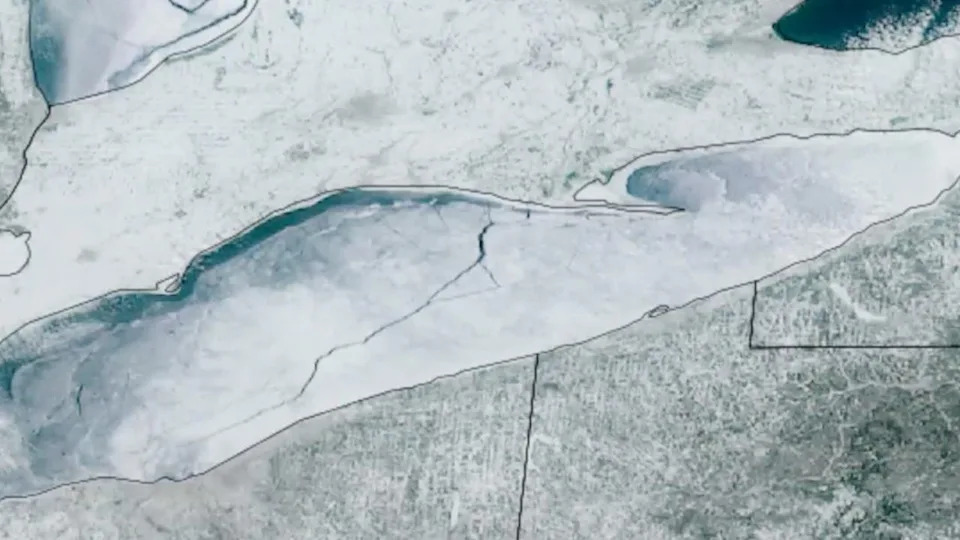
Timelapse footage from the Cooperative Institute for Research in the Atmosphere (CIRA) shows the crack forming.(Credit: CSU/CIRA & NOAA via Storyful)
Ice cover can also boost a number of recreational activities such as ice fishing, hockey, cross-country skiing, and snowmobiling.
Ice on Great Lakes has ‘dramatically increased’
The backstory
Over the last two weeks, the ice extent for the Great Lakes has dramatically increased with Lake Erie reaching 95% ice cover and the combined Great Lakes reaching 51% ice cover, according to the National Oceanic and Atmospheric Administration (NOAAA).
RELATED: What are frost quakes? That popping noise, tremor could be a sign of cryoseism
The year 2026 started with at or below average Great Lakes ice levels. The recent Arctic blast of below-normal cold temperatures, also affecting other portions of the eastern U.S., caused these ice levels to grow quickly, leaping from overall ice coverage on the combined lakes of 5% on January 14 to 51% on January 31.
But the ice is not unprecedented
What they’re saying
Despite being well above average, this year’s ice is not unprecedented, according to James Kessler, a research physical scientist at NOAA’s Great Lakes Environmental Research Laboratory in Ann Arbor, Michigan.
Based on ice measurements for the past five decades, GLERL and the U.S. National Ice Center said there were five years (1977, 1981, 1994, 2014, and 2019) that had as much or higher levels of ice by February 1.
Kessler notes that the ice cover has historically been highly variable year to year.
“The level of ice on a particular day is not that significant,” said Kessler. “The most important metrics for ice cover are the seasonal average ice cover, season duration, and annual maximum which typically occurs in mid to late February.”
The Source
The information for this story was provided by NOAA and CIRA. This story was reported from Los Angeles. Storyful contributed.