
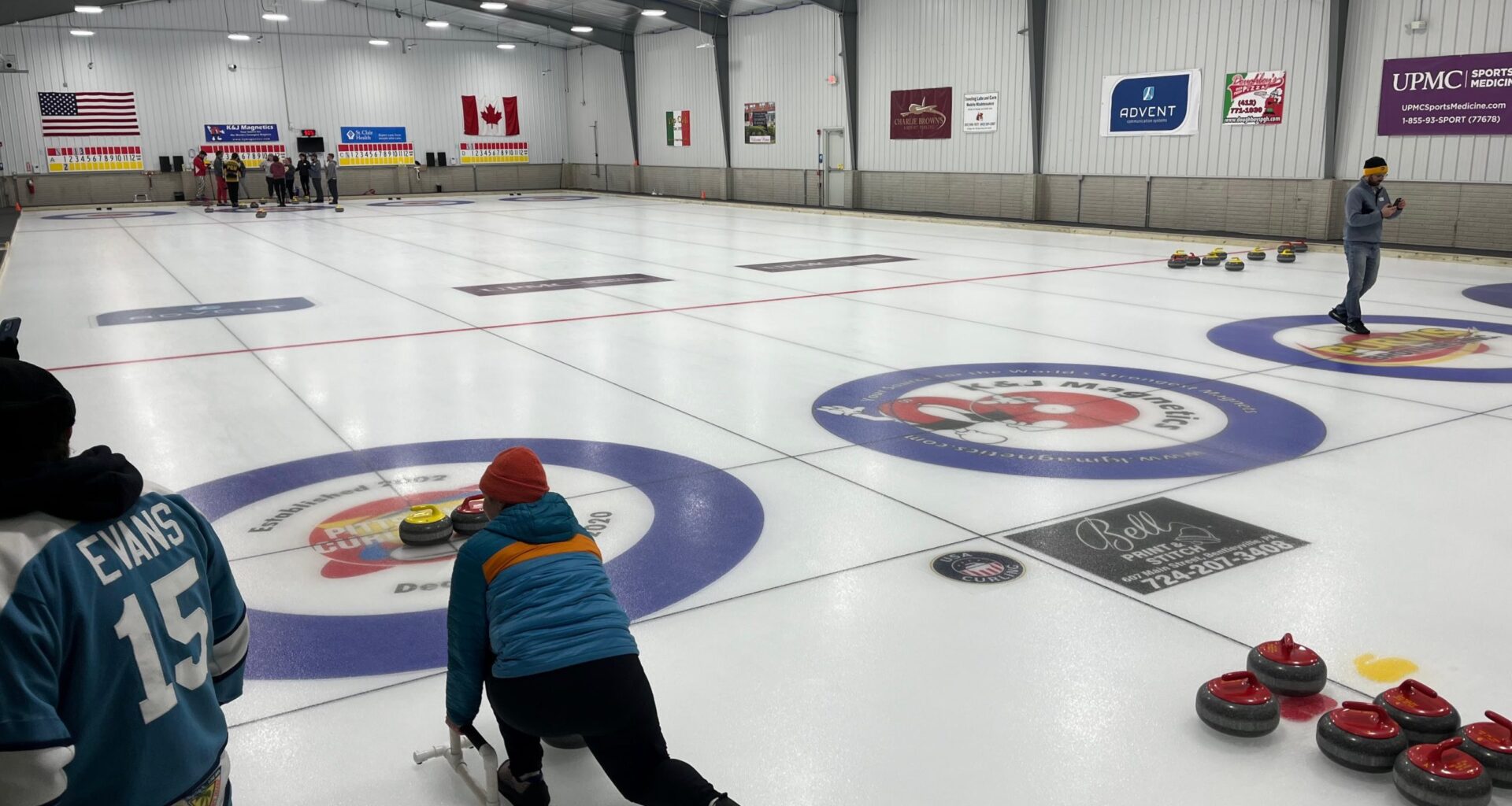
“Sweep! Sweep! Hard! OFF!”
The exclamations can sound like frustrated attempts to communicate with a robotic vacuum via voice command. On the ice at Pittsburgh Curling Club in McKees Rocks, the words echo and bounce around. It can be hard to tell what all the shouting is about while watching Olympic curling on TV. After hearing it in person it’s … even harder. At least at first.
As a casual curling fan (I usually watch it during the Olympics and then forget about it for another four years), when I discovered I could try it for myself here in Pittsburgh, I jumped at the chance. Well, not jumped. You shouldn’t jump on the ice. Slid at the chance?
Jordan Haschets throws while Molly and I sweep.
At Friday’s “Learn to Curl 1” class at the club’s dedicated curling facility at 491 McCoy Road, we learned about the rules of the game, the terms, gear – even the ice and stones themselves. The Olympians make curling look effortless, but even getting into the position to “throw the rock,” as they say, is much more difficult than it seems.
As expected, new interest in curling is highest during the Winter Olympics, said Pittsburgh Curling Club President Dustin Devine. In fact, “Can I play in the Olympics?” is one of the frequently asked questions on the club’s website.
Our group of about 25-30 people gathered in the lobby to watch a brief explainer video and put rubber grippers on our shoes. We were instructed to leave any keys in our jackets or bags, as keys falling on the ice can damage the surface. The ice is pebbled, an effect created by sprinkling water droplets on it. This allows for less friction so the stones can slide more easily toward the target. During real gameplay, the ice is re-pebbled after each match.
After breaking into smaller groups to learn the basics of how to throw and sweep, plus general safety protocols for being on the ice, it was time for a game. Our instructor, Pittsburgh Curling Club Board Member Quintin Lovicks, was beyond patient with our group as we repeatedly asked about which direction to turn the stone and how to know when to sweep or not. We learned about the positions for a team of four (lead, second, skip, vice skip), how scoring works and got going.
Despite spending at least 30 minutes beforehand learning how to get into the proper position (left leg on a shoe-sized piece of Teflon that slides on the ice, left hand gripping a plastic aid for balance, right hand ready to release the rock and right leg ready to glide behind in a lunge position), I wasn’t able to perfect my form enough to be much help to my team.
Sweeping, for me, was easier than throwing, but not easy by any means. I was exhausted by the end of the night. The bottoms of the brooms are nearly smooth, almost the texture of a lint brush. You’ve got to give it your all to make any difference to the speed or direction of the stone.
Most, if not all, of the participants in the session were first-time curlers. Some people picked it up quicker than others. None, though, could pass for a spot at Milano Cortina 2026.
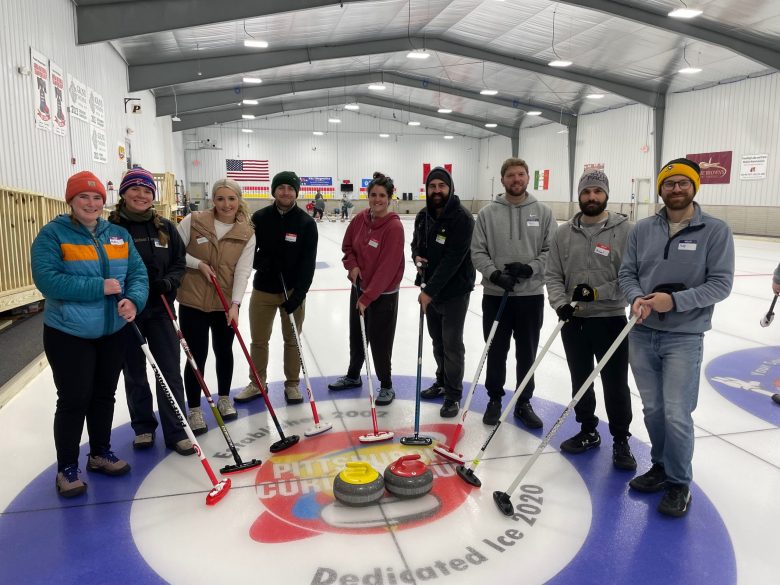 Our “Learn to Curl 1” group from Friday, Feb. 6. Photo courtesy of Pittsburgh Curling Club
“Do people really ask about if they can play in the Olympics?” I asked Lovicks, who goes by “Q.”
“Oh, ALL the time,” he said.
Pittsburgh Curling Club offers three levels of Learn to Curl classes. There are accessibility modifications available including wheelchair-friendly curling and stick curling for those who may not be able to get into the lunge position. Classes are $50 apiece or $100 if you bundle levels one through three together. The next spots available for Learn to Curl 1 are in early April.
PCC also runs several leagues, many of which are open to beginners, and all are open to spectators in-person or via YouTube livestream.
You can also try curling in a more bar game style environment at Millvale’s Playground Dropout.