
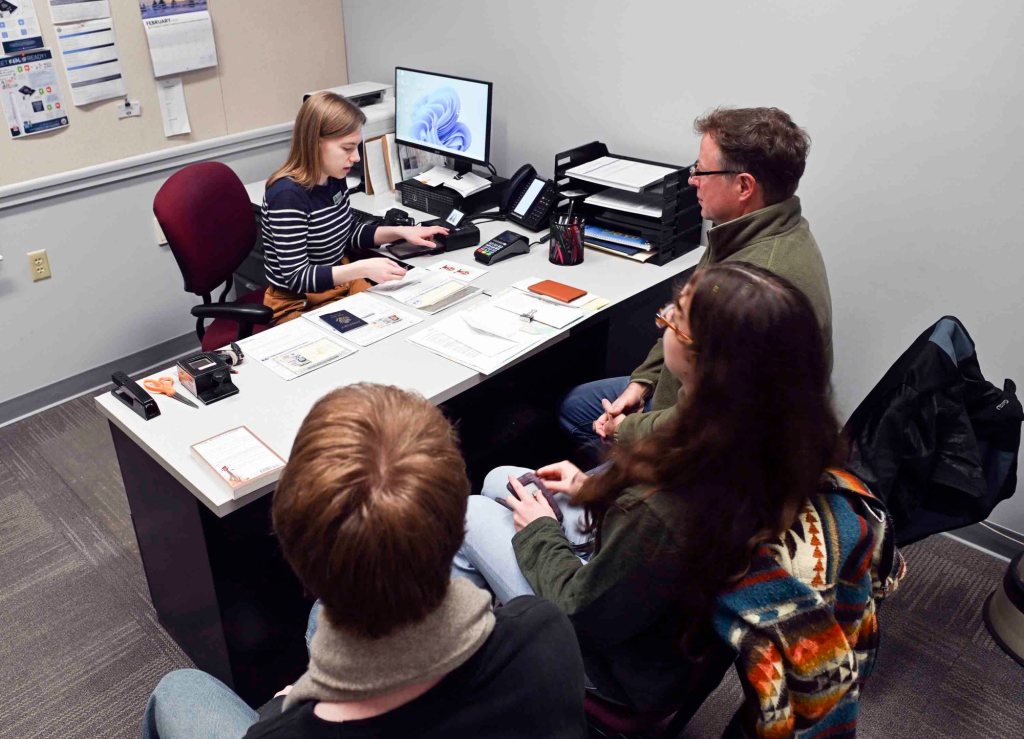
Nonprofit libraries across the nation — including two in Berks County — are facing a significant financial blow as they have been notified that they will no longer be able to process passport applications.
The U.S. Department of State determined last fall that existing federal law doesn’t explicitly allow nonprofits to collect fees related to passport services — despite those locations providing the service for many years. Last year in Pennsylvania, more than two dozen nonprofit public libraries processed more than 41,000 passport applications, according to the Pennsylvania Library Association.
But starting Friday, nonprofit libraries such as the ones in Boyertown and Kutztown will no longer be able to offer passport services.
The move does not impact municipal libraries that provide passport services, such as the Reading Public Library or the Sinking Spring Public Library.
While federal legislation has been introduced to reverse the change, nonprofit libraries are preparing for life without the revenue passports provide.
A significant impact
The Boyertown Community Library has been processing passports for the last 18 years. The service has not only been a benefit for people in the community looking to travel abroad, but also for the library. The $35 acceptance fee and $15 photo fee the library charges has provided a steady stream of revenue.
So when the library learned that it could no longer process passport applications, it was quite a shock, Executive Director Sami Jo Trout said.
Last year, the library processed 2,485 passport applications.
“We generated over $87,000 in revenue from processing passports, which represents a 13% loss for us overall in our budget,” she said.
Trout said that means the library will have to reduce the size of its staff and potentially cut some programming. Fortunately, she added, the communities the library serves have provided financial support to help ease the loss, at least a bit.
“We have been fortunate this year that our municipalities have really stepped up,” she said. “Three out of the four have maintained or increased their annual contributions.”
Trout said the library staff and board have reached out to local elected officials in an effort to get the change reversed. In the meantime, the library is about to launch a fundraising campaign to try to offset the lost revenue.
“I believe it was an oversight,” she said. “I don’t think they realized that not all libraries are municipal libraries.”
Trout said the library’s inability to continue providing passport services is a loss for the community.
“Not only does it affect us financially, but it’s going to affect the community because we offer Saturday hours and a convenient location,” she said. “And many people return because they had such a good experience the first time.”
Jackee Sharayko, executive director of the Kutztown Community Library, said it has been providing passport services for the past two decades.
“We have been doing this for 20 years now, and we’ve processed over 18,000 passports over that time,” she said.
Just last year, the library processed 1,382 passports. That generated $67,699 — accounting for about 20% of the library’s budget.
With that money disappearing, Sharayko said, the library will likely have to reduce staffing hours and its programming and collection budgets.
“This is really going to hurt our bottom line,” she said. “Honestly, I think our library has grown as much as it has because we’ve had the money from passports. We were able to hire more full-time and part-time staff, buy more materials and offer more programs.”
Sharayko said the library has been getting consistent funding from its municipal partners. And because 75% of its budget comes from individual donations, the library has begun reaching out to patrons regarding the situation.
They have asked supporters to write to their lawmakers.
“We are hearing from the U.S. Department of State that we should have never been allowed to process passports, but again we have been doing it for 20 years,” she said. “The only other place in Kutztown that processes passport applications is the post office, and they are very limited, so I don’t know where they’re going to go.”
A legislative fix
Members of Congress across the political spectrum are working on a solution.
U.S. Sens. John Fetterman and Dave McCormick as well as U.S. Rep. Madeleine Dean, whose district includes Boyertown and Kutztown, are helping to lead the effort to ensure these libraries can continue to provide passport services to their communities.
They have introduced the Community Passport Services Access Act, which aims to restore this ability for nonprofit libraries.
But with the decision due to take effect in just a few days, Fetterman, McCormick and Dean joined colleagues in a letter sent Monday to Secretary of State Marco Rubio. They urged the department to extend the existing program while Congress works to enact the legislation.
“In a time when demand for passports is surging, libraries are among the most accessible passport acceptance facilities, particularly for working families and rural residents,” the lawmakers wrote. “This abrupt determination, issued with little notice or explanation, has placed libraries, their employees and the communities they serve in an untenable position through no fault of their own.”
The lawmakers pointed out that libraries are often the most accessible passport acceptance facilities. In states such as Pennsylvania, Maryland, New York, Connecticut, Georgia and New Jersey, many public libraries are structured as nonprofit entities due to historical precedent. And denying those libraries the ability to process passports limits their options for raising revenue.
“At some libraries, the Feb. 13 deadline all but guarantees immediate staff reductions, putting dedicated public servants and their families at risk of losing their jobs, income, and health care overnight” they wrote. “Without an extension, libraries will be forced to lay off employees, cut essential programs for children and families or close their doors entirely.”
The lawmakers said granting the extension would not resolve the issue permanently, but it would prevent irreversible harm while Congress and the Department of State work toward a long-term solution.
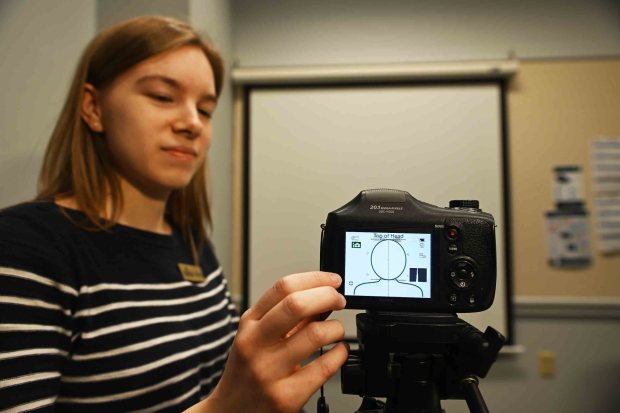 Sairra Cloen, assistant supervisor, sets up a specialized camera for taking passport photos at the Boyertown Community Library, 24 N. Reading Ave. Nonprofits such as the library will no longer be authorized to provide passports. (BILL UHRICH/READING EAGLE)