
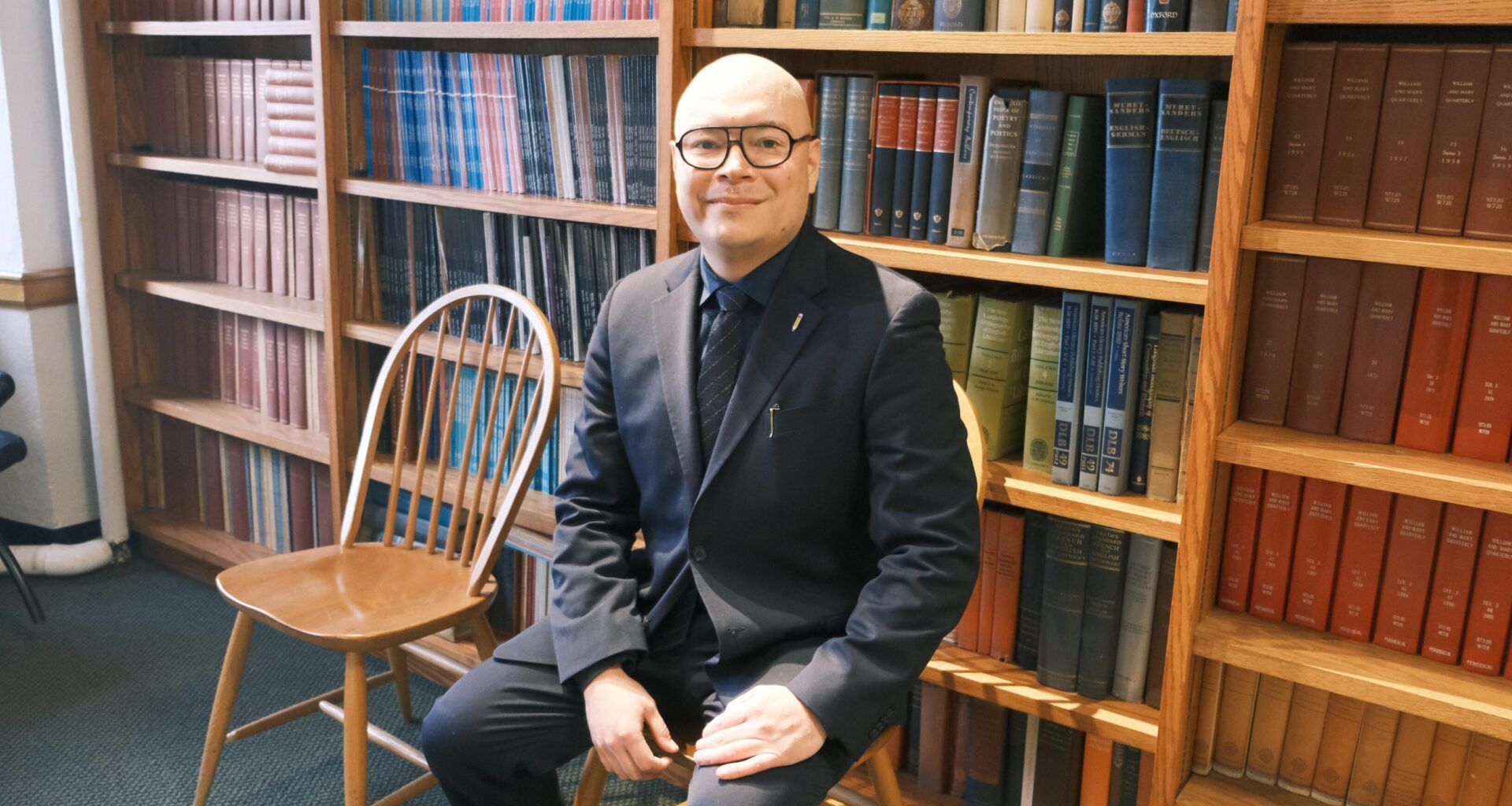
Zakery Muñoz never expected to become a professor.
Growing up, he attended six different high schools and dropped out of college twice. He spent years working in grocery stores, hotels and coffee shops and said he believed school wasn’t for him.
Muñoz began teaching at Lehigh last fall. He arrived with a set of unconventional academic experiences and a teaching philosophy shaped by an untraditional path.
“I feel it is truly a miracle that I now call Lehigh my home,” Muñoz said. “I can’t make sense of how I got so lucky.”
Muñoz grew up in a Spanish-speaking household but was expected to use English in school. He said he struggled with the language barrier and that his love for reading and writing didn’t align with his teachers’ expectations.
After leaving college twice, Muñoz said he believed he was finished with school, though his love for reading and writing remained. While working at a Starbucks in New Mexico, a regular customer who knew about his interests encouraged him to return to school.
Muñoz said the advice led him to enroll at Central New Mexico Community College, where he earned an associate of arts degree in English in 2015.
“Community college gave me a chance, and that’s where I met the professors who changed my whole life,” Muñoz said. “That’s how I got involved with tutoring kids to read.”
Muñoz went on to the University of New Mexico, earning a bachelor’s degree in English and history in 2017. Despite having a GPA below the university’s minimum requirement for its master’s program because of earlier academic struggles, Muñoz said he wrote a personal statement arguing for his admission.
He earned a master’s degree in English with a concentration in rhetoric and composition from the University of New Mexico in 2020. His first teaching experience came in 2017, when he taught Accelerated Composition as a graduate student.
He completed his doctorate in composition and cultural rhetoric at Syracuse University in 2025. Muñoz said teaching throughout graduate school was both a necessity and a passion, as graduate instruction is how many students in his field fund their education.
These experiences shaped his teaching style and influenced how he approaches his students.
Muñoz’s field is rhetoric and writing studies. In spring 2025, he said he began applying for jobs and was drawn to Lehigh’s position because of its prestige and alignment with his specialty.
“(Lehigh) seemed like a dream job,” Muñoz said. “They were not only hiring in my sub-field, but the position was tenure at an R1 school, which was my dream.”
Rojin Tamsen, ‘29, a bioengineer and cognitive science major who took First-Year Writing with Muñoz, said she’s grateful for the class. Tamsen said she disliked writing in middle and high school but found Muñoz’s class refreshing because of the freedom students have to choose their topics.
Tamsen said Muñoz’s approach taught her that writing is subjective, and that writing without the pressure of grades gives her more freedom to express herself.
“My number one priority in the class is to create a sense of community where people feel like they belong,” Muñoz said. “All I want from them is to write anything, and one thing that I do to help the students is to show them that being a writer or learning how to write in college isn’t just about writing a good essay.”
Tamsen said the class is interactive, engaging and refreshing. She said the lectures feel “magical” and that Muñoz’s passion for rhetoric is evident.
Zach Bennett Weltman, ‘29, a mathematics major who also took the First-Year Writing with Muñoz, said free-writing time in class is helpful and therapeutic.
“I think his teaching style is definitely not similar to other professors at Lehigh,” Weltman said. “He is a lot less formal, but I think he is just as effective, if not more.”
Weltman said Muñoz’s assignment prompts are vague compared with those in other writing classes, which often have strict guidelines. He said Muñoz trusts his students’ abilities and gives them greater individual freedom.
As a professor teaching a course required for all students, Muñoz said he wants students to understand that failure and mistakes are part of learning.
“There are a lot of ways to live life,” Muñoz said. “Whatever you want, whatever you pick, or whatever path that you’re taking, just know that there are many other options to be happy.”