
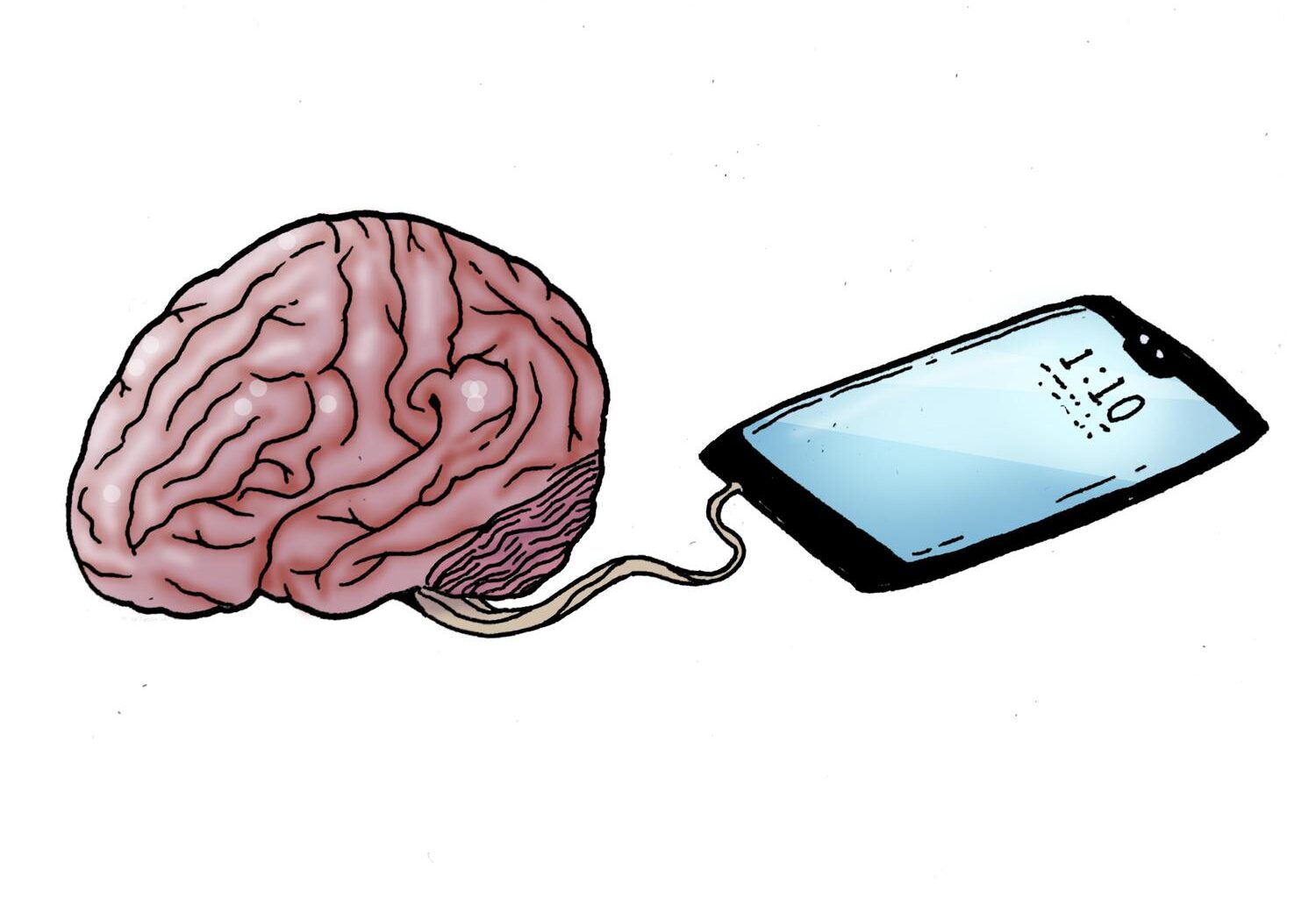
There’s been a lot of talk in online cultural spaces about “decentering men” lately, and although I understand the implications of our often misogynistic social climate, I’d like to propose a different “decentering” target — your phone.
To someone that was raised in the dying age of landlines, it’s incredibly odd to see how instant communication has transformed the world. Texting a school project partner, I am often launched into a work context, skipping the one-or-two-sentence introduction that used to be so common. The experience of using a dating app is similarly alienating, with easy matchups that kill romantic attraction before people even meet. While I have never been a fan of small talk, I also understand that there is no way to establish a rapport between two people without first talking about seemingly meaningless things — the weather, our majors, our shared dislike of math. These small “launching off” points allow us to enter a conversation having quelled our natural social apprehension.
The drawback to technological efficiency is not only that we cannot address our human anxieties but that we lose a magical element of connection — misplaced words, unique sentence structure, audible accents. In an attempt to preserve the power of connection, I’ve compiled a list of things that have helped me to “decenter” my phone.
Treat your phone as a tool. While my phone can be used to check my bank account balance or to tune my guitar, the vast majority of my screentime leading up to now has been spent browsing social media and texting while walking. This is the most important part of decentering your phone — finding a way to recenter it as a tool.
Respect other people’s time and privacy. Growing up with a phone, I developed a sort of entitled approach towards communication. If someone hadn’t replied to my text within three hours, I often felt as though they were ignoring me. The reality is that all of us have the right to our own pace of life.
Stop looking up information to quell your anxiety. The fact that you can’t name the capital of Zimbabwe isn’t embarrassing.
Don’t rely on notifications, automatic suggestions or curated social media feeds. Of all of the pitfalls of modern technology, this one is probably the most damaging. I have gone as far as uninstalling all email apps from my phone and never creating online accounts unless absolutely necessary. While I still watch YouTube, I now use an extension that removes new video recommendations. You might call me the bane of targeted advertisers.
Do not use AI unless absolutely necessary. Maintaining a personal, cognitive relationship with your AI is a surefire way to lose your own agency. I only use ChatGPT to help explain things I don’t understand so that I can learn more effectively. I also do not have a ChatGPT account and do not allow any service — AI or otherwise — to personalize the information it delivers.
Leave your Zoom video preview off. It’s very tempting to keep glancing at yourself when you’re on a video call, especially if you just got a new haircut or are sitting in an unfamiliar place. It’s also very difficult to concentrate when you have a digital mirror in front of you at all times.
Learn — or relearn — basic manners. A recent article by GQ — “125 Rules for Modern Gentlemen” — does a great job of rehashing modern etiquette. Highlights include “ask before vaping indoors,” “no man who doesn’t post for work should have a public Instagram” and “always introduce people.”
Use more analog technology. Physical media like vinyl records, DVDs and paperback books are more than just novelties — they allow us to connect with a given story and to “own” it. There’s a kind of choice anxiety that comes with the $6.99 Student Premium Spotify subscription that I’ve been happy to let go of.
I started the transition from a phone-centric lifestyle to an “analog” lifestyle about two years ago. To be perfectly honest, it hasn’t been easy. I have reinstalled Instagram dozens of times, tried and failed to switch to a flip phone and even asked close friends if they would be willing to go by email only. It has taken a lot of trial and error to understand the seemingly minor — actually enormous — ways in which technology affects me.
While taking these steps has distanced me from a lot of people, the quality of my social connections has also increased dramatically. I’m still looking for a “third space” to connect with like-minded people, but I can safely say that I’m ready to connect with the world around me.
Stepan Kopeykin is a transfer student from the Borough of Manhattan Community College. His favorite movies and books include Interstellar, The Big Lebowski, Choke and The Secret History. You can find him drinking three to four cups of tea a day and playing catch with the wall outside of Hillman. He runs a personal Substack page and can be reached at [email protected].