
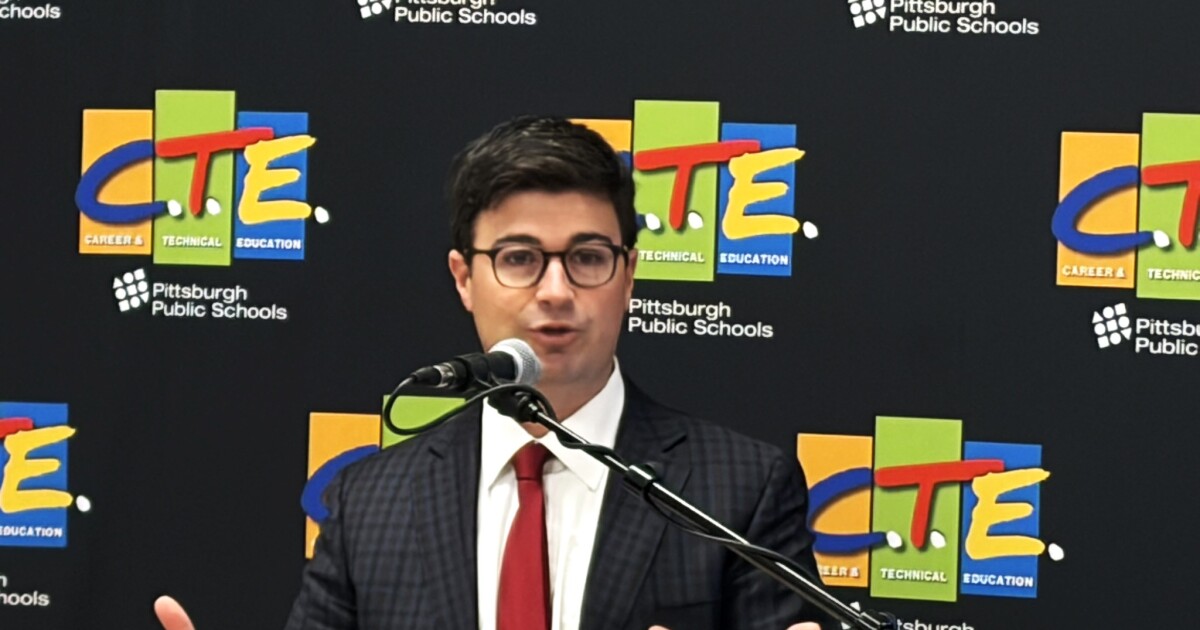
Pittsburgh Mayor Corey O’Connor has made city schools a distinctly visible part of his first weeks in office.
On the day after his inauguration, O’Connor started the morning with a walk to Colfax K-8 in Squirrel Hill to hear how the city can create safer routes to school.
The following week, he met with the school board president and visited three other Pittsburgh Public Schools: Phillips K-5 on the South Side, Arlington PreK-8 in the Hilltop and Westinghouse 6-12 in Homewood.
“Let’s say school is from 9 [a.m.] to 3 [p.m.] I’m responsible for the kids from 3 [p.m.] until 9 a.m. when they return back to school, every weekend, every holiday, every summer vacation,” O’Connor told WESA. “They’re the city’s responsibility outside of school.”
O’Connor, who campaigned on making the city a top choice for families, says it’s time the city works to foster a better relationship with PPS. His call comes as the district faces continued enrollment declines that PPS leaders have proposed managing through more than a dozen school closures.
The district also has an ongoing lawsuit against the city and the state’s Department of Education over income taxes that have been diverted to the city since 2007. District officials expect to give over more than $26 million to the city this year, as required under a lingering mandate from the era in which the city was in Act 47 oversight.
School board members have cited the issue as a barrier to collaboration with city leaders. But while the state no longer deems the city “financially distressed,” the City of Pittsburgh faces its own revenue troubles.
Financial pressures have weighed heavily on the city in the past several years in the wake of falling property taxes Downtown following the start of the pandemic. Increased debt-service payments have also presented a budgetary burden, and while those are scheduled to let up soon, more costs are looming as the city struggles to replace its out-of-date, damaged vehicle fleet.
City Council approved a tax increase this past year to funnel more money towards buying vehicles. Asked whether he’d consider returning diverted funds, O’Connor pointed to these budget pressures, adding that any changes to the statute would have to go through the state.
“But I think, if it’s part of a long-term conversation where that money is going to be spent on joint efforts and programming…. now you can possibly see where we could put some of our money back into facilities and things like that,” he said.
“But we have to be on the same page that our residents have access to these buildings,” O’Connor added. “ I’ve always thought a community school model made the most sense.”
Debating the city’s role in PPS
While O’Connor ultimately graduated from Central Catholic High School in Oakland, the mayor spent his early years at Pittsburgh Public. In the 1990s, he attended East Hills Elementary before it was closed in 2006.
He then went on to middle school at Frick 6-8, now Pittsburgh SciTech 6-12.
“Originally I was planning on going to Allderdice, but since my brother went to Central [Catholic]…it was kind of like a family thing that I went, and then from there went to Duquesne [University],” O’Connor said.
While he never taught in schools, O’Connor graduated from Duquesne with a degree in elementary education and maintained a foot in the schools as a coach at Central Catholic for 17 years.
Today, he has a two-year-old and a four-year-old — although O’Connor says he and his wife are still discussing which schools his kids will attend.
“If you want to grow Pittsburgh, we need families. And we need younger people,” he said. “Usually, what happens is [around] middle school age, they tend to move. We got to stop that trend.”
Under previous administrations, the relationship between the city and its schools has been relatively hands-off. While a 2022 city council resolution established a joint board for the two entities, the body has never been convened (school board president Gene Walker says the district is now working with city councilors to change that).
But a few voices are calling for more city oversight of local schools. The Pittsburgh Post-Gazette’s Editorial Board published a piece last month calling on O’Connor and Gov. Josh Shapiro to convene “an external analysis of the district’s structures and leadership,” while one columnist has proposed a city takeover of the school board.
The governor called for Pennsylvania to require age verification, parental consent and a ban on chatbots producing sexually explicit or violent content featuring kids. He also supports requiring companies to direct users who mention self-harm or violence to the appropriate authorities and to periodically remind users that they’re not engaging with a human.
O’Connor’s late father, Bob O’Connor, had himself once supported a plan to have city officials make appointments to the PPS board. During his unsuccessful 2001 bid for the mayor’s office, O’Connor proposed allowing the mayor and the City Council to each appoint one member of the school board, enlarging it from nine members to 11.
O’Connor espoused the change, which would have required state approval, in the wake of controversy after the school board had voted 5-4 for a budget plan that called for a 20% tax increase and the closing of nearly a dozen schools.
“The schools and education are the reasons that people move into a city,” the Post-Gazette quoted him saying at the time. O’Connor’s plan never came to fruition.
Today, the younger O’Connor says he would “gladly entertain” a conversation about that, although he says it’s first necessary to give the new board time to “settle in” and see what changes emerge. Three new faces were elected to the board last fall.
“But I do think we have to have a long-term conversation about what that partnership looks like,” O’Connor said. “So whether there’s an external audit or the city controller is part of their administration as well, [we must discuss] how we can sit and connect and see where the city can bridge gaps.”
Jillian Forstadt
/
90.5 WESA
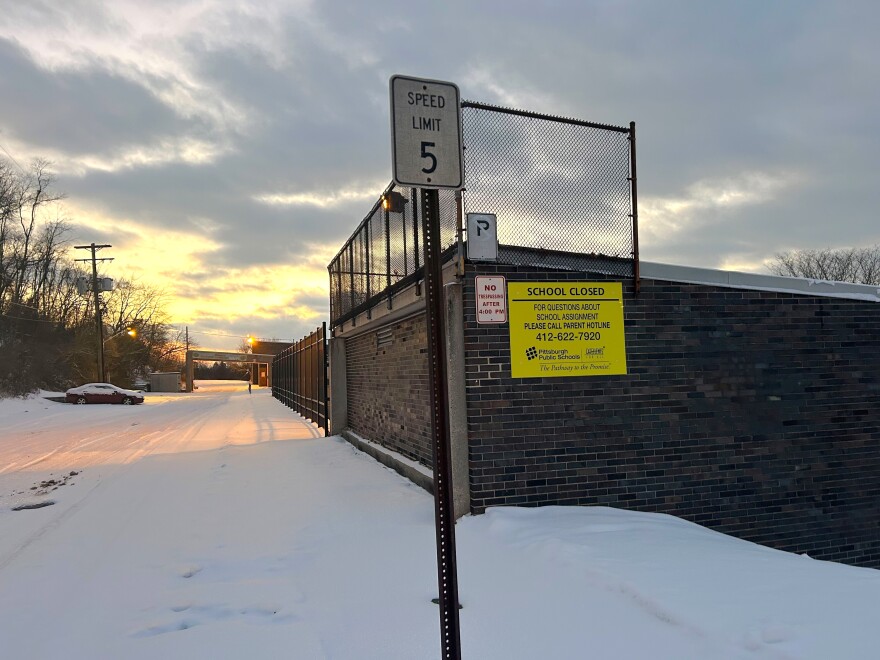
Northview Heights Elementary, closed in 2012, sits vacant on the city’s North Side.
Utilizing vacant buildings
O’Connor says that includes establishing avenues for residents to utilize vacant school buildings. PPS is currently holding on to four previously closed buildings: Fort Pitt Elementary in Garfield, Northview PreK-8 in Northview Heights, Bon Air Elementary and Knoxville Middle School.
The mayor said he’s already held initial discussions with district leaders about establishing a plan for some of these buildings.
“And now I think it’s up to us to put a program together and then pitch it to the schools, but also the neighborhood organizations that are there that have never had access [to them],” he said.
O’Connor added that the groups shouldn’t be charged exorbitant fees to utilize the schools, especially for youth programs that can’t afford their own spaces.
While some city councilors have urged the district not to close schools, O’Connor said the city will ultimately have to adapt to whatever board members decide.
“Whatever plan they come up with, we don’t have a say,” O’Connor said. “But that’s going to impact our neighborhoods, so we have to be at the table for what becomes of all of these types of changes.”
Keeping families in the city amid the closures, however, will require investments beyond school doors, he added. O’Connor’s vision includes bolstering programming at the city’s recreation centers after school and on weekends.
He rattled off a number of ideas, from bringing Pittsburgh Symphony Orchestra performers into neighborhoods to hosting trade unions to engage with students at rec centers citywide.
“I think for so long we just haven’t asked,” O’Connor said. “I think as the mayor, just ask. The worst somebody’s going to say is no, and then you move on to the next person.”
90.5 WESA’s Chris Potter and Julia Maruca contributed to this report.