
When it comes to innovation in the computer science field, Philadelphia and the University of Pennsylvania play a huge role.
Technology continues to advance rapidly. Take, for example, the CBS Philadelphia studios, where a giant, curved green-screen wall transforms into different sets throughout the day.
This is just one example that can be traced back to the development of the first general-purpose electronic computer in Philadelphia.
“This is, I would say, probably the biggest invention in the world,” Penn Engineering Dean Vijay Kumar said.
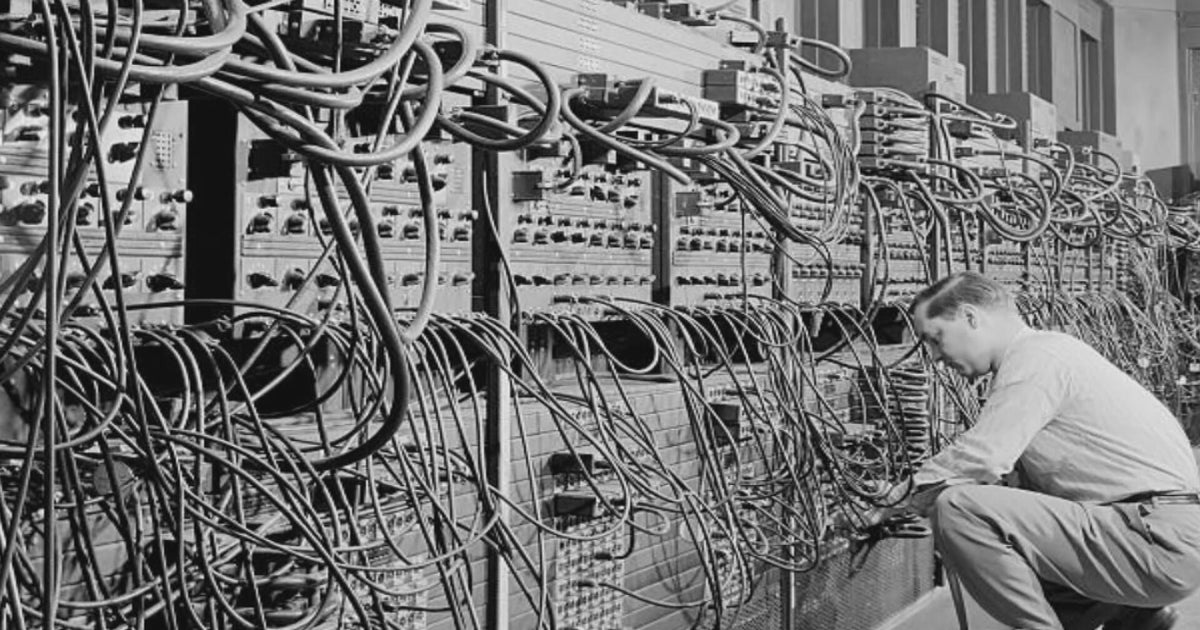
Meet ENIAC, which stands for electronic numerical integrator and computer.
“We like to refer to it as the start of the age of computing,” Paul Shaffer, an ENIAC historian, said.
For context, this machine was the world’s first general-purpose electronic computer.
“It’s an amazing piece of invention that started right here in Philadelphia,” Shaffer said.
It started at Penn Engineering, in fact, back in 1946.
“Every day and twice on Sundays,” Shaffer said. “This takes up my life. It was an Army project. The Army had this problem. They had these beautiful new guns they were trying to put out into the war, in World War II. But you can’t send a gun out without something called a firing table.”
The problem was that those calculations took hours to complete. Cue developers John Mauchly and J. Presper Eckert.
“The guys here proposed electronics instead of mechanics to do this calculation,” Shaffer said. “And when they put it all together, they could do those same calculations not in 12 hours but in just 30 seconds.”
Part of that innovation remains on display at the Moore School of Electrical Engineering.
“We see four panels here, and the finished ENIAC had about 40,” Shaffer said, “so this is about one-tenth of it. It was 60 feet and then 30 feet and then 60 feet in the shape of a U. If you could imagine two tractor trailers, it wraps right around the outside of those.”
“One of the things we take for granted is the things that we work on, and we seldom think of it as a spark of innovation,” Kumar said. “When Mauchly worked on this, when Presper [Eckert] worked on this, I don’t think they thought about it in anything beyond accomplishing a mission.”
ENIAC was in use for a decade or so, but its lasting power spans the ages.
“ENIAC was the starting point for artificial intelligence,” Kumar said, “so that’s why it’s so significant. Put aside the application. It was the first time that a non-trivial calculation was done on a machine, prompting us to ask this question: Can machines actually think? And today we take AI for granted and indeed we ask ourselves the question, do AI chatbots actually think?”
Feb. 15 is World Computer Day, and 2026 marks 80 years since the development of ENIAC. Penn is hosting several celebrations.
More from CBS News