
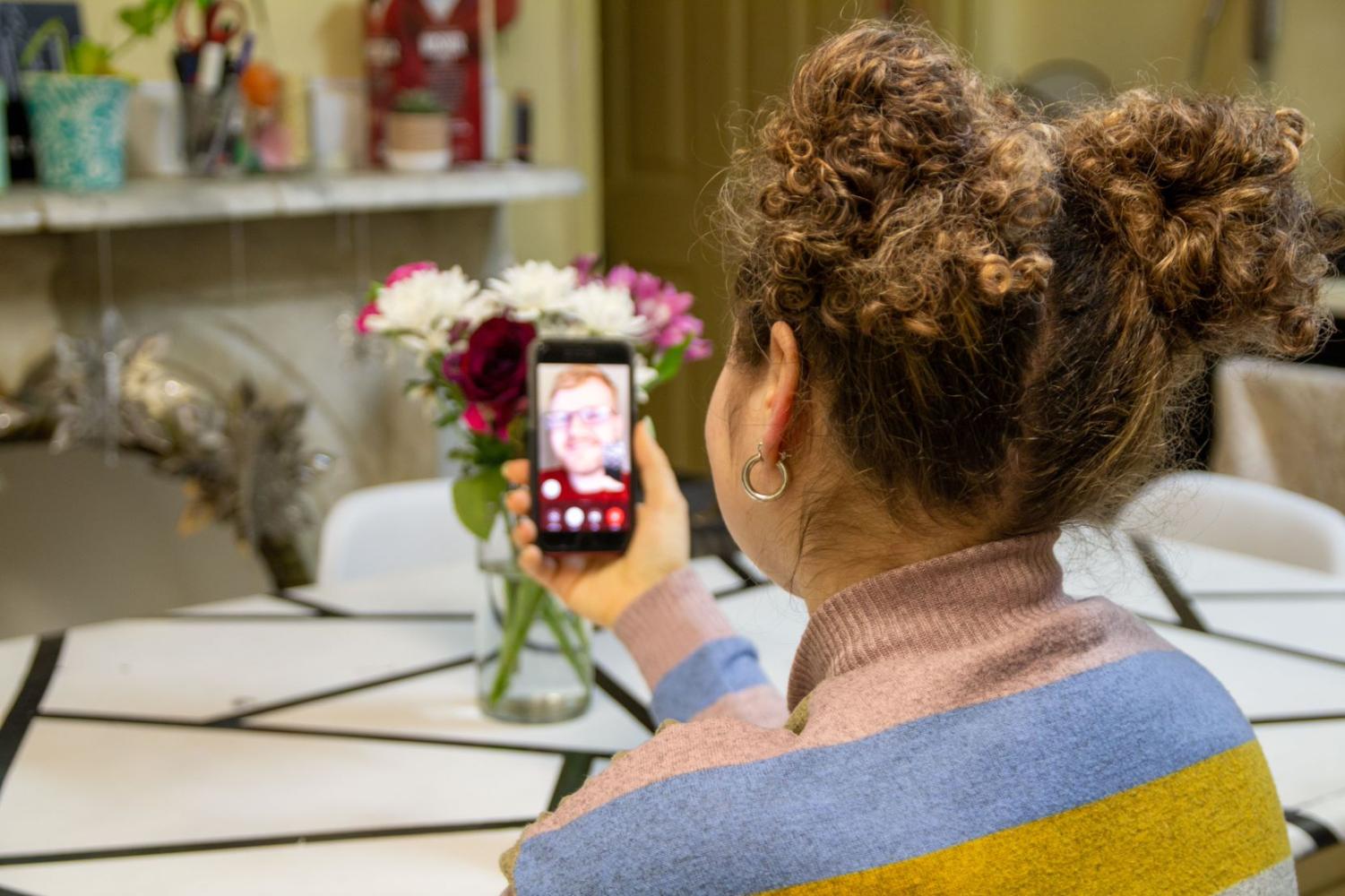
While some Pitt students will have a candlelit dinner on Valentine’s Day, others will be planning their dates virtually.
Though hookup culture is prominent on college campuses, some students are opting for more committed love through long-distance relationships. According to the National Library of Medicine, 34.2% college students are actively in a long-distance relationship. Yet, with Valentine’s Day approaching, long-distance relationships can prove difficult for some Pitt students who are choosing to celebrate virtually.
Jonah Taylor, a licensed clinical social worker and couples and sex therapist at the Center for Mind and Relationship, said the best way to spend time together for a virtual Valentine’s Day is by being present and focused on your partner.
“In an era of fractured attention spans, there may be a strong urge to multitask while speaking by phone. Try to resist that urge by focusing your awareness on your partner for the limited time you have to ‘be’ with each other,” Taylor said. “If just catching up by phone, practice mindfulness by really tuning in to the sound of their voice and the cadence of their speech.”
Technology can provide a way for long-distance couples to engage in a virtual date night, according to Taylor.
“Consider playing a game together, watching a movie or inviting in flirtation and sexuality — there are terrific couples-focused, long-distance friendly activities offered by Arya, Esther Perel and others, often freely provided on Instagram,” Taylor said. “Find ways to invite novelty, as long-distance communication can become monotonous over time.”
Anna Bigert, a sophomore natural science student on the pre-physician track, has been with her partner since her first year of high school.
“This past November was our five-year anniversary,” Bigert said. “We spent all of high school living 15 minutes from each other, but about a year and a half ago when we started college, we became long distance. He goes to Rutgers, so it’s about a six-hour distance between us.”
Although Bigert sometimes struggles with being in a long-distance relationship because of the lack of seeing her partner, she believes there are benefits to personal independence.
“We just both do our best to put in effort and stay in touch with one another,” Bigert said. “Although it’s really hard and I miss him, having a boyfriend that is long-distance pushes me out of my comfort zone to go out and meet other people. I think if we went to the same school, I would spend more time with him and I wouldn’t have the strong friendships I do now.”
Bigert said for Valentine’s Day, they’ll be celebrating virtually.
“We unfortunately won’t see each other, but we are sending each other little gifts to open on FaceTime to celebrate,” Bigert said.
Nora Broering, a sophomore bioengineering major, has been with her partner for six months — the entirety of which has been long distance.
“He’s from Germany, so when we started, it was like 4,100 miles and a six-hour time difference,” Broering said. “But he’s doing a gap year right now, so he’s traveling in the Australia area, and that’s 9,800 miles and a 16-hour time difference away.”
Broering said doing the distance has developed her relationship, despite how difficult it may be.
“We definitely have had to learn to communicate way more effectively than couples who see each other all the time, which I think makes our relationship stronger,” Broering said. “For us, the difficulties are mostly just dealing with missing each other and making sure we aren’t getting so stuck in our phones talking to each other that we aren’t living our own lives while we’re apart.”
Bella Lapi, a junior public health student, said it takes a “very specific relationship and a very specific type of person” to have a healthy long-distance relationship.
“If your love language is solely completely quality time and you can’t experience love in any other way, then you’re doing yourself a disservice by being in a relationship like that because you’re not going to be completely fulfilled,” Lapi said. “I think it takes knowing yourself really well and knowing what you need out of a relationship and also knowing your partner really well.”
Libby Perella-Carvalhaes, a sophomore pre-pharmacy student, believes the most common misconception in a long-distance relationship is that physical closeness equates to emotional connection with your partner.
“I feel like we have even deeper talks when we’re talking over the phone than when we’re in person,” Perella-Carvalhaes. “You have to communicate about everything, and you really don’t want to distract yourself when you are talking — when in person, there are many more distractions.”
Grace Nauman, a sophomore early childhood education student, did long distance for a year before ending things in September.
“If it’s not working, don’t force it — trust your gut and trust your partner at the same time,” Nauman said. “Overthinking will ruin a relationship. Communicate boundaries and make long distance fun. It doesn’t always have to be so negative — buy food for each other and eat it on FaceTime and write each other letters.”
Lapi started dating her partner two and a half years ago, right after graduating high school. Now, her partner goes to Penn State, which she said might qualify as a “medium-distance” relationship.
“We have pretty much done long distance our entire relationship, which is kind of controversial, I know. We were very close friends in high school, and then over the summer, we started dating before going to college,” Lapi said.
Lapi said that although she’s not a “die-hard” Valentine’s Day girl, her partner will come visit and they’ll have a relaxing holiday together.
“I don’t need it to be roses on the bed and all of that stuff, not necessarily the consumerism part of it, [but] we were just going to cooking together and do some of our favorite activities in the city,” Lapi said.
Perella-Carvalhaes will be having a virtual date this Valentine’s Day in lieu of an in-person date — but she said it won’t be the same as face-to-face dates.
“For Valentine’s Day, we keep it lowkey and watch a movie together over Zoom or Discord, and then we’ll DoorDash some food for each other from our favorite restaurants,” Perella-Carvalhaes said. “It does definitely suck, though, watching all my friends be able to go on dates and exchange gifts in-person.”
Perella-Carvalhaes has been in her relationship for three years and has a distance of three and a half hours. She said there are positives and negatives of a long-distance relationship.
“One of the positives is it forces us to actually appreciate the time that we have together, and so, when we are together, we try and make the most out of it,” Perella-Carvalhaes said. “But obviously, it sucks that we can’t be together in person all the time. One of the biggest adjustments was that you have to be able to communicate really well.”